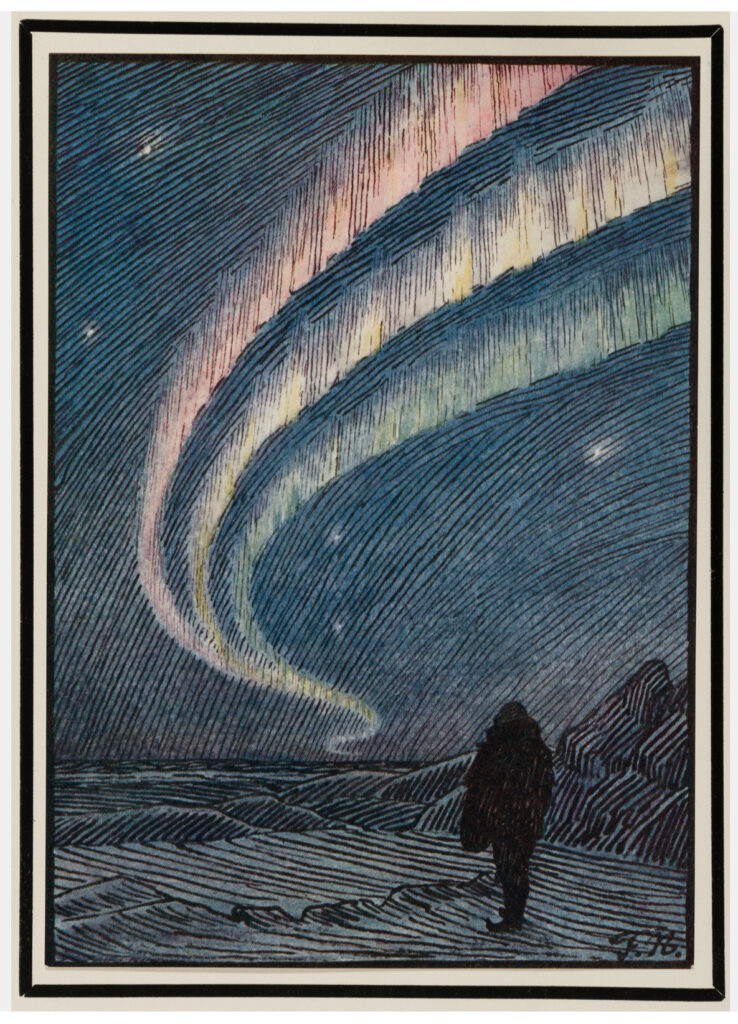
Our Haunted Year 2025

“Northern Lights”
Fridtjof Nansen

After another cycle around the sun, and as the darker days of winter approach, it’s time to look back at what we managed to accomplish this year here at Swan River Press. Along the housing front, the sad answer is not too much. Æon House remains in something of a chaotic state as I continue renovating towards something resembling a grand vision. While most corners of Æon House are still somewhat confused, there are occasional glimpses of hospitable sanity. But enough of that. Onto Swan River . . .

The press was nominated this year for a British Fantasy Award in the “Best Independent Press” category. It’s always an honour to be nominated for an award, and I’ve noticed it’s happening more in recent years. We didn’t win this time around, but I did enjoy spending time in Brighton at the World Fantasy convention in Octobr, where we were sat in the trade hall beside our colleagues from Tartarus Press and Zagava. And our friend Steve J. Shaw, who takes care of Swan River’s typesetting duties, had better luck in Brighton, picking up a World Fantasy Award in the “Special Award—Non-Professional” category for his work with Black Shuck Books. Congratulations, Steve!

I also attended EasterCon in Belfast back in April. I’d not been to Belfast in ages, and had never attended an EasterCon, so this was a new adventure. As always, I couldn’t go to any panels, but I did get to spend a lot of time with both Helen Grant and Lynda E. Rucker, neither of whom I’d seen in a long time. Apparently Belfast will be hosting its own annual convention starting next year . . . should I go? Will you?
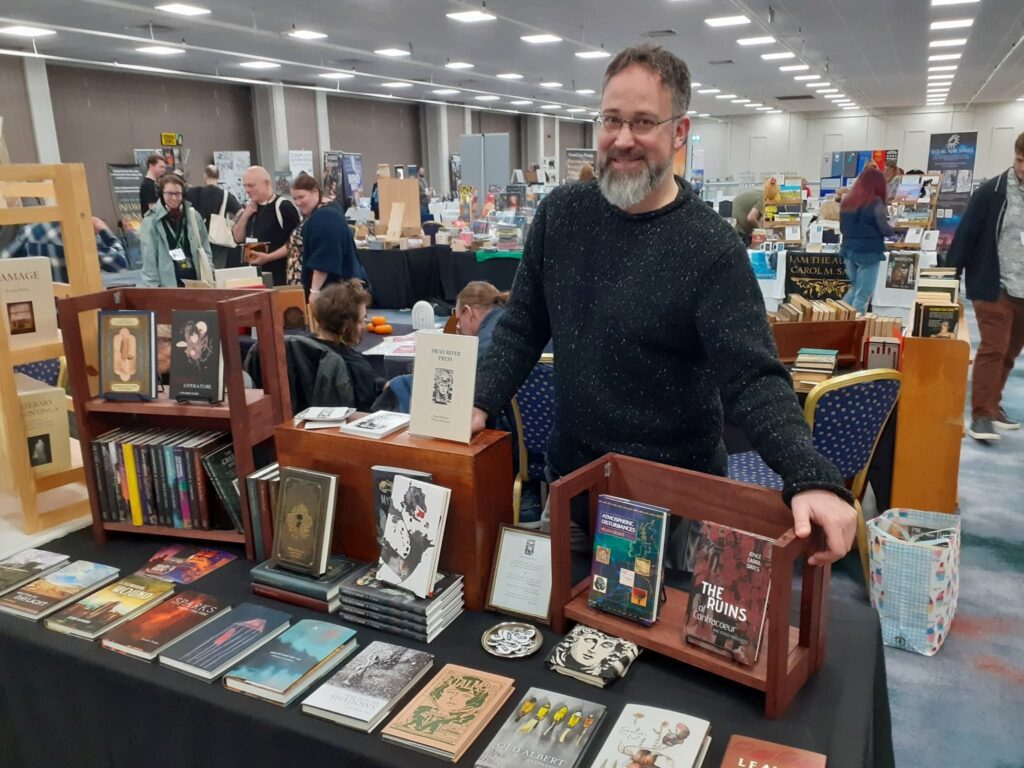
In November we participated in the Dublin Small Press Fair at the Pearse Street Library. We were surrounded by numerous publishers of every stripe and mode; a good reminder of the richness and vibrancy of Ireland’s publishing scene. The event, which included readings and panel discussions, was ably organised by Tom Groenland and Éireann Lorsung, with support from Dublin UNESCO City of Literature. It’s the sort of event that Dublin sorely needs, so kudos to the organisers. With luck, there will be another next year.

And now . . . onto the books!
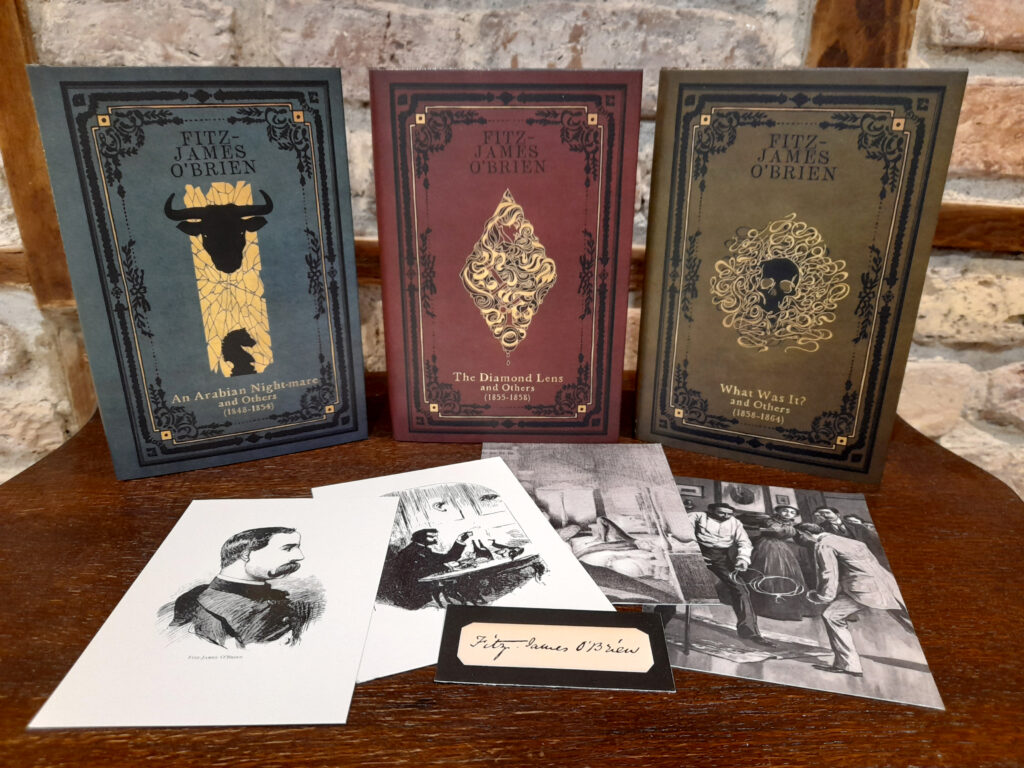
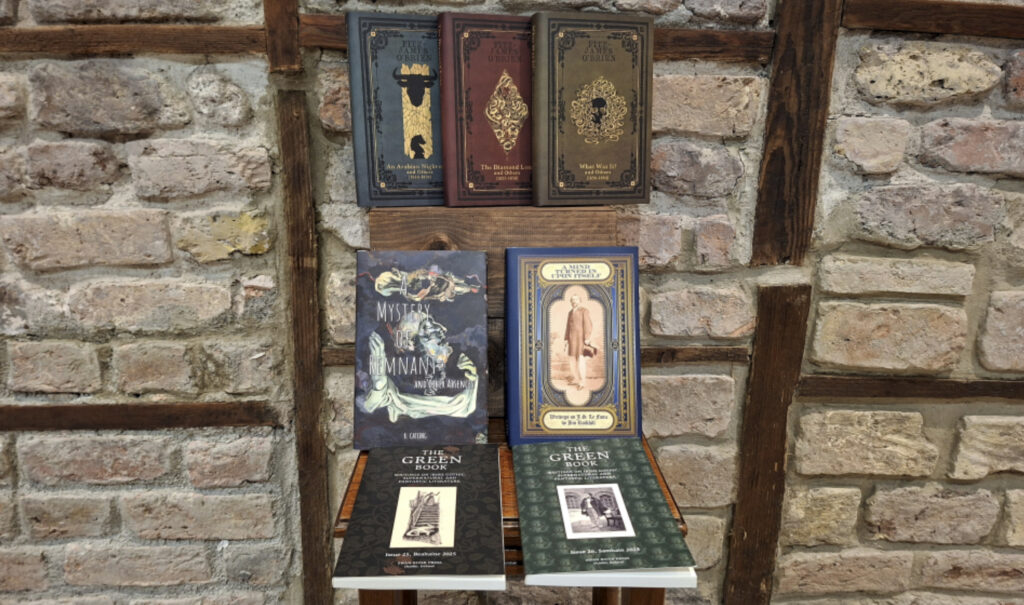
Our first publication this year was an ambitious three-volume Collected Speculative Works by the Cork-born writer Fitz-James O’Brien (1826/8-1862). O’Brien is notable for being at the forefront of genre when it was still in its infancy and the boundaries still blurred: he dabbled in satire, fantasy, horror, science fiction, ghost stories, and more. Pop Matters warmly reviewed the set as “the most comprehensive attempt yet to situate O’Brien firmly within the canon of 19th-century fantastical literature”, while Supernatural Tales wrote, “Quirky humour and darkly imaginative flourishes . . . [O’Brien is] a weaver of visionary images––a writer of reveries.”

These three volumes––An Arabian Night-mare (1848-1854), The Diamond Lens (1855-1858), and What Was It? (1858-1864)––were a long time in the making. I’d estimate somewhere in the region of five years, if not longer. The project was originally proposed by editor John P. Irish, who assembled a career-spanning selection of O’Brien’s fantastical output, both prose and poetry. In an interview entitled “An Irish Wondersmith in New York”, John Irish positions O’Brien in both genre and broader literary contexts: “What continues to impress me about O’Brien is his foresight. His literary style was far ahead of its time. His short fiction incorporates modernist elements such as metafiction, unreliable narration, intertextuality, stream of consciousness, autofiction, and hyperreality—long before these techniques became hallmarks of the modernist movement.”

What makes this such an interesting project is the way in which you can track O’Brien’s development as a writer, one whose stories would become touchstones for later genre scribes. Each of the three volumes contains an introduction by Irish that guides us through O’Brien’s life, tragically cut short in the American Civil War; and so, in reading the set you get a full overview of O’Brien’s life and writing. If you want to know more, I wrote a short article “Publishing Fitz-James O’Brien”.

And here’s a nifty unboxing video from Too Many Books.

The cover art was provided by Brian Coldrick, who came up with a design to unify the three books. As always, I’m proud of the work we’ve produced; I believe this set now supersedes all previous volumes of O’Brien’s work. Thank you to everyone who took a chance on this one! Lovecraft observed that, “O’Brien’s early death undoubtedly deprived us of some masterful tales of strangeness and terror.” I think that’s probably true.

(Buy Collected Speculative Works here.)

Our next release this year was as much a collaborative memorial as it is a collection: A Mystery of Remnant and Other Absences by B. Catling. This is our second Catling book, the first being the novella Munky in 2020. After Catling passed away in September 2022, editors Victor Rees and Iain Sinclair set about assembling a volume of texts that would reflect Catling’s personal pantheon.

The stories collected in A Mystery of Remnant are fragments of Catling’s singular imagination, portals into worlds populated by dog-headed giants and reanimated bog bodies, spirits both beastly and mundane. Tales about visionaries and mystics, about the need to venture into blurry territories of sight in which angels, ghosts and memories merge and reform. Together they showcase the distinctive voice underlying the very best of Catling’s work.

The collaborative aspect of this book is perhaps as important as the book itself: Victor Rees, who introduces the volume, is working on a PhD about Catling’s literature and performance art; Iain Sinclair, who provided photographs and an afterword, and Alan Moore, who supplied short prose pieces to accompany those photos, were long-time friends of Catling; while Eleanor Crook, who created the jacket art for the book, was one of Catling’s former students; and finally artist Jack Catling, who penned the foreword, is Brian’s son. Through them, Catling’s imagination continues to seep, saturate, and inspire.

The reviews for this collection are both receptive and perceptive. The Ancillary Review called A Mystery of Remnant “a delightfully strange formal oddity of a book”, while You’re Reading observed, “This book is a composite picture of a complex and genuine iconoclast, an artist absorbed in an investigation of existence and non-existence, and the border between.” That all sounds about right to me.

“Catling never liked talking about process,” says Rees in a recent talk, “Exploring the Hollows”, “[instead] referring to his books as having written themselves, as though a kind of channelling had taken place in which he was simply there to mediate words that flowed through him into his laptop. Catling suggests the possibility that these words and voices may have reached him from someplace else.” And the stories in A Mystery of Remnant serve as glimpses to that “someplace else”.

A Mystery of Remnant was one of our fastest sellers this year; as I write this, only a handful of hardback copies remain. I’m not sure yet if there will be a paperback edition, so if you’re interested, you’d best pick up a copy now.

(Buy A Mystery of Remnant here.)
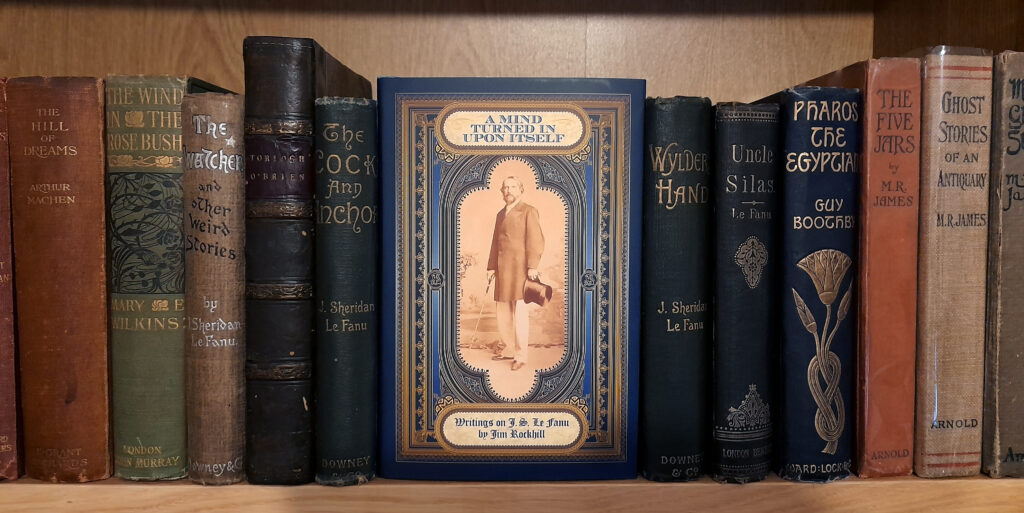
And finally, we have Jim Rockhill’s A Mind Turned in Upon Itself: Writings on J. S. Le Fanu. This is another project long in the making. The core of this volume consists of the introductions Jim wrote for Ash Tree Press’s definitive, but out of print, three-volume ghost stories of Le Fanu. Now collected, revised, and expanded, A Mind Turned in Upon Itself is an excellent overview of Le Fanu’s life and supernatural literature. This non-fiction collection—our first?—is rounded out by a handful of Jim’s other essays on Le Fanu, making this a real treasure trove.

Jim is an ardent admirer of Le Fanu’s work, and in “Dreaming of Shadow and Smoke”, he explains how that came about: “I first encountered Le Fanu through Wise and Fraser’s Great Tales of Terror and the Supernatural. Having reached the innocuously-titled “Green Tea” on a pleasant afternoon while visiting my grandparents, I was shocked at the world the story depicted. [It] terrified me on a more fundamental level than anything else I had read in the book.”
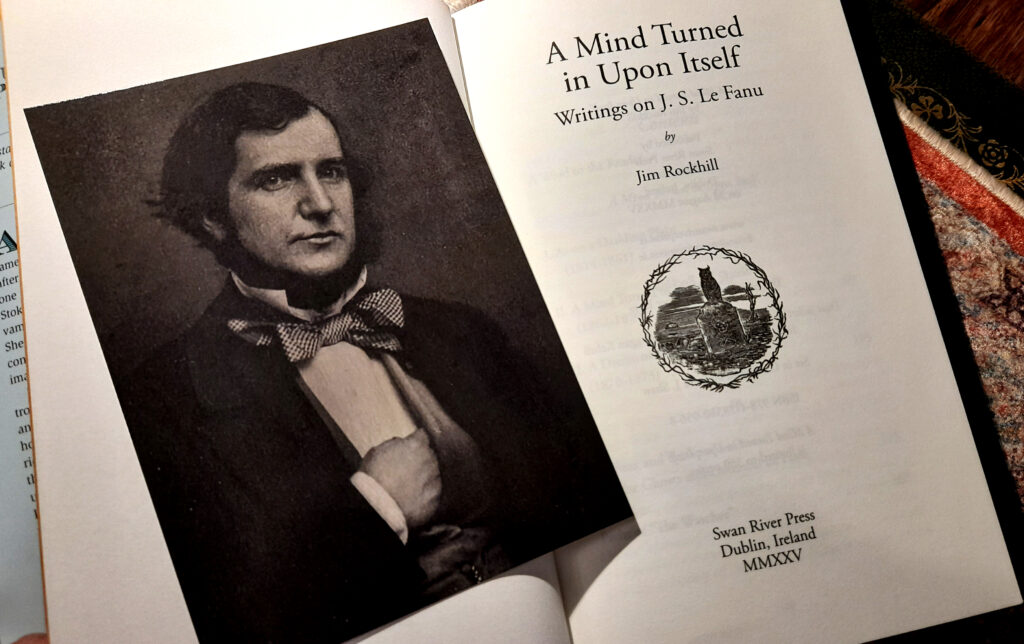
You’re Reading gave the book an incredibly kind notice: “In A Mind Turned in Upon Itself, Jim Rockhill abundantly demonstrates his love and appreciation for J. S. Le Fanu’s fiction and presents such an enthusiastic examination of the work as to inspire people to seek out whatever of that work they have not so far read. Highly recommended.”

John Coulthart did a great cover for us too, and the eagle-eyed will notice Le Fanu’s monogram embedded in the design. As a bonus, back in September, Jim visited Æon House here in Dublin shortly after the book was published and kindly signed the entire print run. A Mind Turned in Upon Itself is the perfect accompaniment to long-time fans of Le Fanu and those who are exploring his ghostly oeuvre for the first time.

(Buy A Mind Turned in Upon Itself here.)

Which brings us to this year’s issues of The Green Book: Writing on Irish Gothic, Supernatural and Fantastic Fiction. And as luck may have it, both issues this year are devoted to Le Fanu.

Issue 25 boasts several rare Le Fanu items, including a memoir by Le Fanu’s friend and publisher Edmund Downey that had not been reprinted in over one hundred years. We’ve expanded Le Fanu’s bibliography, if only in a minor way, by making a new poetry attribution. You’ll also find rare reprint of Le Fanu’s “Some Gossip About Chapelizod”, as well as commentaries on these aforementioned texts. Finally, there’s the bizarre story of a sequel to “Green Tea” published in 1942 by the German writer O. C. Recht. If you want to know more, check out the Editor’s Note.

Issue 26 was another Le Fanu issue. We reprinted “My Aunt Margaret’s Adventure”, which was first attributed to Le Fanu by M. R. James, but passed over for inclusion in Madam Crowl’s Ghost (1923). There are two contributions from Le Fanu’s siblings, including extracts from William Le Fanu’s Seventy Years of Irish Life, plus the sole short story written by his sister Catherine, reprinted here for the first time. Lastly, you’ll find two pieces concerning Le Fanu passing: the first being a collection of obituaries, and the second an attempt at deciphering the capstone of Le Fanu’s vault. An absolute wealth for Le Fanu aficionados. Again, read the Editor’s Note if you’re curious.
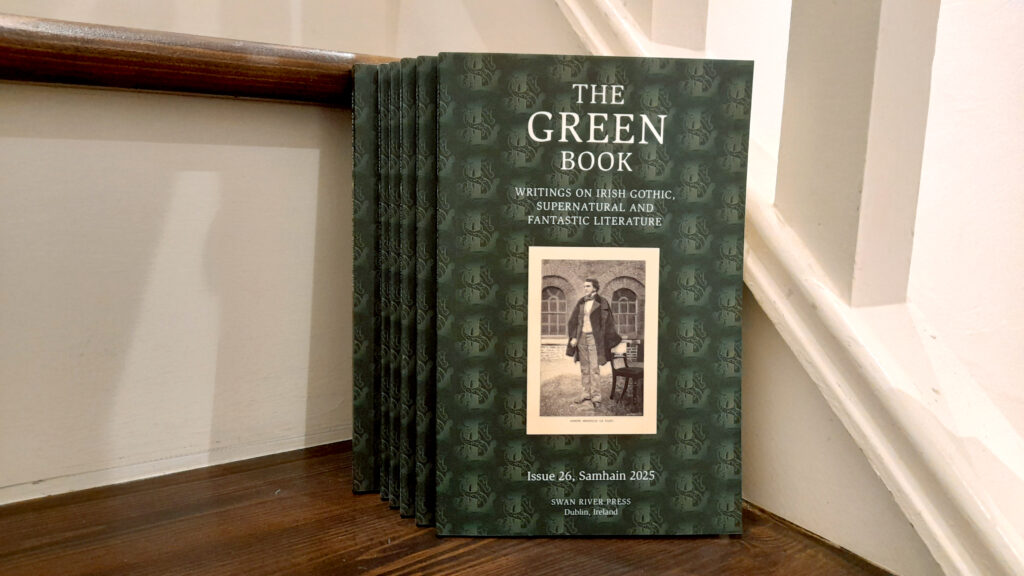
(Buy The Green Book here.)

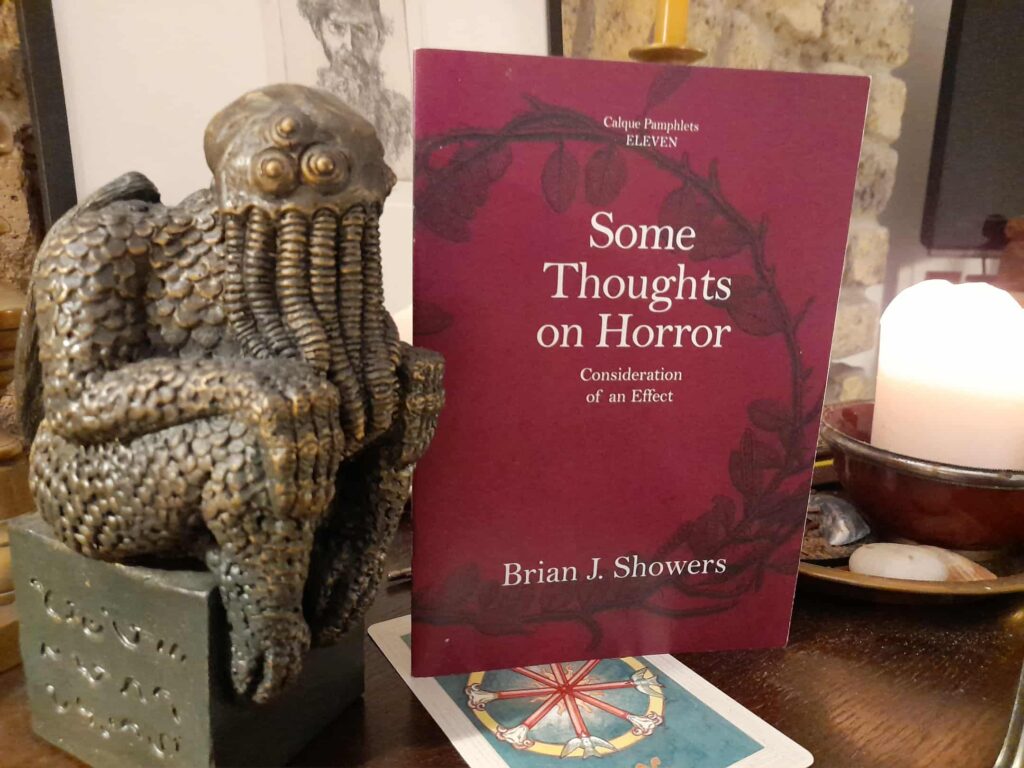
Although not a Swan River Press publication, I’d like to draw your attention to a short monograph I wrote for our friends at Calque Press entitled Some Thoughts on Horror: Consideration of an Effect. It’s a three-part essay, the first part of which some of you will recognise as my musings from the introduction to the now out of print Uncertainties 5. It turned out I had more to say on the subject of how we approach and appreciate horror, so if you like reading that sort of thing, do pick up a copy of this limited edition pamphlet.

(Buy Some Thoughts on Horror here.)

For those interested in statistics, we published 7 new titles this year, totalling 1,480 pages; 2,250 copies; and 392,613 words. That includes this year’s issues of The Green Book.

If you’re looking to keep tabs on what we get up to throughout the year, the best way is probably to sign up for our newsletter. Apart from that, we can be found on Instagram, Facebook, Bluesky, and Threads. So if you don’t want to miss out on any announcements or exciting books, do give us a follow.
And just to draw everyone’s attention to it, you can use the filters on our Titles page to see which books are on the Low Stock Report—the ones that might not be around much longer. The filter menus are a handy tool, I use them quite a bit myself. There are a few titles now in short supply, which you’re better off picking up now while they’re still at cover price.

Of course, as always, I am grateful to the Swan River Press team: Meggan Kehrli, Jim Rockhill, Steve J. Shaw, Timothy J. Jarvis, and John Kenny. I don’t think I could have assembled a more dedicated and talented group, each of whom helps to keep Swan River Press running smoothly and at the calibre you’ve come to expect.

If you’ve read this far, you might be curious what we’ve got in store for next year. Well, there will be another two issues of The Green Book, I know that much. And we’ve a full roster of hardbacks for 2026. In fact, I’ve probably more titles than I’ll be able to publish, which I guess means we’re also lining up for 2027. While I don’t like to announce titles in advance, I will say that I’ve got two lined up for early in the new year, which I hope you’ll like.

Thank you again to everyone who has bought and read our books this year, or otherwise shown us support and encouragement. I particularly enjoyed getting to conventions and fairs to meet people, so with luck there will be more of that over the coming twelve months. Until then, please stay healthy, take care of each other, support your public services, vote, and be sure to keep your communities fascist free.

And may your festive season be filled with shadows, wonderment, and joy!

Brian J. Showers
Æon House, Dublin
2 December 2025

Our Haunted Year 2024

Art: James F. Johnston

It’s no secret that I enjoy a good tradition. Our Haunted Year is one such tradition with which I like to engage as winter closes in, a short reflection on everything we’ve accomplished with Swan River Press this year. When publishing becomes difficult—and there are usually numerous irksome moments every twelve month period—it’s good to remember everything we managed to accomplish despite it all. I write these posts as much for myself as I do for anyone else, but I hope you enjoy them all the same.

Let’s see here . . .

This year, for the first time, Swan River Press was nominated for a World Fantasy Award in the “Special Award—Non-Professional” category. I take “non-professional” as an indication that I have a day job, which I do. Although we didn’t win, it was a nice acknowledgement. We were also nominated for a European Science Fiction Society Award in the “Hall of Fame Best Publisher” category; again, we didn’t win, but I still appreciate this faith in our work. I was also delighted that Timothy J. Jarvis’s weird collection Treatises on Dust (2023) was long listed for the Edge Hill Prize. Again, no win, but it’s a terrific collection that you should read if you haven’t already.

So our first book of the year was published in May: Mark Valentine’s Lost Estates. This is the third collection we’ve done with Mark, preceded by Selected Stories (2012) and Seventeen Stories (2013); these three volumes constitute an informal trilogy. The twelve stories in Lost Estates offer antiquarian mysteries, book-collecting adventures, and otherworldly encounters—all the stuff I love in Mark’s writing. For the cover art to Lost Estates, we went straight to our old friend Jason Zerrillo (now of Lyrical Ballads in Saratoga Springs, New York), who had also done an excellent job with the first two Valentine books. Anyone got all three?

In an interview for Lost Estates, “Reading the Signs”, Mark conveyed some interesting thoughts on “folk horror”: “I prefer a couple of terms I came upon recently in contemporary 1923 reviews of Uncanny Stories by May Sinclair and Visible and Invisible by E. F. Benson. The publisher, presumably with these authors’ agreement, called them ‘borderland’ and ‘otherworld’ stories, evidently terms then in use and well understood for occult and supernatural fiction. I think they do convey better the sense that can sometimes be felt in certain places of being close to a different realm.”

The reviews for Lost Estates are quite positive too, with Rue Morgue writing that, “These are stories of immense subtlety, resonant of obscure history, folklore, and esotery, unpredictable and impeccable.” The signed hardback edition of Lost Estates is sold out, but you can still pick up the paperback.

(Buy Lost Estates here.)

Our next book was the long-awaited follow-up to Ghosts of the Chit-Chat: Friends and Spectres edited by Robert Lloyd Parry. Like its predecessor, Friends and Spectres is an exploration of the world of M. R. James through his colleagues’ stories and biographies. The majority of pieces here were originally published under pseudonyms, and over half appeared first in amateur magazines or local newspapers. All deal with the supernatural, and several of the stories are themselves spectres—or more properly “revenants”, only now re-emerging into the light after decades of oblivion. There are rediscoveries here of “lost” tales by Arthur Reed Ropes, E. G. Swain, and the enigmatic “B.”—whose identity is finally revealed!

John Coulthart, who did the cover art for Chit-Chat, returned to give us this wonderful image of King’s College Chapel at dusk. The reviews have been favourable too, with Supernatural Tales noting, “All credit to Robert Lloyd Parry for not merely assembling a worthwhile anthology, but adding plenty of biographical material to help flesh out the characters behind the fiction.” You can read a bit more about this volume in an interview with Robert entitled, “Of Wraiths, Spooks, and Spectres”.

Robert also came to Dublin in June to launch the book, although, true to form, the book wasn’t delivered while he was here, otherwise we’d have done a signed edition. Sorry about that! Still, we had lots of fun at an intimate event held at Gallery X here in Dublin, where Robert did dramatic readings of “Randalls Round” by Eleanor Scott and “The Sparsholt Stone” by A. C. Benson.

Ghosts of the Chit-Chat was one of our fastest sellers; as I write this, only a handful of hardback copies of Friends and Spectres remain—although it’s available in paperback now too, so don’t fret too much if you missed it. Now how about that third volume . . .

(Buy Friends and Spectres here.)

After a slight production hiccup, our last two books of the year finally arrived simultaneously in mid-November, just in time to be shipped to you for the holiday season.

The first was Atmospheric Disturbances by Helen Grant. Those of you who have been following Swan River will recall Helen’s previous collection, The Sea Change & Others (2013)—Atmospheric Disturbances is a worthy successor that I’m most pleased with. I think you will be too. Again, John Coulthart joins us for duties on jacket art. You’ll notice each of the images on the cover relates to a different spectral tale. John wrote a short blog post on the composition of this cover if you’d like to read it.

No reviews of Atmospheric Disturbances have turned up just yet, as the book is probably still dropping through people’s mail slots as I type this. Still, I expect a warm reception for this volume of suitable holiday chills. And if you want to know a little bit more about said chills, Helen gave a fantastic interview called “Excavating at the Edge of the World” about some of the themes and interests you’ll find in her stories: “I’m a bit obsessed with petrospheres! I find it extraordinary that there are these things which clearly took a lot of time and skill to make, and we don’t know what they were for . . . People have suggested that they were fishing weights or (that most irritatingly vague explanation) that they had some ‘ritual significance’, but we just don’t know.”

Helen was good enough to do a signed edition for us a well, which is something I like to do where possible. There are still copies left as of this writing. Overall, and in particular from a design point of view, I was pleased with how this book turned out. Let me know what you think!

(Buy Atmospheric Disturbances here.)

The last hardback title that we published this year was the seventh instalment of our Uncertainties series, this time ably edited by Carly Holmes, whose work you’ll be familiar with from volume five. We’ve got a whole new crop of contributors this time around, including Georgina Bruce, Sarah Read, Philippa Holloway, Premee Mohamad, Bethany W. Pope, Jessica Hagy, and others. Again, no reviews just yet, but if you’re a fan of previous instalments of this anthology of strange stories by contemporary writers, I’m certain you’ll be pleased with this one.

I’m particularly delighted with the moody cover art by James F. Johnston. I’d long enjoyed James’s work, but as a musician rather than as a visual artist. For many years I’d been a fan of his main gig, Gallon Drunk, who I got to see perform their slinky chaotic hearts out back in 2007 at Whelan’s here in Dublin. And I also have to mention Big Sexy Noise, James’s project with the legendary Lydia Lunch. Their cover of Lou Reed’s “Kill Your Sons” possibly surpasses the original. Give it a loud listen. Anyway, when I saw that James was an excellent painter as well, I couldn’t resist pitching Uncertainties to him. He also kindly provided the images we used on our holiday card this year. Thanks, James!

Again, there are no reviews of Uncertainties 7 just yet, but pick it up and see what you think. In the meantime, you can read a group interview with the contributors where I asked, “What draws you to write tales in the weird/uncanny mode?” Their responses are here: “In an Uncertain Mode. Carly also gave an insightful interview about the anthology: “The Past Is a Different Country”.

(Buy Uncertainties 7 here.)

Which brings us to this year’s issues of The Green Book: Writing on Irish Gothic, Supernatural and Fantastic Fiction.

Issue 23 was comprised of a number of essays I’d had knocking about here for some time. It was high time they saw the light of day. James Clarence Mangan writes on Charles Maturin and Maria Edgeworth; John Irish contributed a piece on Fitz-James O’Brien; there’s an interview with Charlotte Riddell, and Mervyn Wall weighs in on Gerald Gardner and Harry Price. I’m particularly proud to have published a previously unknown poem by “Keith Fleming”, a writer about whom we are still learning. If you want to know more, check out the Editor’s Note.

Issue 24 saw another batch of author profiles, this time featuring folks like Maria Edgeworth, Katharine Tynan, and Dorothy Macardle. I think these profiles are coming to an end—we’ve been running them since Issue 11. The goal is still to collect these profiles in a book, but that’s a long way off yet. The main feature of this issue is Fergal O’Reilly’s commemoration of Charles Robert Maturin, author of Melmoth the Wanderer, whose 200th death anniversary was 30 October 2024. There’s a fair bit of mystery surrounding his final resting place—Fergal digs deeper. Lastly, Bernice M. Murphy weighs in on the freshly restored and re-released Irish “folk horror” film The Outcasts (1982). It’s a peculiar film, worth seeing. Again, read the Editor’s Note if you’re curious.

(Buy The Green Book here.)

We had quite a few paperback publications this year too. Twelve, actually. Hardbacks will always be our bread and butter, but it’s good to be able to keep these works available for new readers to discover. So here are the 2024 paperback titles:

Written by Daylight by John Howard
Here with the Shadows by Steve Rasnic Tem
The Dark Return of Time by R. B. Russell
Death Makes Strangers of Us All by R. B. Russell
Sparks from the Fire by Rosalie Parker
A Flowering Wound by John Howard
Green Tea by Joseph Sheridan Le Fanu
The Fatal Move by Conall Cearnach
Now It’s Dark by Lynda E. Rucker
Treatises in Dust by Timothy J. Jarvis
Lost Estates by Mark Valentine
Friends and Spectres edited by Robert Lloyd Parry

For those interested in statistics, we published 6 new titles this year, totalling 1,176 pages; 2,300 copies; and 332,377 words. That includes this year’s issues of The Green Book (but not the paperback reprints).

This year we also finally abandoned Twitter. It just wasn’t fun there anymore. Instead, we’ve decamped to Bluesky and Threads. Please join us there. You can still find us on Instagram and Facebook, though on the latter we’re more active on the Swan River Press Readers Group than on the business page. You’re also welcome to join our newsletter.

Although I missed Fantasycon in Chester this year due to annoyingly rough health, I’m hoping to attend Eastercon in Belfast and World Fantasy in Brighton. I’ll post updates on our Forthcoming Events page. Will you be there?

And just to draw everyone’s attention to it, you can use the filters on our Titles page to see which books are on the Low Stock Report—the ones that won’t be around much longer. Better to pay the cover price than to be subjected to the secondhand market later.The filter menus are a handy tool, I use them quite a bit myself.

Of course, as always, I am grateful to the Swan River Press team: Meggan Kehrli, Jim Rockhill, Steve J. Shaw, and Timothy J. Jarvis. I’d also like to welcome John Kenny, who you might have noticed has been conducting recent interviews for us. These folks consistently make my job easier—and they’re a pleasure to work with too.

Lastly, here’s a short piece I wrote on David J. Skal, who we tragically lost in January this year. It’s never too late to be grateful for all the fine scholarship he left us. I always think of him now whenever I hear the “Monster Mash”.

So what’s in store for next year? I like to keep tight-lipped until titles at least go to the printer. However . . . early next year I hope to publish a rather large project we’ve been working on for a good few years now. I sincerely hope people will be interested in it enough to buy it (’cause I’d like to be able to keep publishing after it!) The “large project” is a three-volume set of works by a classic Irish genre writer who is rarely looked at in the context of their entire fantastical output. I’ll leave it at that for the time being. I’ve got a bunch more exciting books planned too.

I know I say this every year, but thank you to all of you who have encouraged us this past year. It really means a lot. Publishing is not easy and, like the state of the world in general, it only seems to become more precarious and challenging. The best way to support us is to buy (and read) our books. It sounds so mercenary put that way, but there it is. It’s the best way to keep us going. So if you keep reading our books, we’ll keep publishing them. Until then, please stay healthy; take care of each other and your communities. I’d like to wish you all a restful holiday season, and hope to hear from you all soon!

Brian J. Showers
Æon House, Dublin
8 December 2024


Our Haunted Year 2023

Art: John Coulthart

Greetings, everyone. Thank you for joining me here at the end of another solar cycle, taking time out of your day to read this meditation on what we did here at Swan River Press these past twelve months.

I confess, for much of it, my attention has been on settling myself in Æon House among other personal matters—trickier prospects than anticipated. In fact, it was only last week that I managed to get the heating installed.

I had the pleasure of showing off the new digs to a few guests this past year too. Despite the bare-bones circumstances, I’m pleased to receive visitors into the incense haze of our yellow brick headquarters. Mind the dust, please. Originally I thought the house dated circa 1906. However, further research revealed that Æon House was in fact built in around 1869, the same year that “Green Tea” was published. Does anyone else’s brain work in this way? Linking dates and years to writers and publications? Suffice to say, I’m delighted by the history that’s already been absorbed by these walls and to which I hope to contribute in the years to come.

Although I am settling in well enough, much of my library and some of the Swan River stock remains difficult to access—and it turns out things may be like this for some time. But for the most part, it’s business as usual. This year saw a considerable increase in production over last year . . .

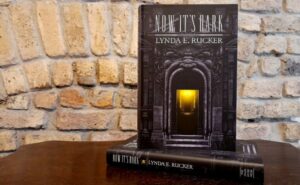
Our first book of the year, back in January, was Lynda E. Rucker’s third collection, Now It’s Dark. We also published Lynda’s second collection, You’ll Know When You Get There (now available in paperback), and of course she also expertly helmed the third instalment of our Uncertainties series in 2018. As always, it was a delight to work with Lynda—I always admire the way in which she regards weird literature. This profound depth of insight, of course, influences her writing. This recent crop is no exception.

The cover is by John Coulthart. Thinking back now, we’ve done quite a few covers with John. There’s a reason for that. John is always a pleasure to work with; he is as professional as he is inventive.

Now It’s Dark was received well too, with Rue Morgue noting, “These horrors come from lived experience, brimming with the juices of life and believable characters who are certain to stay with you for a long time. Strongly recommended for lovers of atmospheric, unusual, and slow-burn literary horror.”

If you want to know more, you can read the interview Steve Duffy conducted with Lynda for our website. I hope we’ll be working with Lynda again in the future. How about it, Lynda?

(Buy Now It’s Dark here.)

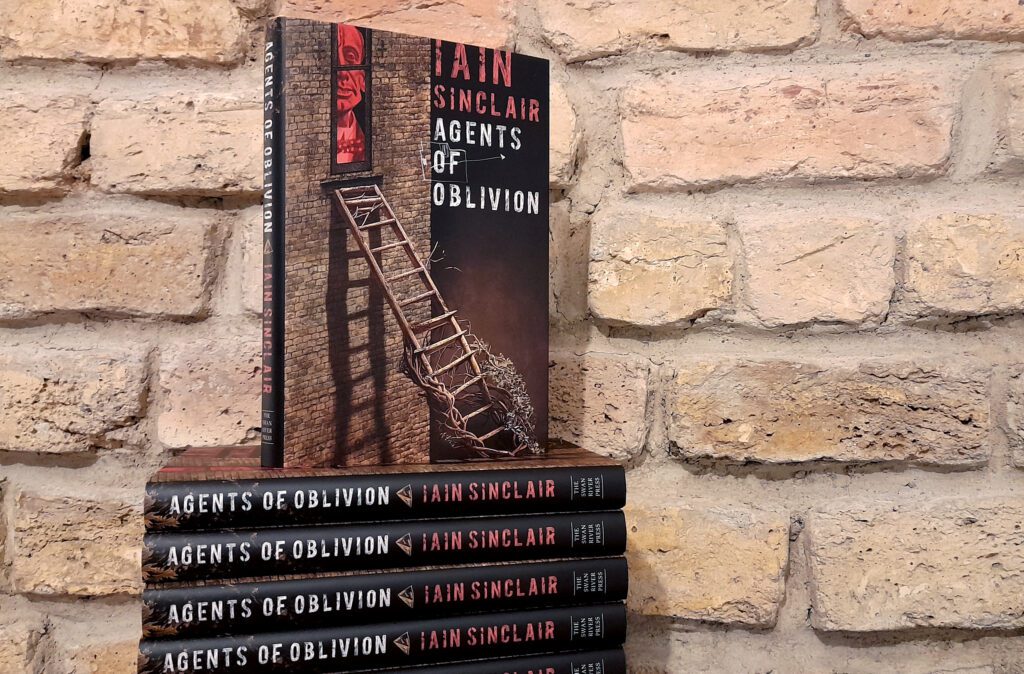
Next up is Agents of Oblivion by Iain Sinclair. Iain had sent this to me with the tentative note, “I’m not sure if you’ll be interested in this . . . ” But of course it was wholly my thing! Check this out:

“Four stories starting everywhere and finishing in madness. Four acknowledged guides. Four tricksters. Four inspirations. Algernon Blackwood. Arthur Machen. J. G. Ballard. H. P. Lovecraft. They are known as ‘Agents of Oblivion’. And sometimes, in brighter light, as oblivious angels . . . As host, as oracle, Iain Sinclair moves through this quartet of tales, through a spectral London that once was, or might never have been.”

What’s not to love? It apparently was a lot of other people’s thing too, because the entire hardback run briskly sold out. Michael Dirda wrote in the Washington Post, “Nobody can do more with a sentence’s cadence, diction and imagery than Sinclair”; while Michael Moorcock said it was one of the best collections of fiction he had read, going so far so to choose Agents of Oblivion as his Book of the Year in The New Statesman.
Not only does Agents of Oblivion feature Sinclair’s writing, but also the artwork of Dave McKean, who is due no small amount of credit for the success of this volume. Thank you, Dave, for another wonderful cover! Matthew Stocker interviewed Sinclair for our website, which you can read here. And never fear: if you missed the hardback, the paperback edition is currently available.

(Buy Agents of Oblivion here.)

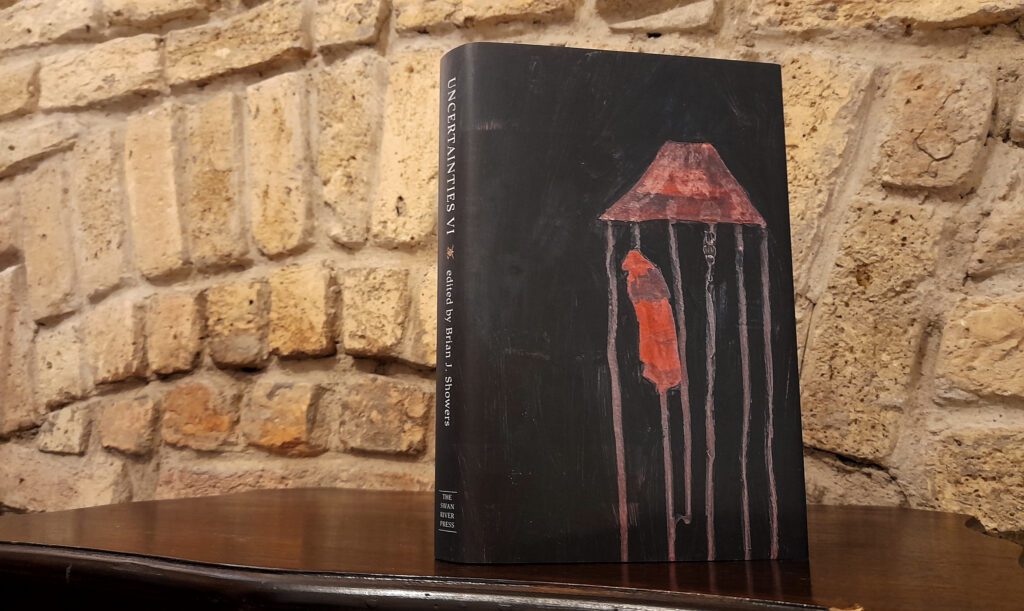
Two new titles showed up on my doorstep in mid-July. The first was Uncertainties 6, which I’d started editing way back in 2020. The volume was delayed for numerous reasons, but I’m pleased that readers are now able to enjoy this excellent crop of contemporary strange stories. It’s as strong a selection as ever, and includes contributions from Naben Ruthnum, Alison Moore, Stephen J. Clark, Anne-Sylvie Salzman, and the late B. Catling. SFRevu gave us a kind review, saying that, “Once again [editor Brian J. Showers] has successfully managed to produce an interesting anthology full of dark atmosphere and disturbing plots.”

Instead of doing an interview for this volume, which I normally like to do, I instead asked each contributor: “What draws you to write tales in the weird/uncanny mode?” You can read their responses here.
Gracing the jacket and boards of Uncertainties 6 are two paintings by David Tibet from his “Dreams as Red Barn” series. Many will know David from his band Current 93. However, for this collaboration, I prefer to invoke David’s pioneering work with the late Richard Dalby for the Ghost Story Press. Over the course of a decade, Ghost Story Press produced fourteen titles, many of which are now considered classics of the genre. I’ve always seen Swan River as part of this publishing continuum that includes Arkham House, Ghost Story Press, Ash Tree Press, Tartarus Press, and others, all inspirations to fine independent publishing. And so it was a real pleasure to collaborate with David for this book, acknowledging our past and forging a connection to our future.

(Buy Uncertainties 6 here.)

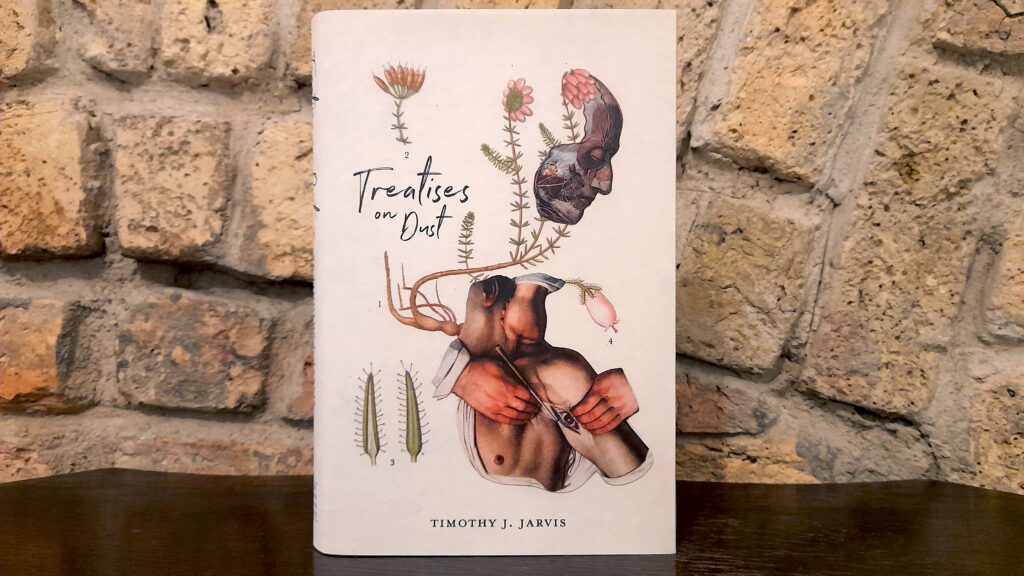
Arriving on the pallet beside Uncertainties 6 was the debut collection by Timothy J. Jarvis, Treatises on Dust. Having been impressed with his novel The Wanderer, which I’d read many years ago, I was determined to publish Tim’s first collection of stories. Up until this point, Tim had contributed to a number of Swan River titles, including Uncertainties 1, The Scarlet Soul, The Far Tower, and Uncertainties 4 (as editor)—I’m probably forgetting something here too.

But Treatises on Dust was on another level entirely and I was excited to publish it. In an interview with James Machin about the collection, Tim said, “I admire contemporary writers such as Mark Valentine who have recurring conceits across their stories, also Laird Baron though his is more cosmic in scale—I really like that mythos thing that comes from Lovecraft and other classic weird tales writers—and I wondered what would happen if you did it, but without the cosmicism.”
This volume, featuring striking artwork by øjeRum, has been one of our briskest sellers this year, with David Longhorn of Supernatural Tales writing, “There is plenty to entertain lovers of weird fiction.” If you’re still not convinced, you should check out the four short films Tim did to promote the book.

(Buy Treatises on Dust here.)

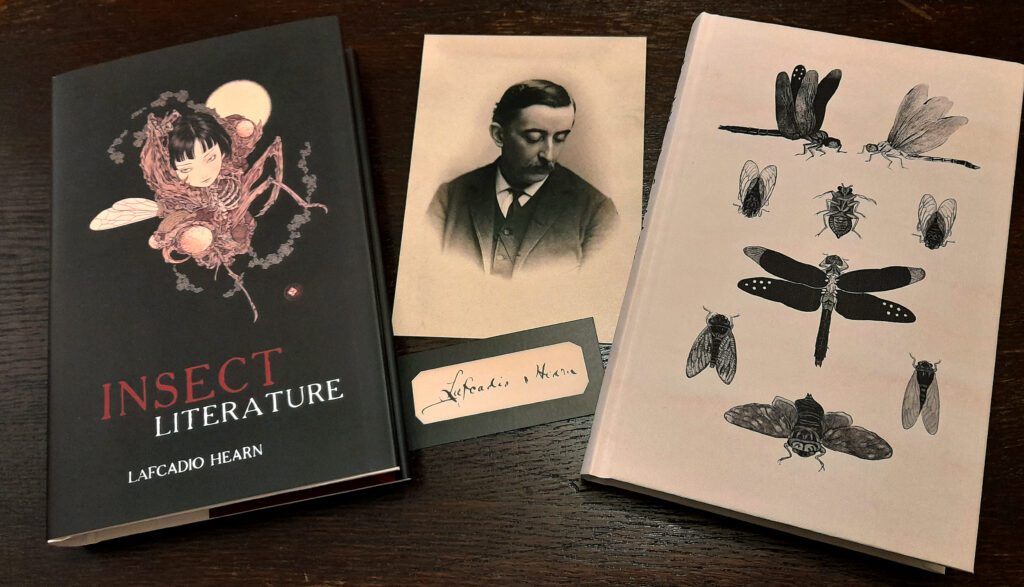
The last hardback of the year was a reprint, something that we rarely do: Lafcadio Hearn’s Insect Literature, originally published in 2015. I’ve always been proud of the design of this book (read about it here), and it’s one that I’m frequently asked about, especially by those who missed buying a copy the first time around. Though the paperback is also currently available, I took this opportunity to make a few adjustments to the new edition, including cleaning up a few formatting issues I was unhappy with, as well as printing the boards on cloth instead of paper. I also issued two new postcards with this edition. So if you missed it the first time around, be sure to pick up the reprint of this fascinating book.

(Buy Insect Literature here.)

We continued this year as well with The Green Book: Writing on Irish Gothic, Supernatural and Fantastic Fiction.

For Issue 21 we reprinted fiction and poetry, including “The Little Brass God” by B. M. Croker, two macabre stories by Mary Frances McHugh, and a previously unpublished story by the decadent artist Althea Gyles. “The Woman Without a Soul” is a Faustian tale of necromancy and obsession; some scholars have likened “A Woman Without a Soul” to The Picture of Dorian Gray (1890) by Oscar Wilde, whom Gyles befriended in Paris after an introduction from publisher Leonard Smithers. This issue is rounded out by a substantial selection of poetry by Gyles—undoubtedly the most complete collection of her poetry published to date. If you want to learn more, check out the Editor’s Note.

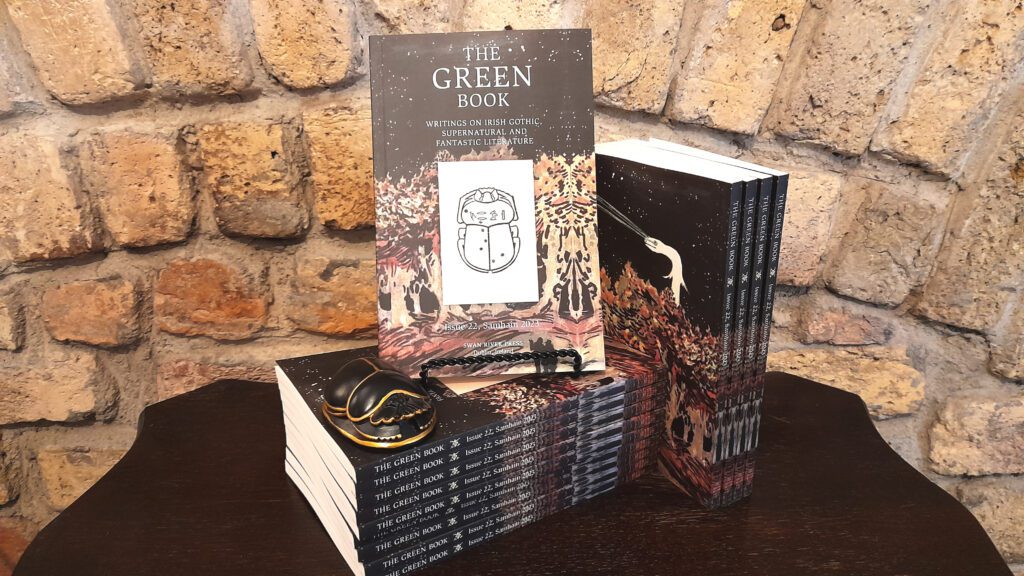
Issue 22 is a long-overdue Bram Stoker issue, and probably our fastest selling issue since our Lord Dunsany issue. In this issue are pieces by Mike Mignola, the late Leslie Shepard, Stoker biographer Paul Murray, and a recent discovery made by Douglas A. Anderson: a story attributed to Henry Irving that may well bear the hallmarks of Stoker’s own pen. Again, read the Editor’s Note if you want to know more. Better yet, pick up a copy of the issue and see what you think yourself.

(Buy The Green Book here.)

We had a few paperback publications this year too, and I believe most of our back catalogue, save for contemporary anthologies, is now available in this format. Let’s see . . . we’ve got:
Old Hoggen by Bram Stoker
Lucifer and the Child by Ethel Mannin

. . . and, of course . . .

Agents of Oblivion by Iain Sinclair

For those interested in statistics, we published 6 new titles this year, totalling 1,112 pages; 2,325 copies; and 297,895 words. That includes this year’s issues of The Green Book, but not Insect Literature or the paperback reprints.

Unfortunately, as many already know, the weird horror community lost Mark Samuels earlier this month. I read Mark’s work in his superb collection The White Hands (2003), the first and only book I bought at Fantasy Centre in London—the hardback Tartarus edition, signed by Mark in green ink. I read it in Sweden. I enjoyed it immensely, and so anticipated Glyphotech (2008), which did not disappoint. In my review for Rue Morgue, I wrote, “Yes, his work can probably be shunted into the urban horror genre, but within this definition he manages a great deal of diversity, and a clear writing style free from over-indulgent descriptions of decay. In Samuels’s world we find misanthropic outcasts, polluted realities and grotesque caricatures that imitate the man-made.”
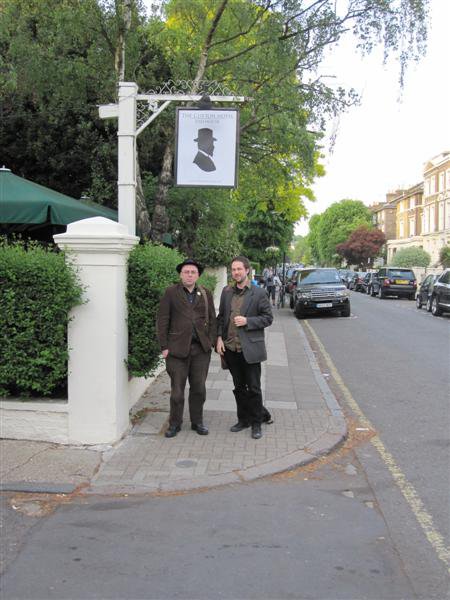
Although I’d met Mark a number of times over the years—he always happily inscribed his books for me too!—I most fondly remember one carefree summer (remember those?) a personal walking tour of Machen’s London, followed by pints at the Clifton Hotel in St. John’s Woods, a pub not only frequented by Machen, mentioned in The London Adventure, but one that features in a memorable photograph of the Welsh writer. Mark and I dutifully recreated that photo.

I’d only had the pleasure of publishing Mark once: “The Court of Midnight” in Uncertainties 2 (2016), later collected in The Prozess Manifestations (2017). Mark was consistently an excellent writer of weird fiction and has left us with a substantial body of work to be explored. If you’re not familiar with his writing, perhaps the easiest way to sample it is by picking up a copy of Hippocampus Press’s The Age of Decayed Futurity: The Best of Mark Samuels. You might also be interested in reading Quentin S. Crisp’s tribute to Mark as well.
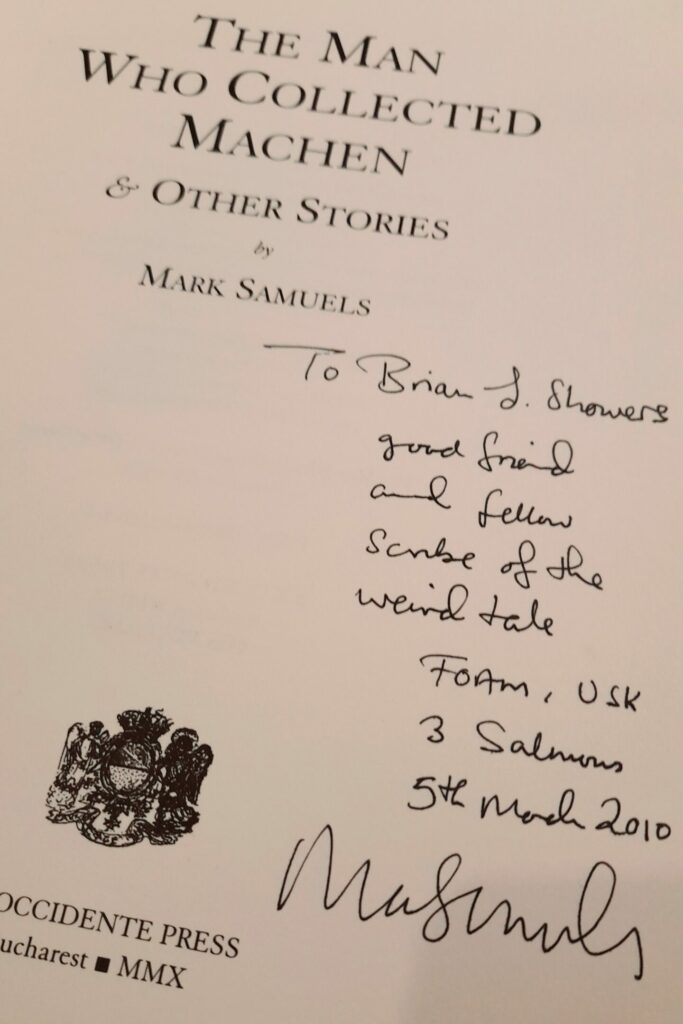
Farewell, Mark. Raising a pint to you!

In less mournful news, Swan River Press celebrated its twentieth anniversary this October. The occasion came and went pretty quietly, if only because I was otherwise occupied to plan a proper commemoration. However, I did write a short blog post on the history of the press. So for what it’s worth, here it is. One of these days I’ll finish writing that Swan River bibliography . . .

Of course, as always, I am grateful to the Swan River Press team: Meggan Kehrli, Jim Rockhill, Steve J. Shaw, and Timothy J. Jarvis. These folks help keep things running smoothly and our books looking the best they can be.

Before I retire to the warmth of my reading mattress (I don’t have a reading chair just yet), I would like to thank everyone who supported Swan River Press this year. Those of you who bought our books, posted about us on social media (we’re on Bluesky now too), sent feedback (especially if you’ve felt inspired by something you’ve read), or showed up on the doorstep of Æon House. Thank you, thank you, and thank you! Until then, please stay healthy; take care of each other and your communities. I’d like to wish you all a restful holiday season, and hope to hear from you in the New Year!

Brian J. Showers
Æon House, Dublin
10 December 2023


Our Haunted Year 2022

Art: Brian Coldrick

From an outside perspective, Swan River Press has probably looked very quiet this year, reduced to a trickle. Though we didn’t publish as much within these last twelve months as I had planned, the year was still a significant one behind the scenes, hopefully positioning us for a more (outwardly) eventful 2023.

In fact, I’d been lamenting how few new titles we had published this year, which is probably why stepping back to take stock in this annual post remains a useful exercise. Because we did accomplish more than I’d initially considered.

So with the year now drawing to a close, let’s have a look at what we did achieve . . .

There was only one hardback this year, but it was a good one: The Lure of the Unknown: Essays on the Strange by Algernon Blackwood. I’d been talking about doing a Blackwood volume with Mike Ashley for quite some time because, when it comes to Blackwood, Mike Ashley is always the first port of call.

Given that Blackwood had only just come out of copyright this year, we didn’t want to contribute to the myriad reprints of “The Willows” that readers were sure to be inundated with. We wanted something fresh and exciting, something a little less expected, something that would hold real insight for admirers of Blackwood and his work. So Mike pitched two ideas, both of which featured writings that had either never been reprinted or were rarely seen.

The Lure of the Unknown is a collection of Algernon Blackwood’s essays, talks, reviews and anecdotes exploring encounters with the strange and unusual or, in Blackwood’s preferred word, the “odd”. They include his first attempts to investigate alleged haunted houses, his association with such luminaries as W. B. Yeats, “A.E.”, and Gurdjieff; his thoughts on telepathy, reincarnation, elemental spirits, other dimensions, and his beliefs in what lies beyond our normal perceptions. These writings reveal not only Blackwood’s diverse experiences, but his depth of reading and analysis of the unexplained. Few of these essays have been reprinted beyond their first publication or their broadcast on radio and television. They provide another dimension to an understanding of one of the great writers of the supernatural.

Reception for the volume was well beyond what I expected, and the limited hardback sold out within six months. Michael Dirda said in the Washington Post that Lure of the Unknown was “an essential book for any Blackwood fan”, while David Longhorn in Supernatural Tales wrote that the volume was, “an excellent collection of occasional writings by one of the most gifted and charming authors of supernatural fiction.” I’ve heard that the Fortean Times will weigh in after the New Year.

Comment on this title would not be complete without mentioning the phenomenal portrait of Blackwood that appears on the boards of this volume. It was by Chloe Cumming, whose work I’ve admired for some time. Thank you, Chloe! (Check out Chloe’s website here.)

While the hardback is now out of print, the paperback edition should be available shortly. You’ll want to keep an eye on our website. And if you’re wondering what that second collection was that Mike had pitched, don’t worry—we’ll be publishing that too before long.

(Buy The Lure of the Unknown here.)

Miraculously, we also managed to publish both issues of The Green Book this year, and in a timely manner (hey, we’ve not always hit the mark!).

The idea for The Green Book 19 had been gestating for a while. I noticed sometime late last year that I’d amassed a number of essays and articles in my Green Book folder focused on Dublin’s Theosophical movement. Once I’d recognised the affinities between these pieces, disparately collected, I set about learning more. What else I could dig up? . . . and the result was Issue 19.

“Probably there has never been in any country,” wrote John Eglinton in his Memoir of A.E. (1937), “a period of literary activity which has not been preceded or accompanied by some stimulation of the religious interest. Anyone in search of this in Ireland at this time may find it if he looks for it, though he certainly will not find it in either the Catholic or the various Protestant religious bodies: he will find it, unless he disdains to look in that direction, in the ferment caused in the minds of a group of young men by the early activities of the Theosophical Movement in Dublin.”

Ireland of the late nineteenth century was awash in reawakened interest in Irish legends and folklore, craft and custom, language and art; the men and women whose works would come to define the ensuing Celtic Literary Revival often concerned themselves with a belief in the authoritative wisdom of ancient traditions and mythology, and with these fervent beliefs, they propelled Ireland toward nationhood. That a new spiritual movement could hold such sway over young minds in late nineteenth-century Ireland comes as no surprise.

Issue 19 launched at Gallery X in April in support of Dolorosa de la Cruz’s Cabinet of Curiosities exhibition (not far from the old Theosophical Lodge on Ely Place). The issue is essentially a portrait in essays, articles, and memoirs of those involved in the Theosophical movement, it’s most notable exponent, the poet A.E., and movement’s profound impact on Irish arts and literature. The issue features writing by Katharine Tynan, Ella Young, W. B. Yeats, Dorothy Macardle, and James Stephens.

(Buy The Green Book 19 here.)

For The Green Book 20, which coincided with the journal’s tenth anniversary, we featured another ten entries from our (still tentatively titled) Guide to Irish Gothic and Supernatural Fiction Writers project, including profiles of James Clarence Mangan, Charlotte Riddell, Bram Stoker, Herminie Templeton Kavanagh, Althea Gyles, F. Frankfort Moore, and more. This on-going project, serialised in The Green Book for a number of years now, continues to be a revelation as, with my co-editor Jim Rockhill, we continue to explore the constellation of Irish writers of supernatural fiction. Eventually these entries will see the light of day as a standalone publication; in my head, it’s a lavish affair, a heavy volume and fully illustrated. We’ve still a few entries to chase before that though.

(Buy The Green Book 20 here.)

We continued this year with our paperback reprints as well, adding ten new (well, actually old) titles to the roster, bringing the total number of paperback titles to twenty-nine. This year’s additions include Longsword by Thomas Leland, The Sea Change by Helen Grant, Reminiscences of a Bachelor by J. S. Le Fanu, November Night Tales by Henry C. Mercer, The Pale Brown Thing by Fritz Leiber, and the Selected Poems of A.E. The last batch of four titles—The Silver Voices by John Howard, A Flutter of Wings by Mervyn Wall, The Dummy by Nicholas Royle, and The Lure of the Unknown by Algernon Blackwood—will be available just as soon as we can approve the proofs.

I’ve had a few queries about reissuing in paperback some of our anthologies that feature contemporary writers—sorry, but we won’t be doing that for a number of reasons. So do be sure to pick them up in hardback if you’re interested. Once they’re gone, they’re truly gone.

For a full list of the paperbacks we have available, have a look at our website and use the filters on the Titles page and select “In Print – Paperback” in the availability field. Which brings me to our next notable accomplishment this year . . .

During the summer we unveiled our new website, something I’d been meaning to do for a number of years. With the help of Simon Appleby at Bookswarm, we came up with something that I think it a vast improvement on my decades of html hammering. It’s cleaner, smoother, and certainly more easy for me to update. The most handy feature from a reader point of view, I think, are the filters on the Titles and Author pages. Play around with them and see what you think.

The website took a good few months of work as well (just in case I wonder where some of the year’s time went). As with most things like this, it’s not entirely “finished” either. If you see anything amiss, please let me know.

Now, if anyone is interested in the annual figures: we published 3 new titles this year, totalling 424 pages, 900 copies, and 111,050 words. This is actually the fewest number of titles we’ve published since we started doing hardbacks in 2010/11. We normally seem to average maybe six or seven new titles per year (including The Green Book, but not any of the paperbacks).

Perhaps our most exciting news, as many of you already know, is that Swan River Press moved house in October. After almost twenty years in Rathmines, we’ve moved to Æon House, a small cottage that, near as anyone can tell, is in the general vicinity of Dolphin’s Barn, on the city side of the canal. It’s a lovely house, a welcoming neighbourhood, and a fresh beginning. Unfortunately, some work is being done on the house still—likely to continue for some months—so we’re not quite settled yet. But with the move now over, I can get back to work on new titles. Still, please bear with us as we figure out our new surroundings.

Just because I haven’t published more this year, doesn’t meant we’ve not been hard at work. I’m not a fan of pre-announcing, but I suppose it’s the holiday season, and I can let slip, just between us, the first title of 2023: a new collection from Lynda E. Rucker called Now It’s Dark. We’ve an introduction by Rob Shearman, a cover by John Coulthart, and the book is currently with the printer, so hopefully we’ll see it before the end of January. (There are just a few hardback copies left of Lynda’s previous Swan River collection, You’ll Know When You Get There.) If you want to be the first to know when Now It’s Dark is available to pre-order, join our mailing list.

I can also divulge that Uncertainties 6 is slowly nearing completion. As with volume 5, I’m editing this one as well. However, unlike previous volumes, this installment is slow to come together for a number of reasons. While I don’t have a release date just yet, I’m appreciative of all the contributors—you know who you are!—who have been bearing with me during this lengthy process. I promise it will be worth the wait and I look forward to announcing the details in due course. I’m very excited about it.

As usual, I would like to express my continued gratitude to the Swan River team: our designer Meggan Kehrli, typesetter Steve J. Shaw, and editors Jim Rockhill and Timothy J. Jarvis. I don’t think one could assemble a better or more talented team. Thank you again to everyone who showed their support during this long and often difficult year.

If you’d like to keep in touch, do join our mailing list, find us on Facebook, follow on Twitter and Instagram. Until next time, please be well, and take care of each other and your communities. From the wintry hearth of Æon House, I wish you all a restful holiday season full of peace and belonging, and hope to hear from you in the New Year!

Brian J. Showers
Æon House
28 December 2022


Our Haunted Year 2021

If there’s one thing I’ve learned over the years, it’s that running a small press is not an easy job. It’s a precarious balancing act with limited resources on one side and an ever-shifting set of challenges on the other. This year was perhaps the most difficult I’ve experienced, due not only to the continuing pandemic, but also from the very real fallout caused by those twin bad decisions: Brexit and the Trump administration. We’ve been subjected to significant jumps in postage, reams of customs forms where there were none before, and supply chain issues that are likely to affect the entire publishing industry for the foreseeable future. And yet . . .

. . . despite all this, publishing remains a pleasure. Swan River Press generates a domineering amount of work—and it’s not even my day job. What it is, though, is an opportunity for me to engage with friends, colleagues and ideas, indulge in creativity, and put some truly wonderful literature into the world. I love designing books, the thrill of unboxing each new shipment, and getting them into the hands of readers. I take a lot of pride in what the Swan River team does, and I know we work hard to do it. Sure, I might grumble occasionally (and will continue to do so), but rest assured, I wouldn’t trade Swan River Press for anything.

As most of you already know, I’ve made it a tradition to take stock of our accomplishments over the past twelve months. I find it’s a good practice, even therapeutic, as it’s easy to lose sight of all the good work that’s being done. It seems all the more important to do so this year as the struggle to keep the barge on an even keel felt all the more difficult. But here we are. We made it. So let’s have a look at 2021.

Our first book of the year was in collaboration with our multi-talented friend to the north, Reggie Chamberlain-King: The Fatal Move and Other Stories by Conall Cearnach. Reggie first wrote about Cearnach for The Green Book 11, prompting me to track down a copy of the Irish writer’s sole collection. “Cearnach” was the pseudonym of the Belfast-born F. W. O’Connell, a peculiar Protestant divine, linguist and Irish language scholar, oddball essayist, and early national broadcaster. The Fatal Move is truly a strange and fascinating collection. It showcases a wide scope of modes: the conte cruel, the ghost story, the locked-room mystery, and the science-fictional satire. I published the Jamesian tale “The Fiend that Walks Behind” in The Green Book 15, and shortly thereafter decided to publish the whole damn book—which hadn’t seen an outing since its initial publication in 1924. Reggie provided a lengthy and erudite study of Cearnach’s fascinating life and works, and we added a selection of equally oddball essays to round out the volume. As Supernatural Tales’ David Longhorn observes, this book “illuminates some of the more obscure byways of Irish literature”. If you want to read more about The Fatal Move—and the fascinating story behind the book’s cover art, check our my previous blog post. You can also listen to Reggie discussing Cearnach on BBC Radio. (Also be sure to check out The Black Dreams: Strange Stories from Northern Ireland, a new anthology edited by Reggie Chamberlain-King.)

(Buy The Fatal Move here.)

Next is the fifth instalment of our ongoing anthology series, Uncertainties, our showcase of new writing—this time featuring contributions from Ireland, Canada, America, and the United Kingdom—with each writer exploring the idea of increasingly fragmented senses of reality. I decided to take the reins this year and put together a line-up of stories from twelve contemporary writers such as Ramsey Campbell, Alan Moore, Aislínn Clarke, and Carly Holmes. The cover for this volume was provided by Ksenia Korniewska, whose work I had long admired on Instagram. With Uncertainties 5, I finally had an excuse to work with her. Along with The Fatal Move, Uncertainties 5 is the first of our books with printed buckram boards, a feature with which we will endeavour to continue. As with previous volumes, Uncertainties 5 has been well-received: Deirdre Sullivan’s “Little Lives” won the An Post Book Award for Short Story of the Year, while the Irish Times reviewed the anthology as, “Challenging and uncanny, these are exactly the kinds of stories we need to survive in a world that keeps getting stranger.” I’m also quite proud of the foreword I wrote, the culmination of an awful lot of ruminating about the horror genre and it’s many facets. You can read the essay online: “That Didn’t Scare Me”.

(Buy Uncertainties 5 here.)

A selection of stories by L. T. Meade was something I’d been considering since Bending to Earth came out in 2019. In that sense, Eyes of Terror and Other Dark Adventures is the next instalment in our unofficial “Strange Stories by Irish Women” series, which to-date includes titles by Dorothy Macardle, Rosa Mulholland, B. M. Croker, Katharine Tynan, and Clotilde Graves. For Eyes of Terror, I went to Meade scholar Janis Dawson, who had written an excellent author profile on Meade for The Green Book 16. Meade’s stories were widely published in popular fin de siècle magazines, and this selection showcases her macabre specialties: medical or scientific mysteries featuring doctors, scientists, occult detectives, criminal women with weird powers, unusual medical interventions, fantastic scientific devices, murder, mesmerism, and manifestations of insanity. Quoth Michael Dirda in the Washington Post, “[Meade’s] scariest, and hitherto scattered, short horror fiction is finally reassembled in Swan River Press’s Eyes of Terror and Other Dark Adventures, superbly edited by Janis Dawson. Highly recommended.”

(Buy Eyes of Terror here.)

Our fourth book this year has its roots in the Dublin Ghost Story Festival at which Joyce Carol Oates was our guest of honour in 2018. Surely working with Joyce would be a career highlight for any publisher: it certainly is for me. The Ruins of Contracoeur and Other Presences is a collection of Joyce’s trademark grotesqueries; check this out: “A group of resourceful young girls punish the men of a small town for unspeakable lusts by luring them to a derelict factory and into the toils of a bizarre contraption; a dead man tries to makes sense of a strange epiphany he experienced one day when out hiking amid gigantic ancient redwoods; and a state judge, fleeing disgrace, settles with his family on an isolated ruinous estate where some dread thing prowls in the night . . . ” Wow! So for this publication, I wanted to do something extra special. First, asking Lisa Tuttle to write the introduction was an obvious choice—folks, I’m still kicking myself for not recording the fascinating guest of honour interview she conducted with Joyce at the DGSF. For the cover, I went to Meggan Kehrli, who mainly serves as Swan River’s designer. I hope you’ll agree, she turned in something special (and just wait until you seen the boards). Finally, the entire edition is signed not only by Joyce, but also by Meggan and Lisa. And in atonement for my aforementioned sin, you can watch an online conversation between Lisa and Joyce that we recorded, with the help of Eric Karl Anderson, for the launch of The Ruins of Contracoeur. My sincere gratitude again to you, Joyce, for the opportunity to publish this book!

(Buy The Ruins of Contracoeur here.)

Our last hardback publication for the year is another entry in the “Strange Stories by Irish Women” series: A Vanished Hand and Other Stories by Clotilde Graves. Of course, you’ll always be familiar with Grave’s work from Bending to Earth. Graves is one of the most interesting and neglected writers I’ve come across, whose writing is as difficult to pin down as her personality. In her early years, she was known as the dramatist “Clo Graves”, but became better known under her fiction-writing persona, “Richard Dehan”. She transgressed contemporary gender norms by dressing in male attire, wearing her hair short, and smoking in public. This border crossing can be seen also in her work, which encompasses a wide variety of forms and modes. And while she wrote relatively few fantastical stories, she was devoted to tales of lingering revenants, mysterious cryptids, and grotesque sciences—often laced with her sardonic sense of humour. This volume seeks to recover this side of Graves’s writing by including stories from across her career, which challenge definition and range across the speculative genres. The selection of thirteen stories was made by Melissa Edmundson, who also provided an expert introduction on Graves and her work. You’ll also, no doubt, notice the exceptionally striking cover by Brian Coldrick, who also gave us the cover for Eyes of Terror earlier in the year (as well as the covers for our Mulholland and Tynan volumes). I had a lot of fun working on this book, another landmark of its kind. We’ll be working with both Brian and Melissa again for sure.

(Buy A Vanished Hand here.)

We also published two issues of our journal The Green Book: Writings on Irish Gothic, Supernatural and the Fantastic. It’s hard to believe that the journal will read its ten-year anniversary next year. Based on the popularity of Issue 15, The Green Book 17 featured a selection of rare fiction and poetry by the likes of H. de Vere Stacpoole, Herbert Moore Pim, Katharine Tynan, Dora Sigerson Shorter, and L. T. Meade. We also reprinted in this volume Althea Gyles’s “weirdly powerful and beautiful” illustrations to Oscar Wilde’s poem “The Harlot’s House”. Issue 18 featured eleven entries from our (still tentatively titled) Guide to Irish Gothic and Supernatural Fiction Writers project, including profiles of George Croly, Anna Maria Hall, Fitz-James O’Brien, Jane Barlow, Harry Clarke, Iris Murdoch, and more. Our issues for 2022 are already coming together nicely—the next will be loosely themed on Dublin’s theosophical scene of the late nineteenth and early twentieth centuries. (Anyone who is unsure where to jump in on this journal, we’ve a special offer running too. It’s a secret.)

(Buy The Green Book here.)

You also might have noticed that we substantially added to our paperback catalogue this year. In 2020 we published three paperback titles. In 2021, we increased that to a total of nineteen. Among them you’ll find Curfew & Other Eerie Tales by Lucy M. Boston, Strange Epiphanies by Peter Bell, and The Anniversary of Never by Joel Lane. We’ve got another six titles waiting to be reprinted in early 2022, including The Pale Brown Thing by Fritz Leiber and The Sea Change by Helen Grant. Rest assured, hardbacks will remain our primary focus—not to mention still the best way to support the press’s ongoing work. Please also be aware that our anthologies featuring contemporary writers will not be reprinted as paperbacks. Once those are out of print, they will truly be gone! If you want to see what books we have available in paperback, have a look here (scroll down to “Paperback”). And if your next question contains the word “When” in it, do be sure to join our mailing list.

Now if anyone is interested in the figures, we published 7 new titles this year, totalling 1,288 pages, 2,481 copies, and 363,460 words. I have a nifty spreadsheet that keeps track of all of this stuff for me. I love literature, but these numbers help put our achievements into perspective too.

We had a bit of change up this year as well. Ken Mackenzie left the team having worked with us since 2013. His first book with us was Seventeen Stories by Mark Valentine and he’d typeset every publication through Uncertainties 5 earlier this year. Ken brought a polish to our pages and helped make our books all the better for it. I’m grateful to Ken for all his work over the years and wish him the best in all his future endeavours. Quickly stepping up as our new typesetter and team member is Steve J. Shaw, who many followers of independent press will know from his own Black Shuck Books imprint. Steve proved himself invaluable from the outset, not only as our new typesetter, but with his insight into the workings of independent publishing. Welcome, Steve—and thanks for your help! (And if you get a chance, do check out his books. I recently enjoyed Only the Broken Remain by Dan Coxon.)

No summation of the year would be complete without acknowledging the rest of the Swan River team: Meggan Kehrli, who does all our design work; and Jim Rockhill and Timothy J. Jarvis, both of whom help with the editorial and proofreading duties, not to mention general advice and support. I’d also like to thank John Howard, Joe Mitchen, Alison Lyons of Dublin UNESCO City of Literature, and John Connolly (check out his new anthology Shadow Voices: 300 Years of Irish Genre Fiction), all of whom continue to give their support, encouragement, and enthusiasm for our work.

This year has been difficult for many, and I’ve had a lot of books and media to keep me company lately. I’d like to give a shout out to the creatives that I’ve been enjoying lately. Maybe you’ll find something new and interesting: Tartarus Press, Zagava, Ritual Limited, Egaeus Press, Sarob Press, Side Real Press, Black Shuck Books, Supernatural Tales, Hellebore, Nunkie Productions, Eibonvale Press, Undertow Publications, Nightjar Press, Friends of Arthur Machen—all of these people are doing the sort of things that I love, so be sure to give them your support if you find something new and exciting. Not to mention the many booksellers out there who stock our books—and even if they don’t, be sure to support your favourite local, independent bookseller. Choose to put your money into their pockets instead of Am*zon’s, because it really does make a difference.

Lastly, thank you to everyone who supported Swan River Press this year: with kind words, by buying books, donating through our patron programme, or simply spreading the word—I’m grateful for it all! If you’d like to keep in touch, do join our mailing list, find us on Facebook, follow on Twitter and Instagram. We’ve got some exciting projects for next year that I’m looking forward to sharing with you all. Until then, please stay healthy; take care of each other and your communities. I’d like to wish you all a restful holiday season, and hope to hear from you in the New Year!

Our Haunted Year 2020

We can probably safely say that few could have guessed what 2020 would have in store for us. I haven’t quite decided yet whether or not I take comfort in the fact that this can be said at the start of any given year. Anyway, here at Swan River Press I had to adjust quickly: I started to work my day job from home last March, which then blurred daily into the evening hours that I put into the press. Time is a bit elastic in this room, and it isn’t uncommon to find myself wondering what day of the week it is.

Whenever I write one of these annual reviews, it seems that the most recent passing year is the “most ambitious yet”. This year feels no different, if only because most of my free moments—for better or for worse—were given over to Swan River. I suppose one must keep oneself distracted, right? I admit, I enjoy the indulgence in work. At least this sort of work.

But here we are at the end of a difficult year, and it’s time for me to take stock of what we’ve accomplished on the publishing front. I say “we” because, though it’s just been me in this room for the majority of the year, Swan River is far from just myself as you’ll quickly see.

So let’s start at the beginning.

Our first book of the year was the fourth instalment in our ongoing anthology series, Uncertainties, our showcase of new writing—featuring contributions from Britain, America, Canada, Australia, and the Philippines—each writer exploring the idea of increasingly fragmented senses of reality. This year’s volume was edited by Timothy J. Jarvis, and included an impressive line-up of stories from fourteen contemporary writers such as Lucie McKnight Hardy, Camilla Grudova, John Darnielle, Brian Evenson, and Claire Dean. I was particularly delighted to feature on the cover a painting by B. Catling, who we’ll return to in a moment. David Longhorn of Supernatural Tales had some kind things to say about the anthology: “[Uncertainties 4] has, for me, illustrated yet again the broad range of Gothic fiction, and more than hints at a genre revival in this century far more impressive than anything in the last. Perhaps this is because, like the Victorian era, ours is one of uncertain peace, irrational fads, scientific progress, and deeply unstable societies that are mirrored in confused personal identities and relationships. And people still like spooky stuff a lot.”

(Buy Uncertainties 4 here.)

Lucifer and the Child by Ethel Mannin felt like one of our biggest discoveries of the year, something to be truly excited about: the first Irish edition of an overlooked novel once banned in this country. An atypical book from Mannin, Lucifer and the Child was originally published in 1945, then reviewed in the Irish Times as “a strange, but gripping book”. Our new edition of this extraordinary novel features an introduction by Rosanne Rabinowitz, and was given favourable notice in the Dublin Inquirer: “It is not surprising that this book was deemed unsuitable for 1940s Ireland. The allure of Lucifer and the occult would certainly have been deemed inappropriate, as would the depictions of female sexuality.” (Although no records exist that give reason, I personally suspect it wasn’t the occult themes that got the book banned, but rather the mention of abortion.) Despite the challenges it poses to conservative pearl-clutchers, this book was warmly received as evidenced by the many emails I got from delighted readers. The cover is by Australian artist Lorena Carrington—she did a wonderful job of depicting the dark faerie tale within its pages.

(Buy Lucifer and the Child here.)

Our next title, Munky, allowed us not only to work with artist and novelist B. Catling RA, author of the Vorrh trilogy, but for the cover art the opportunity to team up with artist Dave McKean. This project started as a submission to Uncertainties 4, but after some consideration, we decided it stood better on its own. Munky is a quirky novella that illustrates an English town and its inhabitants, as ridiculous as they are quaint, evoking an atmosphere that “might be called M. R. James with a soupçon of P. G. Wodehouse and a dash of Viz” (The Scotsman). We had also arranged for this edition to be signed by both author and artist, making this book one helluva package. Once a book is published, I tend not to go back and read it (yet again). Not so with Munky. Over these past months I found myself picking it up on occasion to revisit Catling’s charmingly cracked world.

(Buy Munky here.)

Our fourth book this year was also our fourth by Irish author Mervyn Wall: Leaves for the Burning, originally published in 1952. We’ve been championing Wall’s work for quite some time now: The Unfortunate Fursey (2015), The Return of Fursey (2015), A Flutter of Wings (2017), and in a few issues of The Green Book. A mid-century portrait of Ireland, Leaves for the Burning is rich in grotesque humour and savage absurdity, depicting a middle-aged public servant who works in a shabby county council sub-office in the bleak Irish midlands, mired in Kafkaesque bureaucracy and petty skirmishes with locals. Although we stray from our typical fantastical themes with this one, we hope you’ll still give it a chance. With an introduction by Susan Tomaselli, editor of gorse, we are proud to make available again Mervyn Wall’s great “half-bitter book”—as it was judged by Seán O’Faoláin—surely now just as relevant as it was over half a century ago. The cover art for this one is by Niall McCormack, whose work will be recognisable to those who read Tomaselli’s gorse.

(Buy Leaves for the Burning here.)

Continuing with our “recovered voices” of Irish women writers of the supernatural, this year we published The Death Spancel and Others by Katharine Tynan. Research for this project started over three years ago—though you’ll recall we featured Tynan in Bending to Earth: Strange Stories by Irish Women (2019) and in various issues of The Green Book. Consisting of fifteen stories, seven poems, three appendices, and an introduction by Peter Bell, The Death Spancel is the first collection to showcase Katharine Tynan’s tales of the macabre and supernatural. It is also the only volume of this once-popular Irish author’s work currently in print, perhaps making this book all the more important. The Death Spancel was reviewed in Hellnotes by Mario Guslani to be “of remarkably high literary quality . . . a great collection recommended to any good fiction lover.” Brian Coldrick, who is quickly becoming one of our favourite artists to work with, did the cover for this one. You might recognise his work from the cover of Rosa Mulholland’s Not to Be Taken at Bed-time (2019).

(Buy The Death Spancel here.)

The final hardback of the year was Ghosts of the Chit-Chat, edited by actor and scholar Robert Lloyd Parry. The book is as much an anthology of stories and poems as it is a work of scholarship. Lloyd Parry introduces each author with a short biographical sketch, building a portrait of those in the orbit of M. R. James, who debuted his own ghost stories on the evening of Saturday, 28 October 1893, Cambridge University’s Chit-Chat Club. Like many of our books, this one was long in the works. In addition to reprinting numerous rare and only recently discovered pieces, Ghosts of the Chit-Chat also features earlier, slightly different versions of James’s “Canon Alberic’s Scrap-book” (here titled “The Scrap-book of Canon Alberic”) and “Lost Hearts”. We also had a Zoom launch for Chit-Chat, and though it wasn’t recorded, we’ve got a video of Lloyd Parry reading Maurice Baring’s “The Ikon”. The volume was published on 8 December, and proved to be so popular that the already extended edition of 500 swiftly went out of print on 20 December, breaking some sort of record for us. Reception has been encouraging, with James scholar Rosemary Pardoe noting, “People who’ve missed out on it should be kicking themselves.” But don’t worry. We have plans for a paperback edition next year—sign up to our mailing list if you want advance notice.

(Buy Ghosts of the Chit-Chat here.)

We also published three issues of our journal The Green Book: Writings on Irish Gothic, Supernatural and the Fantastic. Issue 14, outstanding from 2019, was published simultaneously with Issue 15. Based loosely around the theme of memoir and biographical sketches, Issue 14 contained pieces by or about Dorothy Macardle, Fitz-James O’Brien, Rosa Mulholland, among others. Issue 15 was a departure from our standard practice: we decided to feature fiction, and so reprinted rare pieces by Conall Cearnach, Herbert Moore Pim, Robert Cromie, and others. Issue 16 featured ten entries from our (still tentatively titled) Guide to Irish Gothic and Supernatural Fiction Writers project, including profiles of Edmund Burke, L. T. Meade, Forrest Read, Elizabeth Bowen, and more. Our issues for 2021 are already coming together nicely.

(Buy The Green Book here.)

And there you have it!

So is anyone interested in the final tallies? I’ve got my nifty spreadsheets set up to spit out some figures. We published 8 new titles this year, totalling 1,584 pages, 2,950 copies, and 462,763 words.

Naturally we attended no conventions this year, either online or in person. I think the last might have been FantasyCon in Glasgow. But I look forward to seeing everyone again soon!

Perhaps the biggest Swan River development over these past twelve months was a long-mooted foray into paperbacks. We’ve dipped our toes in the water so far with Earth-Bound (Dorothy Macardle), The House on the Borderland (William Hope Hodgson), and Insect Literature (Lafcadio Hearn). We’ll be doing more in 2021, so it will be your chance to read some of our out-of-print books at a more reasonable price than what you’ll often find them for on the secondhand market. The reason it took so long is because I wanted to make sure we were doing paperbacks as best we could given the myriad challenges I had to consider and balance. This not only includes the books themselves, but also the behind-the-scenes admin work they create. But I’m happy we’ll been able to make available again some great stories. If you want to read more about our paperbacks, I wrote an entire blogpost about it.

(Buy Swan River Paperbacks here.)

Next I’d like to extend a warm welcome to Timothy J. Jarvis, who will be joining (actually, already has) the Swan River team. I’ve known and worked with Tim for a good many years now. I’ve always found both his fiction and writings on supernatural literature to be nothing but insightful; and I, as I am sure do many, value his generosity, passion, and friendship highly. If you want to check out Tim’s work, I suggest starting with his novel The Wanderer (2014). Tim also edited Uncertainties 4 this year, and his short fiction and articles can be found in innumerable anthologies. He is also co-editor of Faunus, the journal of the Friends of Arthur Machen (to which you should subscribe if you don’t already). Welcome, Tim!

Not forgetting the Swan River team, who make sure that I’ve not sat alone in this room for the year: Meggan Kehrli, who has once again done a superb job designing and laying out all our titles (including the various other ads and graphics I occasionally need); Jim Rockhill, who is always at the ready to provide proofreading and sage editorial input, always backed with his thoughtful scholarship; and Ken Mackenzie, who takes care of all our books’ insides, always patiently putting up with my dithering until things are just right. And finally, Alison Lyons and the team at Dublin UNESCO City of Literature, who continues to give their support, encouragement, and enthusiasm for our on-going work, allowing us to reach just a bit further than we might otherwise be able to.

(Don’t worry, I’m nearly finished.)

This year has been difficult for many, and I’ve had a lot of books and media to keep me company lately. I’d like to give a shout out to the creatives whose work I’ve been enjoying lately. Maybe you’ll find something new and interesting too: Tartarus Press, Zagava, Ritual Limited, Egaeus Press, Sarob Press, Side Real Press, Supernatural Tales, Hellbore, Nunkie Productions, Eibonvale Press, Undertow Publications, Nightjar Press, Friends of Arthur Machen—all of these people are doing the sort of things that I love, so be sure to give them your support if you find something you like. Not to mention the many booksellers out there who stock our books—and even if they don’t, be sure to support your favourite local, independent booksellers anyway. Choose to put your money into their pockets instead of Am*zon’s, because it really does make a difference.

Lastly, thank you to everyone who supported Swan River Press this year: with kind words, by buying books, donating through our patron programme, or simply spreading the word—I’m grateful for it all! If you’d like to keep in touch, do join our mailing list, find us on Facebook, follow on Twitter and Instagram. We’ve got some exciting projects for next year that I’m looking forward to sharing with you all. Until then, please stay healthy; take care of each other and your communities. I’d like to wish you all a restful holiday season, and hope to hear from you in the New Year!

Our Haunted Year: 2019

2019b Christmas

It looks as though 2019 was our most ambitious year to date. I had a suspicion this time last year that it might be and I wasn’t wrong. I had originally planned nine publications for 2019—alas, we only managed seven. But they’re seven of the best books we’ve done and results of which all involved can be proud. So let’s have a look at what we got up to these past twelve months.

53717333_775664036154255_1018230587174944768_nThe first book was a long time in coming: Bending to Earth: Strange Stories by Irish Women edited by Maria Giakaniki and Brian J. Showers. The anthology came together over many years, after much searching for tales that were not only good, but also infrequently reprinted, if at all. The original publications of these tales range from 1847 to 1914. There are names you might already be acquainted with, such as Lady Jane Wilde and L. T. Meade, and those that will certainly be less familiar to most, such as Katharine Tynan and Clotilde Graves. Darryl Jones, in his review of the this volume for the Irish Times, notes a particularly exciting aspect of this book: “Bending to Earth is full of tales of women walled-up in rooms, of vengeful or unforgetting dead wives, of mistreated lovers, of cruel and murderous husbands . . . ‘The De Grabrooke Monument’, a previously uncollected story by Charlotte Riddell [ . . . ] is a significant coup for Giakaniki and Showers.” Bending to Earth also marks the first time we worked with Dublin illustrator Karen Vaughan, who did an excellent job on the cover. We hope to work with her again sometime! You can read some more reviews and even an extract from the introduction if you wish.

2019-01-25 Final PosterOn a related note, some of you will recall the “Irish Writers of the Fantastic” poster that I designed with Jason Zerrillo in 2015. The poster was later issued by Dublin City Libraries and Dublin UNESCO City of Literature—I hope some of you managed to get a copy. Well, Jason and I created another poster this year: “Strange Stories by Irish Women”. It’s meant as a sort of illustrative companion to Bending to Earth, showcasing portraits of each author in the anthology and featuring suitably unsettling quotes from each of their stories. I believe the library still has plans to issue this as a poster at some point. I’d love to see it in libraries across Ireland and beyond.

IMG_20190426_144126_190Our next book was Not to Be Taken at Bed-Time and Other Strange Stories by Rosa Mulholland. As an Irish author Mulholland, of course, also featured in Bending to Earth, so those who liked her story in that anthology may wish to explore her other gothic offerings. There is something of a faerie tale quality to Mulholland’s stories, or as David Longhorn pointed out in his review for Supernatural Tales, “Mulholland also draws strongly on her Irish heritage, and this gives the tales an extra dimension, that of the looming Celtic Twilight.” Not to Be Taken at Bed-Time was originally published by Sarob Press in 2013 and swiftly went out of print. With an introduction by the late Richard Dalby, I’m pleased to bring this title not only back into print, but also under Swan River’s wing. An extract from Richard’s introduction can be read here. Our edition was given a vibrant new cover by Irish artist Brian Coldrick. Fans of the ghost story will want to check out Coldrick’s Behind You: One-Shot Horror Stories, a marvellous collection of illustrations perfectly capturing that moment of a pleasing terror.

67143631_1806947816074520_6074629506683895808_nAfter Mulholland we published a new collection by John Howard: A Flowering Wound. This is the third book we’ve worked on with John, having previously published Written by Daylight in 2013 followed by The Silver Voices in 2014. Once again, David Longhorn of Supernatural Tales weighs in on this marvellous collection: “John Howard’s tales seemed to me like suitable summer reading. Many of the stories concern overlit urban landscapes not unlike those in the stories of J. G. Ballard, though the mood is very different . . . . There are also some stories that recall Arthur Machen’s approach to London, his insistence that the great metropolis is a place of magic and mystery.” The cover, perfectly evocative of John’s writing, was provided by our long-time collaborator Jason Zerrillo. If you’d like to read more about A Flowering Wound, check out this wonderful interview with John Howard conducted by Florence Sunnen.

ECGhq8pWkAAOvArThe Mulholland book was not to be our only Sarob Press reprint this year. We also reprinted “Number Ninety” & Other Ghost Stories by B. M. Croker, originally published in 2000. This volume, like the Mulholland, was also long out of print, and being written by an Irish writer, we were keen to bring Croker’s stories to our audience. Unlike Mulholland, who wrote often about Ireland, the majority of Croker’s stories are often set further afield. In his review for Wormwood, Reggie Oliver writes: “[Croker’s] Indian stories evoke colonial life vividly and there is no imperial condescension towards the native characters who are treated with the same respect and sharpness of vision as her British ones . . . . What makes them all readable are the well-observed characters and settings which, besides India, include Britain, Ireland, Australia, the South of France and the American Deep South.” You’ll find Croker also represented in Bending to Earth; likewise, Richard Dalby has provided us with another excellent introduction. The expert cover for “Number Ninety” is by Alan Corbett, who also provided the illustration for The Green Book 2—a panel from his excellent Cork-set graphic novel The Ghost of Shandon.

IMG_2173Next up was quite a special project, an opportunity that could not be missed: a 150th anniversary edition of Joseph Sheridan Le Fanu’s Green Tea, which was originally published in Charles Dickens’s All the Year Round in October 1869. “Green Tea” stands as one of my favourite ghost stories; it’s the world at its cruellest, Le Fanu at his bleakest. To create something really special, we put together a great team: Matthew Holness (writer/director of Possum) is a long-time admirer of Le Fanu’s work, and provided an introduction to Reminiscences of a Bachelor back in 2014. We also called in Alisdair Wood, who provided illustrations for our edition November Night Tales by Henry C. Mercer. For Green Tea, Alisdair not only fully illustrated the story, but designed the cover as well. We then teamed up with Reggie Chamberlain-King of Belfast’s Wireless Mystery Theatre to produce a dramatic recording of Le Fanu’s masterful tale of paranoia and fear—you’ve got to hear it!

69426386_10216983751123616_2449381894282805248_o

Finally, the book is rounded out by a pair of essays, written by myself and Le Fanu scholar Jim Rockhill, exploring the background and publishing history of “Green Tea”. The entire edition is signed by Holness, Wood, Rockhill, and Showers—and includes a facsimile signature of Le Fanu. Just to make the occasion even more special, I took the pile of signing sheets to Le Fanu’s grave here in south Dublin, where they rested for a while with a cup of strongly brewed green tea before I sent them off to the printer to be bound. Praised by Michael Dirda in the Washington Post as a “beautiful keepsake volume”, I’m confident our new edition of Green Tea is book Le Fanu himself would be proud of.

IMG_2312Our last book of the year arrived just a few short weeks before the holidays: The Far Tower: Stories for W. B. Yeats edited by Mark Valentine. Stories of magic and myth, folklore and fairy traditions, the occult and the outré, inspired by the rich mystical world of Ireland’s greatest poet, W. B. Yeats. The Far Tower is something of a tribute anthology, similar to The Scarlet Soul: Stories for Dorian Gray (2017), and Mark invited many of the same collaborators to the project, including cover artist John Coulthart, who really gave us something special this time. As the calendar draws to a close, I hope readers will enjoy this final offering of the year somewhere warm and relaxing. If you’d like, you can read Mark’s introduction as well!

67063061_715995905509991_3361863342883864576_nMoving on to The Green Book. Some might have noticed that there was only one issue this year. This was quite unintentional, and one of the two books I had hoped to publish, but simply didn’t manage. However, The Green Book 13 did see the light of day last spring. Much like the previous two issues, issue thirteen contains a number of entries on obscure Irish writers of the fantastic, including Dora Sigurson Shorter, Cheiro, Oliver Sherry, Stephen Gilbert, and others. Issue fourteen will likely appear around the same time as issue fifteen, so don’t fret. Apologies for the delay!

Uncertainties 4The other book I was hoping to publish this year, but was unable to complete in time, is Uncertainties 4 edited by Timothy J. Jarvis. However, I am happy to say that the book is now finished, with a remarkable selection of stories, and will go to print in early 2020, complete with a fantastic cover from the painting “Night Beach” by B. Catling. This is the first time Swan River has worked with Catling, and won’t be the last . . .

A lot of publishing takes place in isolation, with me sitting here in Dublin at my desk tapping away at the keyboard: answering emails, updating accounts, editing, or simply reading. Occasionally I also have the opportunity to leave the house. This year Swan River Press attended Worldcon here in Dublin. It was my first Worldcon: slightly overwhelming, but loads of fun to meet people and talk about books. In October I made my way up to Glasgow for Fantasycon. Although smaller than previous years, it was still great fun to see friends. I’m very much looking forward to Stokercon in 2020—Scarborough is such a fun city to visit. I hope to see you all there!

dublin logo final copyJust because I’ve been asked lately, it does not look as though we’ll be hosting a Dublin Ghost Story Festival in 2020. The event is not permanently cancelled, so don’t despair just yet, but the idea does need to reach a certain momentum before I’m comfortable committing myself. The events in both 2016 and 2018 were great fun, guests of honour being Adam Nevill and Joyce Carol Oates, respectively. So I do hope we’ll be able to do another one when the time is right. If you want to keep abreast of any announcements, do join our mailing list or follow us on Facebook.

While much of publishing can take place in isolation, it is by no means a vacuum. There’s a reason Swan River books look so good. Jim Rockhill continues to proofread all of our volumes, offering his sharp eye and invaluable advice; Meggan Kehrli once again designed all our covers, keeping the look of the Swan River books uniform and exciting; and Ken Mackenzie, who typesets all our books, often a less noticed contribution, but one of great importance. I’d also like to thank Alison Lyons of Dublin UNESCO City of Literature for her constant support of fine literature.

Lastly, thank you to everyone who supported Swan River Press this year: with kind words, by buying books, donating through our patron programme, or simply spreading the word—I’m grateful for it all! If you’d like to keep in touch, do join our mailing list, find us on Facebook, follow on Twitter and Instagram. I’d like to wish you a restful holiday season, and hope to hear from you in the New Year!