


It’s no secret that I enjoy a good tradition. Our Haunted Year is one such tradition with which I like to engage as winter closes in, a short reflection on everything we’ve accomplished with Swan River Press this year. When publishing becomes difficult—and there are usually numerous irksome moments every twelve month period—it’s good to remember everything we managed to accomplish despite it all. I write these posts as much for myself as I do for anyone else, but I hope you enjoy them all the same.
Let’s see here . . .
This year, for the first time, Swan River Press was nominated for a World Fantasy Award in the “Special Award—Non-Professional” category. I take “non-professional” as an indication that I have a day job, which I do. Although we didn’t win, it was a nice acknowledgement. We were also nominated for a European Science Fiction Society Award in the “Hall of Fame Best Publisher” category; again, we didn’t win, but I still appreciate this faith in our work. I was also delighted that Timothy J. Jarvis’s weird collection Treatises on Dust (2023) was long listed for the Edge Hill Prize. Again, no win, but it’s a terrific collection that you should read if you haven’t already.
So our first book of the year was published in May: Mark Valentine’s Lost Estates. This is the third collection we’ve done with Mark, preceded by Selected Stories (2012) and Seventeen Stories (2013); these three volumes constitute an informal trilogy. The twelve stories in Lost Estates offer antiquarian mysteries, book-collecting adventures, and otherworldly encounters—all the stuff I love in Mark’s writing. For the cover art to Lost Estates, we went straight to our old friend Jason Zerrillo (now of Lyrical Ballads in Saratoga Springs, New York), who had also done an excellent job with the first two Valentine books. Anyone got all three?
 In an interview for Lost Estates, “Reading the Signs”, Mark conveyed some interesting thoughts on “folk horror”: “I prefer a couple of terms I came upon recently in contemporary 1923 reviews of Uncanny Stories by May Sinclair and Visible and Invisible by E. F. Benson. The publisher, presumably with these authors’ agreement, called them ‘borderland’ and ‘otherworld’ stories, evidently terms then in use and well understood for occult and supernatural fiction. I think they do convey better the sense that can sometimes be felt in certain places of being close to a different realm.”
The reviews for Lost Estates are quite positive too, with Rue Morgue writing that, “These are stories of immense subtlety, resonant of obscure history, folklore, and esotery, unpredictable and impeccable.” The signed hardback edition of Lost Estates is sold out, but you can still pick up the paperback.
Our next book was the long-awaited follow-up to Ghosts of the Chit-Chat: Friends and Spectres edited by Robert Lloyd Parry. Like its predecessor, Friends and Spectres is an exploration of the world of M. R. James through his colleagues’ stories and biographies. The majority of pieces here were originally published under pseudonyms, and over half appeared first in amateur magazines or local newspapers. All deal with the supernatural, and several of the stories are themselves spectres—or more properly “revenants”, only now re-emerging into the light after decades of oblivion. There are rediscoveries here of “lost” tales by Arthur Reed Ropes, E. G. Swain, and the enigmatic “B.”—whose identity is finally revealed!
John Coulthart , who did the cover art for Chit-Chat, returned to give us this wonderful image of King’s College Chapel at dusk. The reviews have been favourable too, with Supernatural Tales noting, “All credit to Robert Lloyd Parry for not merely assembling a worthwhile anthology, but adding plenty of biographical material to help flesh out the characters behind the fiction.” You can read a bit more about this volume in an interview with Robert entitled, “Of Wraiths, Spooks, and Spectres”.
Robert also came to Dublin in June to launch the book, although, true to form, the book wasn’t delivered while he was here, otherwise we’d have done a signed edition. Sorry about that! Still, we had lots of fun at an intimate event held at Gallery X here in Dublin, where Robert did dramatic readings of “Randalls Round” by Eleanor Scott and “The Sparsholt Stone” by A. C. Benson.
Ghosts of the Chit-Chat was one of our fastest sellers; as I write this, only a handful of hardback copies of Friends and Spectres remain—although it’s available in paperback now too, so don’t fret too much if you missed it. Now how about that third volume . . .
(Buy Friends and Spectres here.)
After a slight production hiccup, our last two books of the year finally arrived simultaneously in mid-November, just in time to be shipped to you for the holiday season.
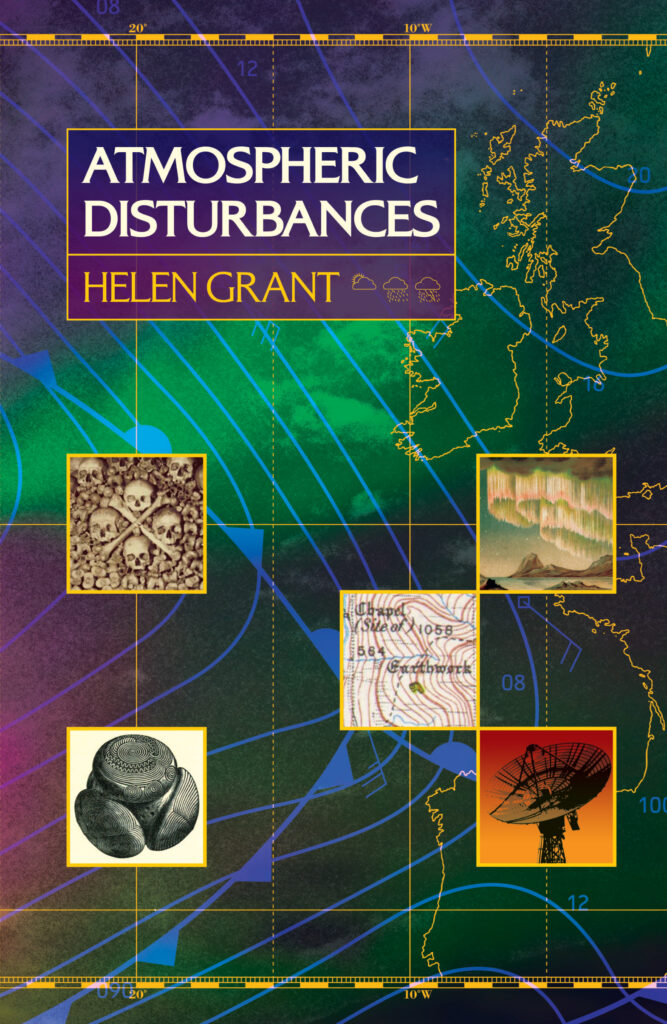
 The first was Atmospheric Disturbances by Helen Grant. Those of you who have been following Swan River will recall Helen’s previous collection, The Sea Change & Others (2013)—Atmospheric Disturbances is a worthy successor that I’m most pleased with. I think you will be too. Again, John Coulthart joins us for duties on jacket art. You’ll notice each of the images on the cover relates to a different spectral tale. John wrote a short blog post on the composition of this cover if you’d like to read it.
No reviews of Atmospheric Disturbances have turned up just yet, as the book is probably still dropping through people’s mail slots as I type this. Still, I expect a warm reception for this volume of suitable holiday chills. And if you want to know a little bit more about said chills, Helen gave a fantastic interview called “Excavating at the Edge of the World” about some of the themes and interests you’ll find in her stories: “I’m a bit obsessed with petrospheres! I find it extraordinary that there are these things which clearly took a lot of time and skill to make, and we don’t know what they were for . . . People have suggested that they were fishing weights or (that most irritatingly vague explanation) that they had some ‘ritual significance’, but we just don’t know.”
Helen was good enough to do a signed edition for us a well, which is something I like to do where possible. There are still copies left as of this writing. Overall, and in particular from a design point of view, I was pleased with how this book turned out. Let me know what you think!
(Buy Atmospheric Disturbances here.)
 The last hardback title that we published this year was the seventh instalment of our Uncertainties series, this time ably edited by Carly Holmes, whose work you’ll be familiar with from volume five. We’ve got a whole new crop of contributors this time around, including Georgina Bruce, Sarah Read, Philippa Holloway, Premee Mohamad, Bethany W. Pope, Jessica Hagy, and others. Again, no reviews just yet, but if you’re a fan of previous instalments of this anthology of strange stories by contemporary writers, I’m certain you’ll be pleased with this one.
I’m particularly delighted with the moody cover art by James F. Johnston. I’d long enjoyed James’s work, but as a musician rather than as a visual artist. For many years I’d been a fan of his main gig, Gallon Drunk, who I got to see perform their slinky chaotic hearts out back in 2007 at Whelan’s here in Dublin. And I also have to mention Big Sexy Noise, James’s project with the legendary Lydia Lunch. Their cover of Lou Reed’s “Kill Your Sons” possibly surpasses the original. Give it a loud listen. Anyway, when I saw that James was an excellent painter as well, I couldn’t resist pitching Uncertainties to him. He also kindly provided the images we used on our holiday card this year. Thanks, James!
Again, there are no reviews of Uncertainties 7 just yet, but pick it up and see what you think. In the meantime, you can read a group interview with the contributors where I asked, “What draws you to write tales in the weird/uncanny mode?” Their responses are here: “In an Uncertain Mode”. Carly also gave an insightful interview about the anthology: “The Past Is a Different Country”.
 (
(Which brings us to this year’s issues of The Green Book: Writing on Irish Gothic, Supernatural and Fantastic Fiction.
Issue 23 was comprised of a number of essays I’d had knocking about here for some time. It was high time they saw the light of day. James Clarence Mangan writes on Charles Maturin and Maria Edgeworth; John Irish contributed a piece on Fitz-James O’Brien; there’s an interview with Charlotte Riddell, and Mervyn Wall weighs in on Gerald Gardner and Harry Price. I’m particularly proud to have published a previously unknown poem by “Keith Fleming”, a writer about whom we are still learning. If you want to know more, check out the Editor’s Note.
 Issue 24 saw another batch of author profiles, this time featuring folks like Maria Edgeworth, Katharine Tynan, and Dorothy Macardle. I think these profiles are coming to an end—we’ve been running them since Issue 11. The goal is still to collect these profiles in a book, but that’s a long way off yet. The main feature of this issue is Fergal O’Reilly’s commemoration of Charles Robert Maturin, author of Melmoth the Wanderer, whose 200th death anniversary was 30 October 2024. There’s a fair bit of mystery surrounding his final resting place—Fergal digs deeper. Lastly, Bernice M. Murphy weighs in on the freshly restored and re-released Irish “folk horror” film The Outcasts (1982). It’s a peculiar film, worth seeing. Again, read the Editor’s Note if you’re curious.
We had quite a few paperback publications this year too. Twelve, actually. Hardbacks will always be our bread and butter, but it’s good to be able to keep these works available for new readers to discover. So here are the 2024 paperback titles:
Written by Daylight by John Howard
Here with the Shadows by Steve Rasnic Tem
The Dark Return of Time by R. B. Russell
Death Makes Strangers of Us All by R. B. Russell
Sparks from the Fire by Rosalie Parker
A Flowering Wound by John Howard
Green Tea by Joseph Sheridan Le Fanu
The Fatal Move by Conall Cearnach
Now It’s Dark by Lynda E. Rucker
Treatises in Dust by Timothy J. Jarvis
Lost Estates by Mark Valentine
Friends and Spectres edited by Robert Lloyd Parry
 For those interested in statistics, we published 6 new titles this year, totalling 1,176 pages; 2,300 copies; and 332,377 words. That includes this year’s issues of The Green Book (but not the paperback reprints).
This year we also finally abandoned Twitter. It just wasn’t fun there anymore. Instead, we’ve decamped to Bluesky and Threads. Please join us there. You can still find us on Instagram and Facebook, though on the latter we’re more active on the Swan River Press Readers Group than on the business page. You’re also welcome to join our newsletter.
Although I missed Fantasycon in Chester this year due to annoyingly rough health, I’m hoping to attend Eastercon in Belfast and World Fantasy in Brighton. I’ll post updates on our Forthcoming Events page. Will you be there?
And just to draw everyone’s attention to it, you can use the filters on our Titles page to see which books are on the Low Stock Report—the ones that won’t be around much longer. Better to pay the cover price than to be subjected to the secondhand market later.The filter menus are a handy tool, I use them quite a bit myself.
Of course, as always, I am grateful to the Swan River Press team: Meggan Kehrli, Jim Rockhill, Steve J. Shaw, and Timothy J. Jarvis. I’d also like to welcome John Kenny, who you might have noticed has been conducting recent interviews for us. These folks consistently make my job easier—and they’re a pleasure to work with too.
 Lastly, here’s a short piece I wrote on David J. Skal, who we tragically lost in January this year. It’s never too late to be grateful for all the fine scholarship he left us. I always think of him now whenever I hear the “Monster Mash”.
So what’s in store for next year? I like to keep tight-lipped until titles at least go to the printer. However . . . early next year I hope to publish a rather large project we’ve been working on for a good few years now. I sincerely hope people will be interested in it enough to buy it (’cause I’d like to be able to keep publishing after it!) The “large project” is a three-volume set of works by a classic Irish genre writer who is rarely looked at in the context of their entire fantastical output. I’ll leave it at that for the time being. I’ve got a bunch more exciting books planned too.
I know I say this every year, but thank you to all of you who have encouraged us this past year. It really means a lot. Publishing is not easy and, like the state of the world in general, it only seems to become more precarious and challenging. The best way to support us is to buy (and read) our books. It sounds so mercenary put that way, but there it is. It’s the best way to keep us going. So if you keep reading our books, we’ll keep publishing them. Until then, please stay healthy; take care of each other and your communities. I’d like to wish you all a restful holiday season, and hope to hear from you all soon!
Brian J. Showers
Æon House, Dublin
8 December 2024
 JK: I note that you’re a fan of M. R. James’s short stories and have spoken at a couple of conferences devoted to his life and work. I’m curious to know what aspects of his work you discussed.
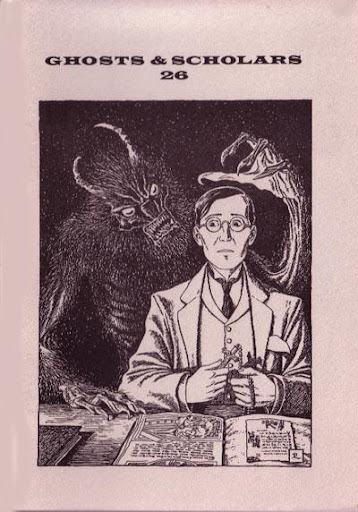 JK: Speaking of cinematography, your latest novel, Jump Cut, deals with a “lost” film called The Simulacrum. Is this an actual film? I read something about it online that seems to suggest it is.
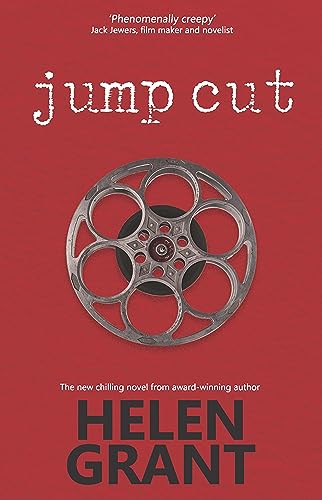 JK: The sense of place you create in your stories is vivid. particularly in stories like “The Valley of Achor”, “The Edge of the World”, and “Atmospheric Disturbances”. I see the setting for “The Valley of Achor” is Perthshire, where you live. Is there a burial mound or ruined chapel where you’ve mentioned it?
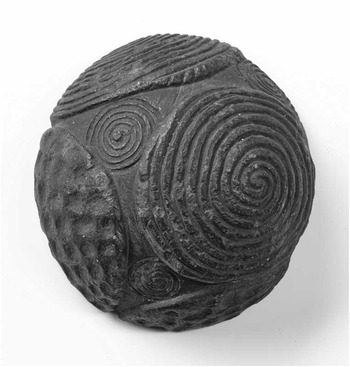 JK: Another story in the collection that uses a real object as its inspiration is “The Field Has Eyes, the Wood Has Ears”. There are a number of facets to the story that combine to generate a genuine sense of terror: the outbreak of Covid-19, the worsening migraine, the bizarre sketch by Hieronymus Bosch.
 HG: It’s interesting that you picked those stories out. I don’t say I never do pulp and gore (one of my recent stories for Nightmare Abbey was about carnivorous goldfish) but on the whole I think I tend towards the “less is more” approach. Letting the reader’s imagination do the work can be more effective than spelling it all out. At the end of “Mrs. Velderkaust’s Lease”, would the story be improved by describing what has happened in graphic detail? I don’t think so. I mean, Ellen Velderkaust herself doesn’t want to think about what has happened. Plus I think there is a risk of spilling over into the ridiculous. It’s taste, though, isn’t it? I guess some folks love to roll in gore . . .