In the late-nineteenth century Rosa Mulholland achieved great popularity and acclaim for her many novels (written for both an adult audience and younger readers), several of which chronicled the lives of the Irish poor. These novels, notably The Wicked Woods of Tobereevil (1872), incorporated weird elements of Irish folklore. Earlier in her career, she became one of the select band of authors employed by Charles Dickens to write stories for his popular magazine All the Year Round, together with Wilkie Collins, Elizabeth Gaskell, Joseph Sheridan Le Fanu, Hesba Stretton, and Amelia B. Edwards.
She was born in Belfast on 19 March 1841, the second daughter of a doctor (Joseph Stevenson Mulholland) whose family had become prosperous from textile manufacture. She was educated at home and studied art in South Kensington.
While living in London, Rosa published her first novel, Dunmara (1864), under the pseudonym “Ruth Murray”, and was personally encouraged by Dickens to begin contributing regularly to his bestselling weekly All the Year Round.
She wrote “Another Past Lodger Relates His Experience as a Poor Relation”, the third chapter of Mrs. Lirriper’s Legacy, the 1864 Christmas Number (which also contained Amelia B. Edwards’ classic “The Phantom Coach”), followed by “Not to be Taken at Bed-Time” for the 1865 Christmas Number, Doctor Marigold’s Prescriptions. This memorable Irish witchcraft horror tale became her best-known story following its appearance in The Supernatural Omnibus, edited by Montague Summers in 1931 and much reprinted.
“Not to be Taken at Bed-Time” was closely followed by two of Rosa Mulholland’s best ghost stories, “The Ghost at the Rath” (14 April 1866) and “The Haunted Organist of Hurly Burly” (19 November 1866).
Dickens serialised her novella “The Late Miss Hollingford” in All the Year Round from 4 April to 2 May 1868, and it was immediately reprinted in a Tauchnitz edition together with No Thoroughfare by Charles Dickens and Wilkie Collins. As “The Late Miss Hollingford” was not credited to any specific author, it was wrongly assumed by many readers to be the work of Dickens and Collins until it was eventually published separately in book form under Rosa Mulholland’s name in 1886.
Her next novel, Hester’s History, was serialised in All the Year Round from 29 August to 28 November 1868, and published in book form (as by R.M.) in 1869.
After Dickens died in 1870, Rosa Mulholland continued to write many stories for All the Year Round, notably “The Signor John” (Christmas 1871), “A Will o’ the Wisp” (Christmas 1872), and “The Country Cousin” (16 and 23 May 1874).
During the 1870s she began a productive career as a children’s writer, and these books are her most collectable and sought after today: The Little Flower Seekers, being adventures of Troy and Daisy in a Wonderful Garden by Moonlight (1871), richly illustrated by W. H. Frith, W. French, and F. E. Hulme; The First Christmas for Our Dear Little Ones (1875), with fifteen colour wood-engravings painted by L. Diefenback “richly executed in xylography”, and verse texts by Rosa Mulholland telling the Nativity story beneath each picture; and Puck and Blossom (1875), one of the earliest books to be illustrated by Kate Greenaway.
Among Rosa Mulholland’s later stories for All the Year Round were three notable examples written for the special “Extra Summer Numbers”; “The Mystery of Ora” (1 July 1879), a memorable supernatural tale, not reprinted until 2013; “A Strange Love Story” (3 July 1882), featuring reincarnation; and “The Hungry Death” (1 July 1880), a graphic macabre tale set on a remote Irish island during the 1840s famine.
When Rosa Mulholland left London to settle permanently in Dublin in the 1870s, she befriended Father Matthew Russell, S. J., who edited the Irish Monthly, and whose brother Francis (later Lord Russell of Killowen) was married to her elder sister Ellen Clare Mulholland, author of a dozen children’s books from The Little Bogtrotten (1878) to Terence O’Neill’s Heiress (1909).
Richard Dalby (1949-2017), born in London, was a widely-respected editor, anthologist, and scholar of supernatural fiction. He has edited collections by E. F. Benson, Bram Stoker, and Rosa Mulholland; and his numerous anthologies include Dracula’s Brood, Victorian Ghost Stories by Eminent Women Writers, and Victorian and Edwardian Ghost Stories.
An Extract from the Introduction by Maria Giakaniki and Brian J. Showers
Irish women have long produced literature of the gothic, uncanny, and supernatural. Bending to Earth draws together twelve such tales. While none of the authors herein were considered primarily writers of fantastical fiction during their lifetimes, they each wandered at some point in their careers into more speculative realms — some only briefly, others for lengthier stays.
Names such as Charlotte Riddell and Rosa Mulholland will already be familiar to aficionados of the eerie, while Katharine Tynan and Clotilde Graves are sure to gain new admirers. From a ghost story in the Swiss Alps to a premonition of death in the West of Ireland to strange rites in a South Pacific jungle, Bending to Earth showcases a diverse range of imaginative writing which spans the better part of a century.
There is a latent urge among literary scholars to define grand traditions in literature that sweep through the centuries. Joining the dots between one author’s influences on the work of another writer a generation thence makes for a tantalising and occasionally illuminating game. For some, these distinguished pedigrees are absolutely vital. Such contexts can give better understanding to the evolution of literary movements, the development of genres, and affinities between various coteries of writers.
Consider how much ink has been expended in an effort to prove whether or not Bram Stoker, author of Dracula (1897), had read or was definitively influenced by Joseph Sheridan Le Fanu’s “Carmilla” (1871-2). Sometimes connections can be delightfully subtle, such as recognising the spine of Lord Dunsany’s The Gods of Pegana (1905) in a photograph of C. S. Lewis posing before a bookshelf in his study. But establishing a conscious tradition — one author knowingly working in the wake of another in an unbroken chain — can be a difficult and frequently tenuous task. This is especially true when genre is concerned, where delineations are often already nebulous.
If a novel or short story displays only scant elements of a particular school of literature, it is granted the prefix “proto”; the author, usually long dead at the time of the pronouncement, may well find herself surprised by such an inclusion. The best one can do in some cases is make an informed speculation — though the peril here is that these assertions can transform over time, without further erudition, into assumed fact.
The present volume is subtitled “Strange Stories by Irish Women”, and its authors populate the better part of the nineteenth century. One might rightfully wonder if such a joined-up tradition can be delineated, and if the tales in this anthology constitute part of a literary continuum. In his essay on Irish literature for Supernatural Literature of the World (2005), Peter Tremayne makes the helpful observation that “Practically every Irish writer has, at some time, explored the genre for the supernatural is part of Irish culture.” Indeed, one would be hard-pressed to find an Irish author who did not, at some point, include elements of the fantastic in their work — be it supernatural, folkloric, surrealist, or something else. Naturally, this makes broad declarations a particularly challenging endeavour.
What we are more certain about is that the writers included in Bending to Earth were not considered during their lifetimes to be chiefly writers of fantastical fiction. Yet they each at some point in their careers wandered into more speculative realms — some only briefly, others for lengthier stays. Some of them, like Katharine Tynan, Ethna Carbery, and Dora Sigerson Shorter, were known primarily as poets. Others, such as L. T. Meade, and Clotilde Graves deliberately wrote for more general popular markets; while the likes of Lady Wilde and Lady Gregory — perhaps now the most commonly known — linger in the Irish national psyche for their explorations of legends and folklore.
And then there are writers whose posthumous reputations have been sustained through the years solely on the merits of their supernatural tales, their once mainstream writings now almost entirely abandoned by modern readers. In 1882 Charlotte Riddell published her seminal collection, Weird Stories, and her supernatural novellas are still celebrated for their effectiveness. Meanwhile, Riddell’s realist mainstream novels have faded from memory, outside the cloistered world of scholars and academics. Similarly, the ghostly writings of Rosa Mulholland and B. M. Croker were kept alive, with varying levels of success, by the industrious efforts of twentieth-century anthologists, while the remainder of their works passed into the afterlife of the unfashionable from which they seldom return.
In compiling this anthology of strange tales, we sought stories by Irish women writing in the broader range of the darkly fantastic. We focused on the merits of each writer and their contribution, arranging stories in a sequence that we hope makes for an agreeable read. As one might expect, these selected tales reflect the diverse backgrounds, experiences, and preoccupations of each author. While there might not be a formal pedigree in the supernatural tradition, there is certainly a more ethereal sense of connection that characterises these writers and their offerings to strange literature.
Read more about our Strange Stories by Irish Women poster here.
Maria Giakaniki is an independent scholar and editor-in-chief of Ars Nocturna, a small publishing house in Athens that focuses on Gothic fiction. She has compiled and co-translated Gothic Tales by Victorian Women Writers and Gothic Tales by Modern Women Writers.
On this day, 23 October 1869, readers of All the Year Round, edited by Charles Dickens, may well have been unprepared for a chilling tale of paranoia and despair that commenced in Mr. Dickens’s weekly journal. That story was “Green Tea”, and though it was originally published anonymously, it was penned by the Dublin writer Joseph Sheridan Le Fanu.
While Le Fanu is probably now better known for his pre-Dracula vampire novella “Carmilla” (1871/2), for me “Green Tea” will always be his masterpiece. The story tells of the good natured Reverend Mr. Jennings, whose late night penchant for green tea brings on a curious malady—that of opening the interior eye. The Reverend Mr. Jennings finds out that, in opening the interior eye, genii of the infernal plane can also perceive the world of man, and soon he is plagued relentlessly by a demonic chattering simian. For the delight of hell is to do evil to man, and to hasten his eternal ruin.
“Green Tea” was collected (along with Carmilla”) in Le Fanu’s most famous volume, In a Glass Darkly (1872), one of the author’s final books before he died in February of 1873. “Green Tea” has since become a staple of horror anthologies, gaining admirers from Dorothy L. Sayers to V. S. Pritchett.
For the story’s 150th anniversary, I wanted to create an edition worthy of such a powerful tale. My first port of call was Matthew Holness, known to many for his horror send-up Garth Marenghi’s Darkplace, but also as the writer/director of Possum, one of the most emotionally chilling horror films I’ve ever seen. Holness is a long-time admirer of Le Fanu, which is why it seemed natural to ask him to write an introduction for our new edition. We’d also previously worked together on a volume in 2014 for the bicentenary of Le Fanu’s birth: Reminiscences of a Bachelor.
That same year I asked Reggie Chamberlain-King of Belfast’s Wireless Mystery Theatre if he would adapt “Green Tea” as a radio drama. He did this, and the piece debuted at Toner’s Pub that August. I’d been searching for an excuse to record this wonderful adaptation, and when work on the new edition began, an opportunity had finally manifested. Each copy of our new edition of Green Tea will be issued with a CD of this magnificent recording.
Then there are the illustrations of Alisdair Wood, with whom I worked on November Night Tales by Henry C. Mercer. As with Holness, working with Wood again seemed an obvious choice. His pen and ink style is reminiscent of magazine illustrations from the nineteenth century. For the book, Wood created twelve original illustrations, plus the book’s striking cover.
Rounding out the volume, Jim Rockhill and myself once again teamed up to write a pair of afterwords to explore the publication history and contemporary reception of “Green Tea”. We had previously done the same for Reminiscences of a Bachelor. Rockhill has long worked as a Le Fanu scholar, with perhaps his greatest achievement being a three-volume complete stories of Le Fanu, published by Ash Tree Press (2002-2005). It was great fun looking at “Green Tea” in depth. As always, we hope you find our scholarship illuminating, possibly even useful to your own explorations.
Other features found their way into the design. For example, the monogram on the full title page is from Le Fanu’s letterhead; and on the signing page, signed by all contributors, we’ve reprinted a facsimile of the author’s signature—I’m afraid the best we could do under the circumstances. The rest of us have signed the page ourselves. I did, however, take the opportunity to visit Le Fanu’s vault with the signing pages before they were bound into the books. There they rested while we enjoyed a freshly brewed cup of green tea (a pot of which I am drinking now. In moderation, of course).
Further instalments of “Green Tea” were published in All the Year Round over the subsequent three weeks in 1869: 30 October, 6 November, and 13 November. While you may have read this story before, we hope you’ll make time this season to return to its pages. For “Green Tea” Le Fanu holds no punches: exploring as he does the absolute limits of a man dogged by a fiend from hell, caught in the enormous machinery of a malignant universe. This is no cosy ghost story, no pleasing terror. The climax in “Green Tea” remains one of the bleakest in all of supernatural literature.
Swan River Press’s deluxe hardback edition of Green Tea, in celebration of the story’s 150th anniversary, is now available on our website www.swanriverpress.ie.
If you’d like to read more about Joseph Sheridan Le Fanu, please see our previous post here.
And don’t forget to check out our journal The Green Book (Writings on Irish Gothic, Supernatural and Fantastic Literature), past issues of which have featured J. S. Le Fanu and his work.
One perennial question about genre fiction centres around the notion of “tradition”: the influence authors and their works have on the next generation, and so on down the line. In posing this question, we ask whether or not an unbroken literary pedigree can be established. For example, an excessive amount of energy has been expended exploring links, both legitimate and spurious, between Le Fanu’s “Carmilla” (1871/2) and Stoker’s Dracula (1897) — and believe me, this seems to be an all-consuming pastime for some. But to me, Irish genre fiction has always seemed more a web of thematic shadows, authorial echoes, even social links, rather than a series of linear connections.
Those who read the editor’s note in Issue 12 will recall our endeavour to serialise biographical/critical sketches of Irish writers, which commenced in Issue 11. These entries are the results of an on-going project tentatively called the Guide to Irish Writers of Gothic, Supernatural and Fantastic Fiction, edited by myself and Jim Rockhill. What form this project will ultimately take is still uncertain, but until then we will continue to share the results here. This issue continues with fourteen further such entries, a new crop of names featuring authors with whom readers of The Green Book might already be acquainted, such as Cheiro and A.E., while the likes of Beatrice Grimshaw and Mary Fortune may be less familiar — but whom I hope you will find no less fascinating.
Earlier this year Swan River Press published Bending to Earth: Strange Stories by Irish Women, which I co-edited with Maria Giakaniki. In the introduction to that volume are more musings on the Irish genre tradition, or rather how Irish authors, with their disparate blossomings, are still connected through conversations in the margins. Indeed, with Ireland being such a small country, there are countless such communications between its authors, both direct and indirect. As you read this issue’s entries, along with those in previous instalments, you’ll certainly notice myriad connections and crossovers in the frequently overlapping lives of these authors and their writings.
Back in Issue 12, I outlined the criteria Jim and I used to select authors for consideration. The difficulty in this lies with the definitions of both “Irish” and “fantastical literature” — in the end always a fool’s errand. We continue to err on the side of inclusivity, fully aware that we cannot please everybody.
While editing this issue, the question of inclusivity reared its head when I noticed that, although we’ve a contributor line-up of the usual, impressive quality, there wasn’t a single woman among them. This is a glaring shortfall, one for which I, as editor, take full responsibility. The entries in Issue 13 are the sum total of what was available at the time of publication. Nevertheless, this is not a reasonable excuse for such a discrepancy. So with that in mind, I take this opportunity to remind people that The Green Book is open for submissions. And I would like to urge women in particular to submit. There are still a number of authors for whom we need entries, so please contact me for a current list of availability. General submission guidelines can be found on the last page of this issue, and also on our website. I hope this gender imbalance is something I can begin to redress in future issues.
As with each issue, I hope you will find something of interest, discover new authors, and that your list of books to read will grow ever longer.
Occasionally I like to write about how a Swan River book can come together. Back in 2015, I wrote a short piece on how we assembled our edition of Lafcadio Hearn’s Insect Literature, a beautiful book that is now unfortunately out of print. (Though you can still read about how we put it together!)
This time I’d like to write a little about Selected Poems by A.E. (George William Russell, 1867-1935), which we published in April 2017 to coincide with the bicentenary of the great poet’s birth.
A few years prior to the sesquicentenary, I realised there was no proper edition of A.E.’s work in print. Sure, a few cheap print-on-demand volumes of his mystical writings are floating about, but let’s face it, the content of those sort of things can be dodgy at the best of times, often going unedited and rarely even proofed or decently typeset. Caveat emptor. And given that A.E.’s work is no longer fashionable in the Irish literary world, I knew that a new edition done right would be up to Swan River.
I can remember the precise moment I decided to reprint A.E.’s work. My house isn’t too far from Mount Jerome Cemetery, in south Dublin, where A.E. was laid to rest on 17 July 1935. As I was stooped down to remove clumps of moss and other debris from the chipped stone atop his grave, the thought entered my mind: in 2017 I would reprint something by Ireland’s foremost mystical poet. But what? Would I create my own selection? Ask a contemporary poet to complete such a task? Or maybe I would reissue a prose work, such as his thin short story collection The Mask of Apollo (1905). I did not ponder this question for long. A definitive answer arrived a few weeks later.
Over the years I have amassed quite the collection of first editions of A.E.’s work. Shortly after that visit to his resting place I found a first edition copy of Selected Poems, originally published in autumn 1935, just a few months after its author died. This particular copy of Selected Poems still had its original dust jacket, on which were inscribed the words: “If I should be remembered, I would like it to be for the verses in this book. They are my choice out of the poetry I have written.” It would appear A.E. himself had given me the answer. I decided then and there to honour the will stated so clearly before me.
The painting of A.E. on the cover of Selected Poems is by the husband of Constance Markiewicz: Count Casimir Dunin Markiewicz (1874-1932). The original is held by the Hugh Lane Gallery in Dublin, and just so happened to be on display at the time I was working on this project. So I wandered up one weekend to have a look. After I had seen the painting, it struck me that perhaps we could re-interpret the 1935 jacket, reproducing Count Markiewicz’s painting, but of course this time in colour. The gallery kindly obliged, and so the project began to take shape.
Next I asked Meggan Kehrli, Swan River’s long-time designer, to lift the typeface of the title, author’s name, and inscription from the cover of the first edition jacket. We did this trick for both Insect Literature and Longsword, and it works pretty well. Although most readers won’t necessarily notice this subtle design choice, I like knowing it’s there. Of course you can compare the two covers above to see both their similarities and differences.
On the title page we reprinted the “Sword of Knowledge”. This emblem, a downward-pointing winged sword designed by the poet, is emblazoned on the free front end papers of Cuala Press’s multiple A.E. volumes. The keen-eyed will notice that it is also carved into the lower right-hand corner of the poet’s tombstone. It only seemed appropriate to include it on our title page as well.
Finally there was the question of the printed paper case — that’s the image that’s printed onto the boards underneath the dust jacket. It’s become a feature of all Swan River books that this image is different from that on the jacket cover, allowing readers to discover something beneath the jacket of each of our books. Given that A.E. also produced a wealth of beautiful paintings depicting his visionary experiences, I started the search to find the perfect picture.
Again, I didn’t have to search too long before I found what I was looking for at the National Gallery of Ireland. There they had one of A.E.’s paintings given the rather uninspired posthumous title “A Landscape with a Couple, and a Spirit with a Lute”. Of course the painting depicts exactly that — but for the purposes of our project it spoke of so much more. It was perfect. The golden figure, with its radiant headdress and lute, appearing before an awestruck pair, seems to me the very embodiment of Song, an extension of the mysticism A.E. also sought to express in his writing.
Just as A.E.’s poetry and prose were glimpses behind the veil, so too did I want a scintillating image beneath our purposefully staid dust jacket — so that each reader here too could glimpse behind the veil, turning the cover into a sort of interactive metaphor. In the photo at the left you can see the book with the jacket both on and off.
Needless to say, Selected Poems by A.E. is a book that I’m quite proud of, and I hope you like it too.
After that visit to Mount Jerome, the book just sort of came together. The elements I required materialised as I needed them, and the finished volume was published on 10 April 2017 — just in time for the poet’s 150th birthday. This project was, for me, an exceedingly special one. I would like to think that A.E. himself would be proud of this book.
If you’d like to read more about A.E., including who he was and why he is an important contributor to Irish literature, I wrote another piece about him that you can read here.
The end of the 2017 is upon us and I’d like to take a moment to look back at the books we’ve published over these past twelve months. While I’ve always defined Swan River as an Irish press, this year all of our books were either by Irish authors or have a strong Irish connection.
The publication date of our first book was pre-determined: the Selected Poems of A.E. (George William Russell). Last April was the 150th birth anniversary of Ireland’s under-appreciated mystical poet. And as no other edition of his books were properly in print, I knew it fell upon us to do something to mark the occasion.
The genesis of this book dates a few years back. I was casting around for an A.E. project to mark the sesquicentennial year, and for a brief time considered assembling a collection of my own favourites. That’s when I acquired a first edition of Selected Poems, the dust jacket of which bore a request from the poet himself: “If I should be remembered I would like it to be for the verses in this book.” So that’s exactly what I did. On the boards is reproduced a painting by A.E., and rounding out the book is an excellent afterword by Ambassador Dan Mulhall. If you’re interested in learning more about A.E., we’ve a few past blog posts for you to check out.
Our next book was a real pleasure to work on. Following on from the success of Mervyn Wall’s beloved cult classics, TheUnfortunate Fursey and The Return of Fursey, I wanted to bring back into print his equally delightful short story collection A Flutter of Wings, which hadn’t been available for over forty years. To this new edition we added Wall’s nightmarish bureaucratic drama, AlarmAmong the Clerks, which had been out of print for an alarming seventy years.I hope people will like this book as much as the Furseys.
What makes this edition even more special are the illustrations by Clare Brennan. In addition to being an excellent artist and designer, Clare has the distinction of being Mervyn Wall’s granddaughter. If you like Clare’s illustrations for A Flutter of Wings, you’ll be delighted to know prints are available to buy from her website. And of course, with an introduction by Val Mulkerns, this book has become one of my favourites of the year.
In November we were happy to publish a new collection by Bram Stoker: Old Hoggen and Other Adventures. It’s not every day a new collection of short stories by Stoker gets published, which is what makes this book extra special. It brings together for the first time a number of adventure tales that have been rediscovered in recent years. You can read more about how the “lost” volume of stories was assembled, and its relationship to Dracula’s Guest and Other Weird Stories, in the Preface. Old Hoggen also provided a joyful opportunity to work with Stoker scholar John Edgar Browning, who has been leading the charge in all things Bram in recent years. The striking cover is by long-time Swan River conspirator Jason Zerrillo, who I’m sure we’ll see more from in the new year.
The final book of the year was The Scarlet Soul: Stories for Dorian Gray, an anthology edited by Mark Valentine and including ten new stories of art, obsession, love, lust, and sorcery by Reggie Oliver, Caitriona Lally, Lynda E. Rucker, John Howard, D. P. Watt, Rosanne Rabinowitz, Avalon Brantley, Timothy J. Jarvis, John Gale, and Derek John. In addition to this fine volume of tales, which I hope you will enjoy, this book is the first time I’ve worked with artist John Coulthart, who designed the front cover and boards.
Turning now to our journal, The Green Book, which has now entered the double digits! Issue nine focused on Irish women writers, with included, among other pieces, two essays by Elizabeth Bowen, an article on Rosa Mulholland by the late Richard Dalby, and an uncollected story by Dorothy Macardle called “The Boys’ Room”. Issue nine was one of the strongest issues we’ve had to date.
Issue ten, published in the autumn, was devoted to the fantasist Lord Dunsany, and comprised of writings about him by his contemporary Irish peers. With pieces by W.B. Yeats, Francis Ledwidge, Forrest Reid, Elizabeth Bowen, Katharine Tynan, and others, my intention was to remind readers that Dunsany once held a firm position in early-twentieth century Irish literature. I hope people read this issue from cover to cover as it illuminates Dunany over the course of his entire career.
While not a book publication, another project that came to fruition this year was the Irish Writers of the Fantastic poster that I designed with Jason Zerrillo a couple years back. The poster showcases twelve writers, spanning three centuries, each of whom made significant contributions to Irish literature.
While the poster was designed in late 2015, it wasn’t until this October that Alison Lyons of Dublin City Libraries and Dublin UNESCO City of Literature agreed to produce copies of the poster to distribute for free around Dublin, coinciding with the Bram Stoker Festival. Copies of the poster are still available, and I urge everyone (especially if you’re a teacher or librarian!) to pick up a copy. Absolutely free! For those living abroad, there are other ways of procuring a copy.
This post wouldn’t be complete without thanking Meggan Kehrli, Ken Mackenzie, Maurice Healy, and Jim Rockhill for all the work they’ve done this year. For those who don’t know, these are the folks who make Swan River books look so good. Meggan handles all of our design, Ken takes care of the typesetting, while Jim looks after proofreading. Maurice only recently joined us this year, and has proven invaluable. On a sadder note, most will have heard by now that Richard Dalby passed away earlier this year. Richard acted informally as an advisor, as he did for many small presses, and the void that he leaves behind will be sorely missed.
So there you have it! That’s what we got up to this year, and I hope you found something to enjoy. There’s plenty to look forward to next year as well. We recently announced our forthcoming deluxe edition of William Hope Hodgson’s The House on the Borderland, which will be out for April 2018. I’ve spared no expense with this one, which will bear a cover and interior illustrations by John Coulthart, accompanied by a newly commissioned soundtrack by Jon Mueller. Not stopping there, Alan Moore contributed a new introduction, while Iain Sinclair is looking after the afterword. Everyone who participated in this project has a passion for Hodgson’s cosmic masterwork. As an added bonus, the book will be fully signed by all contributors.
And perhaps the biggest new for next year is the return of the Dublin Ghost Story Festival. I’m very excited that the guest of honour will be Joyce Carol Oates, with an opening night performance by Reggie Oliver. Even if next year’s festival is only half as fun as last year’s, we’ll be in for a huge treat. The event is already half sold-out, so if you’d like to attend, please don’t delay! We’ll be announcing further guests in the coming weeks. You’ll not be disappointed!
So that’s everything for now. Thank you again to everyone who contributed to the press this year, be it through buying books, supportive emails, or even coming out to see us at festivals and conventions. I’m looking forward to new books and hearing from everyone in the new year.
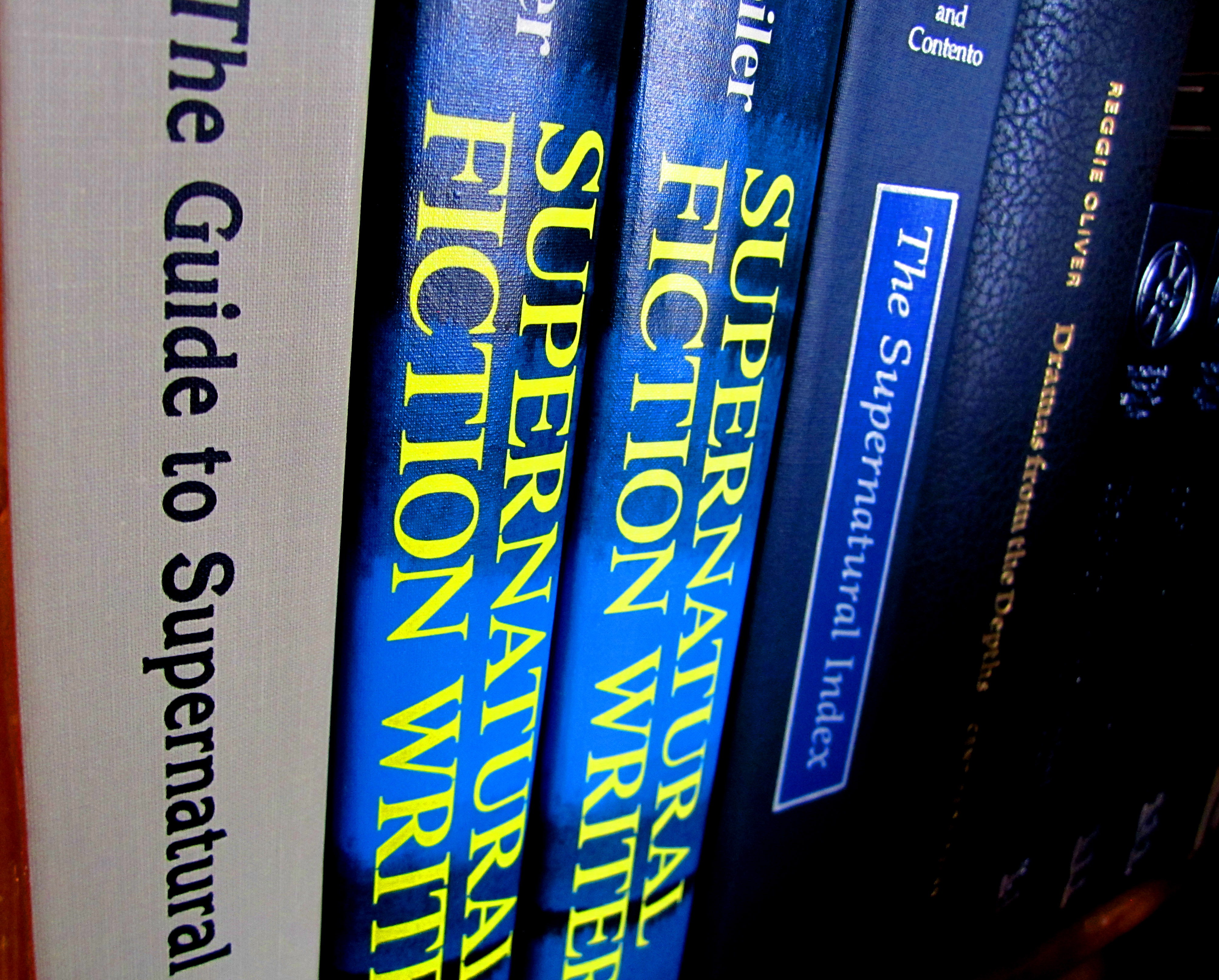
I’ve long been a fan of checklists, indicies, bibliographies, literary guides, and genre studies. From Lovecraft’s Supernatural Horror in Literature to E.F. Bleiler’s Guide to Supernatural Fiction, and many more besides. One can spend hours immersed in these books, discovering new avenues for exploration and making mental notes on obscure titles to look out for. My shelves groan with these sorts of volumes, and despite severe bowing in some places, I don’t regret it one bit.
Those of you who regularly peek at this blog might also recall the poster I designed with Jason Zerrillo a couple of years back featuring “Irish Writers of the Fantastic”. It was a reaction to the all-male “Irish Writers” poster and the subsequent all-female response. The goal of the exercise was to promote genre writers from Ireland. Naturally with posters there are some restrictions, and for one reason or another we couldn’t include everyone we would have liked without turning a simple poster into a city block-length mural.
Well, I decided to do something about that. For the past few months I’ve been in the early stages of assembling an “Encyclopaedia of Irish Writers of Fantastic Literature”. Loosely inspired by E.F. Bleiler’s Supernatural Fiction Writers and Jack Sullivan’s Penguin Encyclopedia to Horror and Supernatural, my first step was to compile a list of authors who I felt in some way contributed to Irish fantastic fiction. This list includes obvious writers such as Bram Stoker and Elizabeth Bowen, but also writers who are less well known, or whose contributions might not have had such a detectable effect on their peers.
Naturally any such list will be highly idiosyncratic. I have chosen to focus primarily on fiction. Generally I’ve erred on the side of inclusion (if only because someone once told me that the Dublin-born painter Francis Bacon “wasn’t really Irish, now was he?”). On the whole I have shied away from oral tradition, mythology, and folklore. No doubt these modes have had a profound impact on Irish literature, but to include them would make scope of the project unwieldy. I am also keeping away from Irish science-fiction, not only due to my lack of knowledge on the subject, but because Ireland’s contribution to that genre could easily fill a book on its own. That said, do expect occasional overlaps.
While I have contributors for most of the entries on my list, there are a handful of yet unclaimed authors who need to be written about. This is where you come in. If you’re interested in and have the ability to write such an article, I would love to hear from you. I’ve currently got a list of 75 writers, with a growing roster of contributors that currently numbers around 25.
I do appreciate enthusiasm, but when writing please tell me a bit about your background qualifications and interest. I’ll be glad to tell you more about the project and which entries are available. Generally speaking, the deadline for articles is 1 December 2017 and the article length should be around 2,000 words depending on the author. There is payment involved.
If you have any suggestions for authors to include, I would be happy to hear them, along with rationale as to why they should be included. And if you’re interested in writing about your suggestion, all the better! I’m looking forward to hearing from you.
Finally, anyone with an interest in Irish genre fiction might like to know that Swan River Press publishes a twice-yearly journal called The Green Book: Writings on Irish Gothic, Supernatural and Fantastic Literature. You might find something of interest!
“Ce qu’on aime le mieux dans Yeats, ce sont ses vers. Mais le chef-d’œuvre d’A.E., qui est un grand artiste, c’est encore lui-même.” – Simone Téry
The poet, painter, political philosopher, and mystic George William Russell (1867-1935)—better known as “A.E.”—was no stranger to divine visions and secret wisdom. Often he oracled out of his shadow these revelations to friends and fellow writers: how he bore witness to a “dazzling processions of figures, most ancient, ancient places and peoples, and landscapes lovely as the lost Eden”; or how in his youth the “rock and clay were made transparent so that I saw lovelier and lordlier beings than I had known before and was made partner in memory of mighty things, happenings in ages long sunken behind me”. Even Russell’s pen-name—“A.E.”, an esoteric sigil imbued with cosmic mystery as much as it is a nom de plume—came to him in a moment of transcendental significance.
In his Memoir of A.E. (1937), John Eglinton—pen-name of William Kirkpatrick Magee, who worked for the National Library of Ireland from 1904-1921—recounts the origin of A.E.’s pseudonym:
He began to paint his visions, and had been attempting an ambitious series of pictures on the history of man, in one of which he “tried to imagine the apparition in the Divine Mind of the idea of the Heavenly Man”, when, as he lay awake considering what legend he should write under the picture, something whispered to him “call it the Birth of Aeon”. Next day the entire myth “incarnated in me as I walked along the roads near Armagh”.
A.E. continues his story of self-genesis in his chapter on “Imagination” in The Candle of Vision (1918), describing the effects of this epiphany:
The word “Aeon” thrilled me, for it seemed to evoke by association of ideas, moods and memories most ancient, out of some ancestral life where they lay hidden; and I think it was the following day that, still meditative and clinging to the word as a lover clings to the name of the beloved, a myth incarnated in me.
That day an awareness embedded itself in the fervent mind of the adolescent. Not long after, Russell experienced another event that would transform the young man from Lurgan into Ireland’s visionary poet of the Celtic Revival:
I returned to Dublin after a fortnight and it was a day or two after that I went into the Library at Leinster House and asked for an art journal. I stood by a table while the attendant searched for the volume. There was a book lying open there. My eye rested on it. It was a dictionary of religions, I think, for the first word my eye cause was “Aeon” and it was explained as a word used by the Gnostics to designate the first created beings. I trembled through my body.
Unfortunately neither Eglinton’s account, nor A.E.’s are given dates. However, that Russell initially requested an art journal is not surprising. From October 1883 until the summer of 1885, he was enrolled at the Dublin Metropolitan School of Art in Kildare Street; and from 1885 until 1887, he attended evening sessions affiliated to the Royal Hibernian Academy. The building that housed the Metropolitan School of Art, now non-extant, at the time stood across the road from the library. The National Library of Ireland currently (and appropriately) houses a substantial archive of A.E.’s manuscripts, letters, and artworks—all accessible to the public. Go see A.E.’s papers if you have the opportunity.
At the time of A.E.’s now mythic revelation, the National Library was located in Leinster House, presently occupied by the Houses of the Oireachtas. In September 1890, the collection was relocated to the north wing of Leinster House, an extension added to the central structure in the late-nineteenth century, where it remains to this day. This is where I found myself one afternoon doing research for Swan River Press’s anniversary edition of A.E.’s Selected Poems.
While the old catalogue remains available—tall, tattered books with pleasantly loose hinges lining the shelves just inside the reading room—the modern catalogue can be accessed online or via the computer terminals adjacent their analogue ancestors. That afternoon I had a revelation of my own. It seemed a reasonable assumption that not only would A.E.’s “dictionary of religion” still be in the library’s collection, but I should also be able to call it up from the stacks.
I conducted a search for book titles containing the words “dictionary of religion” published between the years 1780 and 1890. Among the results I found two possibilities.
The first was A Classical Dictionary of Hindu Mythology and Religion (Trübner, 1879) by John Dowson. Given A.E.’s life-long reverence for the Bhagavad Gita, Upanishads, Theosophy, and the eastern religions, this book seemed a sound likelihood, and so I put in a request to see it. There is, however, no entry for “Æon” to be found in this volume.
Courtesy of the National Library of Ireland
The other option was the aptly titled Dictionary of Religion (Cassell, 1887) edited by the Rev. William Benham, B.D., F.S.A., Canon of Canterbury; and Rev. J.H. Blunt (the latter editor indicated only in the preface and by an emendation lightly pencilled in on the title page). This book is described in the library’s catalogue as “An Encyclopaedia of Christian and other Religious Doctrines, Denominations, Sects, Heresies, Ecclesiastical Terms, History, Biography, etc. etc.” I scribbled the call number (203 b1) onto the slip and waited for the book to arrive. I took a desk in the reading room and switched on the green-shaded Emeralite lamp.
What the porter brought out was a thick octavo, cleanly bound in black leather with gold lettering on the spine. I thumbed through the leaves until I reached page sixteen. The first bolded-black word that my eye rested on was at the very top of the page. I trembled through my body:
Æon.—An “eternal being”; the name given to the “emanations” from the Supreme Being in the Gnostic system.
Could this be not only the book that Russell chanced upon, but even the actual copy? The entry for “Æon” was there, the definition similar to what he later recalled, and it was published in the late-1880s while Russell was still an art student—this all seemed to fit my theory. But what other information could I find?
The National Library’s copy of The Dictionary of Religion bears three purple stamps, two of which are topped by a royal crown. The first bears the date “26 AUG 87”, an accession stamp indicating the library acquired the volume on 26 August 1887. The preface by Benham is dated March 1887, and so the book was probably published during late spring or early summer of that year.
Courtesy of the National Library of Ireland
The second stamp, also under a crown, reads “BOUND 22 APR 92”; while in the downward horseshoe design of the third stamp is printed “BOUND 25 JUN. 1900”. A duty librarian confirmed that these latter two stamps indicate the book was twice rebound.
I left the library that afternoon pleased that I had found and held in my hands a unique volume, one that rested inconspicuously in the stacks of the National Library for well over a century. A book which I hoped might be removed from the general collection and re-catalogued with the A.E. manuscripts in special collections. A book that seemed to me most definitely a literary relic. Alas, this elation would last only until I got home to my own library, and from these otherwise faithful volumes a single uncertainty emerged . . .
A.E.’s own recollection in The Candle of Vision wasn’t published until 1918, but that evening I found a reference to a more contemporary account of the burgeoning artist’s chance discovery in a letter to fellow esoteric explorer Carrie Rea:
I was thinking of what would be the sound for the most primeval thought I could think and the word “aön” passed into my head. I was afterwards surprised at finding out that the Gnostics of the Christian Era called the first created being “Æons” and that the Indian word for the commencement of all things is Aom.
This extract is from a letter dated December 1886, and appears as a footnote on page fourteen in Henry Summerfield’s highly-recommended biography of A.E., That Myriad Minded Man (1975). If the date on this letter is correct, then it predates the publication of Benham’s Dictionary of Religion by some five or six months. Although A.E. does not mention a “dictionary of religion” in this extract, or even the arcane happenstance in the National Library, he does imply that he was already familiar with the definition of the word “Æon”.
What to make of this?
My wholly unsubstantiated intuition tells me that A.E. did in fact consult Benham’s Dictionary of Religion, and that later recollections were an intentional conflation of events for the purpose of self-mythologising—something of which his kindred soul W.B. Yeats was also guilty. It is also perhaps significant that A.E. became acquainted with Yeats in mid-1884 while attending the Metropolitan School of Art. The two became deeply imbued with esoteric thinking—cf. Summerfield, “The two young men would discuss such subjects as the nature of the cosmic sounds that stimulated the growth of mushrooms.” Such an embellishment of one’s own origin of character, as detailed by A.E., must have seemed natural and indeed even appealing.
But as evidenced in the letter to Rea, A.E. must have come across the word “Æon” much earlier than he would lead us to believe thirty years later in The Candle of Vision. His happening upon Benham’s Dictionary of Religion in the National Library, while still possibly by chance, might nevertheless have led to an intentional, if idle, looking-up of “Æon” while waiting for that art journal.
I hasten to add, if I am correct, that this does not dismiss in any way the epiphany or inspired choice to focus on “Æon” as his true name. After all, Æon seems to have been embedded in his psyche much earlier, and should not diminish A.E.’s National Library experience in any way.
So perhaps the recounting in The Candle of Vision was a conscious attempt at streamlining or telescoping a personal mythology? I have not yet been able to locate the original manuscript of the Rea letter—but I wouldn’t mind verifying the date and reading the rest of it just to be sure.
Curiously this letter to Rea is not included in Letters from A.E. (1961) edited by the meticulous scholar Alan Denson. The earliest missive collected in Denson’s book signed as “AE” (instead of “Geo. W. Russell”) was written to Helena Blavatsky, co-founder of the Theosophical Society, which A.E. later formally joined. Though dated 6 November 1888, it appeared in the December 1888 issue of Lucifer, the society’s monthly journal edited by Blavatsky, and is generally considered the first time Russell used his new identity in print.
A second letter to Blavatsky signed “A.E.”, apparently written in December 1888, appeared in the January 1889 issue. But Summerfield notes that it wasn’t until February 1893, following his admission to the Theosophical Society’s Esoteric Section, that Russell started using his pen-name regularly, perhaps then recognising fully the power and significance of his two chosen letters.
Although Russell initially preferred the diphthong—“Æ”—typesetters persistently divided the letters—“A.E.” Ultimately Russell accepted this easier transcription. He both signed himself with the letters separated, and published the majority of his books using the latter rendering.
Russell’s first volume of poetry, Homeward, Songs by the Way, appeared in 1894 under the name A.E. So too did his second collection of verse, The Earth Breath (1897), his social commentary The Dublin Strike (1913), his political volume The National Being (1916), and so on. A.E. continued to use this sacred identity, his “true face”, not only to sign his poetry, but also his paintings, books, political pamphlets, letters to newspaper editors and friends alike, etc. etc. Whatever may or may not have occurred in the National Library in the 1880s, one thing is for certain: George William Russell had become A.E.
By 1925, the prescient French journalist Simone Téry observed:
Have you doubts regarding Providence, the origin of the universe and its end? Go see A.E.—Are you seeking information on Gaelic literature, the Celtic soul, Irish history? Go see A.E.—Are you interested in painting? Go see A.E.—Do you want to know the exports of eggs . . . or how best to cultivate bees? Go see A.E.—Do you find society badly run, and want to better it? Run to A.E.’s . . . You doubt yourself? Find life insipid? A.E. will give you confidence, will comfort you.—Do you need a friend? A.E. is always there. (L’Île des bardes, trans. R.M. Kain)
But by the close of the twentieth century, A.E. had been reduced in popular memory to little more than a footnote in Ulysses. In episode nine, “Scylla and Charybdis”, Joyce refers to Russell as “A.E.I.O.U.”, a playful allusion to the bearded sage of Dublin as much as to Joyce’s debt to A.E. for publishing his first stories in The Irish Homestead, stories which were later collected in Dubliners.
Yet despite all this, the name A.E. is still imbued with a certain magic, a presence that gathers around it the like-minded, drawing with a natural magnetism, ears straining to hear old traces of the new songs of Ireland. And just as they did during his lifetime, readers, historians, writers, mystics, activists, poets, students, journalists, organisers, politicians, artists, and the open-minded are still discovering kinship in A.E. and his works.
As for me, I still have one lingering question: Did I find the right book in the National Library? I have further theories, and you’re more than welcome to ask me about them some day. But if you’re looking for an answer now . . . Go see A.E.
This article originally appeared on the Irish Times website on 10 April 2017.
Swan River Press’s deluxe hardback edition of Selected Poems, in celebration of A.E.’s 150th birth anniversary, is now available on our website www.swanriverpress.ie.
If you’d like to read more about A.E., please see our previous post here.
You might also be interested in A.E.’s short essay, “The Making of Poetry”, which you can read here.
And don’t forget to check out our journal The Green Book (Writings on Irish Gothic, Supernatural and Fantastic Literature), past issues of which have featured A.E. and his work.
The following article by Fred Henderson was first published in the Eastern Daily Press (Norwich) on 19 July 1935, just two days after A.E.’s death. We reprint it here on the cusp of A.E.’s 150th birth anniversary.
Most of the papers to-day, in announcing the death of the famous Irish poet, George Russell—better known to the lovers of beauty in literature all the world over as “A.E.”—make some appraisement of his work, and most of them might easily convey to the reader an impression which is quite inaccurate. It is probably not intended, but when we are told that “fairyland was Russell’s spiritual home, and in his edition of collected poems there is reflected a spirit of calm, perfect in its serenity,” the ordinary reader might very easily take “fairyland” to indicate the ineffectual dreamer in literature. And nothing could be further from the truth about Russell than that. Of the calm serenity of his outlook on the future of humanity there is no question. I have never met any man more serenely confident about the assured triumph of beauty in human life and human associations, or less perturbed by all the evidence to the contrary which our present squalors and the ugliness of a world spending its resources on providing itself with teeth and claws for its barbarian quarrels presents to us. But his serenity was not the vague hope of a poetic dreamer. It was based on a profound philosophy and knowledge of the deeper things stirring in the world’s life “under the measureless grossness and the slag.” Russell was a practical man, if ever there was one; practical as only the man with a great vision and purpose can be. His work with Horace Plunkett in the building up of the co-operative movement in Irish agriculture should be sufficient evidence of that.
I had the great privilege recently of spending a fortnight in seclusion with him on his return home from America. I missed him by only a few days at Washington where he had been visiting the Agricultural Department of the Federal Government and studying the projects which were being worked out there under the Roosevelt administration; and I had no idea when I went on board the Aurania homeward bound that he was returning by the same boat. But we came across one another before we got out of New York Harbour, and my remembrance of the rest of the voyage is mainly a remembrance of George Russell. It was a voyage of incessant storm, thirteen days out from New York before we landed in London. There were few passengers on board; and for the three most violent days of storm we had the deck pretty much to ourselves, watching the magnificence of the great seas, and talking together over the whole range of human interests and world affairs. The charm of the man; his soft musical Irish voice; his genius for discerning the tidal movements in human affairs under the foam and uproar of the surface—I treasure the remembrance of those days, and more than ever now that one knows that it was the last period of spiritual expansion in the setting of the elemental natural movement of the wild sea and sky which he loved that life was to give him. I wonder whether if now he knows the word which we spend an hour trying to discover one afternoon when a great sunburst, with a hundred shafts of light moving with the movement of the scattering clouds, turned the welter of the mountainous seas into a wild glory, and we flung line after attempted line at one another in the effort to picture it and express its movement, and found it inexpressible.
Courtesy of Martin Hayes
I am happy in having not only the memory of that fortnight of a great companionship, but a tangible evidence of Russell’s infinite variety in pursuit of the beauty which he loved. On the morning of our landing at London he brought me a copy of one of his books. “Let me,” he said, “inscribe it in my own way as a remembrance of the time we’ve had together”; and thereupon sat down in a deck chair, took a box of coloured crayons from his pocket, and in about ten minutes sketched in on the title page a drawing of a piece of mountainous sea coast, “The coast at my home in Donegal.” His last piece of work, I imagine, as an artist in colours as well as in words.
It was easy to understand, on such an intimacy with him, the deep and almost devotional affection in which people of all parties in Ireland regarded George Russell. It was not only what he wrote or what he painted, nor even what he did in the active movements of Irish life; the man himself was an inspiration.
Swan River Press’s deluxe hardback edition of Selected Poems, in celebration of A.E.’s 150th birth anniversary, is now available on our website www.swanriverpress.ie.
If you’d like to read more about A.E., please see our previous post here.
You might also be interested in A.E.’s short essay, “The Making of Poetry”, which you can read here.
And don’t forget to check out our journal The Green Book (Writings on Irish Gothic, Supernatural and Fantastic Literature), past issues of which have featured A.E. and his work.
Here we are on the first day of 2017, and I realise that Swan River Press hasn’t had a single publication since August 2016. But the end of summer was certainly busy enough: we not only published one collection and two anthologies, but also helped run a festival. I’d feel a little more guilty about it had I not spent most of my holiday working on no less than three forthcoming publications (erm, one of them being the now overdue issue of The Green Book, I admit!) But I thought it would be worth the moment to have a look back at what we accomplished this year.
The first half of the year was overshadowed by Ireland’s 1916 Commemoration. Hundreds of events throughout Dublin and beyond marked the one hundred-year anniversary of the Easter Rising. Our first contribution to the occasion was issue seven of The Green Book, a themed issue that featured writings by genre writers who were affected by or even directly involved with the Rising. As I said in the Editor’s Note, the idea of doing a 1916-themed issue started tongue-in-cheek – especially given the country’s saturation in all things Easter Rising – but the result included pieces by AE, James Stephens, Arthur Machen, and Dorothy Macardle. One of the more poignant elements of the issue, something that makes the Rising seem much closer than a distant 100-years, is the intimate cover image: an x-ray of Lord Dunsany’s skull with the shrapnel embedded from a skirmish near the Four Courts. We reprinted in the issue his vivid recollection of the Rising from his autobiography Patches of Sunlight. For me the issue was a gratifying exploration of the Republic’s early beginnings.
Our second contribution to the national spirit of Ireland was a never-before reprinted collection from 1924 by Dorothy Macardle. The stories in Earth-Bound and Other Supernatural Taleswere written while Macardle was incarcerated in Kilmainham and Mountjoy after being arrested at the Sinn Fein offices in 1922. While better known in Ireland for her political writings, and in the rest of the world for her novel ghostly The Uninvited (1941), I was pleased to make her collection of ghost stories available to readers again. And to the original collection we added numerous other tales and poems that Macardle wrote in the 1920s, making this one of the most complete collections of her short supernatural work. Once again, assembling this collection was an absolute pleasure as I got to work with Peter Berresford Ellis (who genre readers might also know as Peter Tremayne). Peter is a long time supporter of Macardle’s work, and his excellent introduction to our edition of Earth-Bound drew on his own archive of Macardle’s personal papers, including the rare photograph of Macardle standing beside a fireplace that we used for the author photo on the jacket. Needless to say, the whole experience was a pleasure, and I hope people enjoy the book.
The next book we did was another dream project: Fritz Leiber’s The Pale Brown Thing, which is an earlier version of his classic novel Our Lady of Darkness (1977). Not only did this book provide a great excuse to re-engage with one of my favourite novels of the supernatural and occult, but it also gave me the opportunity to work with the Californian poet Donald Sidney-Fryer. Donald has proven to be a enjoyable correspondent as well, in addition to being a fine writer of poetry. But his friendships with Fritz Leiber, Clark Ashton Smith, and others provides us with an important and direct link with the our literary heritage. Donald is a fascinating gent and if you’re interested in learning more about him, I suggest you pick up his recent autobiography, Hobgoblin Apollo. Finally, in an unexpected twist, I was able to visit San Francisco this December and made the pilgrimage to the Hotel Union at 811 Geary Street – where Leiber both lived and used as the setting for The Pale Brown Thing/Our Lady of Darkness – and of courseI also climbed to the peak of Corona Heights where Franz Weston first spies the pale brown thing . . . I’m a sucker for literary tourism. (Here’s my earlier post about Donald and The Pale Brown Thing.)
Next up is a book I feel most privileged to have published: Lynda E. Rucker’s second collection, You’ll Know When You Get There. Lynda’s fiction is the sort of stuff I love to read. I’d been hoping to work with her for a long time now, and this was the year. Supernatural fiction is the sort of thing that’s sometimes read with half a mind for nostalgia – who doesn’t love M.R. James? – but Lynda’s stories are fully modern, atmospheric and, above all, disquieting. True, she reaches back to the past masters (one of the best stories in the collection is “Who Is This Who Is Coming?”, a not-so-subtle nod to James), but you’ll also find stories like “The Haunting House”, an inexorable drive into loneliness and darkness. I’m looking forward to what Lynda does next, and even if I hadn’t had the pleasure of publishing this collection, she’s a writer I’d recommend keeping an eye on. Steve Duffy interviewed Lynda just before You’ll Know When You Get There came out this summer. You can read the whole interview here. And when you’re finished, if you haven’t already, pick up a copy of this book. You won’t regret it.
Also published in August were a pair of books I’d been working on for well over a year. I’m happy to introduce the first two volumes of Swan River Press’s anthology series, Uncertainties (Volume 1 and Volume 2). As with some of the other books we did this year, it was a good excuse for me to work with a number of authors who I’ve admired and wanted to work with for a long time now. And since I’m limited by how many books I can realistically publish in a year, this was a good way to cover some ground, self-indulgent though it may be. With these books I wanted to show where the supernatural genre is at now – a modern and still evolving literary style – and showcase the writers exploring themes of the uncanny in all its myriad guises. You’ll find in these volumes some of my very favourite writers, including Emma Darwin, Reggie Oliver, Rosalie Parker, Timothy J. Jarvis, V.H. Leslie, and others. I was also fortunate to have an introduction by John Connolly in Volume 1. How cool is that? If you want to read my introduction to Volume 2, you can find it online here. And I hope Lynda E. Rucker won’t mind if I announce here that I’ve asked her to edit Volume 3, due out in 2018. (She said yes.)
And this post wouldn’t be complete without mentioning the Dublin Ghost Story Festival held at the Freemason Hall on Molesworth Street this past August. Here’s a short piece I wrote for the Irish Times about the genesis of the festival; you can read it here. I co-organised the event with John Connolly, and without his help I don’t think it would have happened at all, or certainly not as successfully. The vibe was casual and intimate, with 170 registered attendees, and for one solid weekend we got to indulge in our mutual passion: the ghost story. Our guest of honour couldn’t have been better, so special thanks is due to Adam Nevill for charming Dublin. Other guests included Sarah Pinborough, David Mitchell, Angela Slatter, John Reppion . . . I could list more, but there were so many people who contributed I’d undoubtedly miss some. Suffice to say I’m grateful to absolutely everyone who helped out, attended, or cheered us on from other countries. The Dublin Ghost Story Festival was a real highlight of the year. Although there are no firm plans just yet, we’re looking at the possibility of doing another festival for 2018. Stay tuned. Or better yet, join our mailing list.
So there you have it. Those were the Swan River Press highlights of 2016. Let me know if I missed something. The schedule for 2017 is already shaping up to be an intimidating and ambitious enough project. While I wouldn’t want to say too much, I will say that the first book of the year will be Mervyn Wall’s 1974 short story collection A Flutter of Wings – this reprint will additionally include Wall’s play Alarm Among the Clerks (1937) and the opening chapter of an abandoned novel. Our new edition will feature an introduction by Val Mulkerns and illustrations by Clare Brennan (who is Mervyn Wall’s granddaughter).
Once again, I’d like to thank everyone who made 2016 such a successful year, both for myself and Swan River. Running a small press is a pleasure and a privilege, and I’m grateful to all for it. I’d like to wish everyone a happy new year and I hope to hear from you all soon.



 An Extract from the Introduction by Richard Dalby
 “Not to be Taken at Bed-Time” was closely followed by two of Rosa Mulholland’s best ghost stories, “The Ghost at the Rath” (14 April 1866) and “The Haunted Organist of Hurly Burly” (19 November 1866).


 In compiling this anthology of strange tales, we sought stories by Irish women writing in the broader range of the darkly fantastic. We focused on the merits of each writer and their contribution, arranging stories in a sequence that we hope makes for an agreeable read. As one might expect, these selected tales reflect the diverse backgrounds, experiences, and preoccupations of each author. While there might not be a formal pedigree in the supernatural tradition, there is certainly a more ethereal sense of connection that characterises these writers and their offerings to strange literature.
 On this day, 23 October 1869, readers of All the Year Round, edited by Charles Dickens, may well have been unprepared for a chilling tale of paranoia and despair that commenced in Mr. Dickens’s weekly journal. That story was “Green Tea”, and though it was originally published anonymously, it was penned by the Dublin writer Joseph Sheridan Le Fanu.
 “Green Tea” was collected (along with Carmilla”) in Le Fanu’s most famous volume, In a Glass Darkly (1872), one of the author’s final books before he died in February of 1873. “Green Tea” has since become a staple of horror anthologies, gaining admirers from Dorothy L. Sayers to V. S. Pritchett.
 That same year I asked Reggie Chamberlain-King of Belfast’s Wireless Mystery Theatre if he would adapt “Green Tea” as a radio drama. He did this, and the piece debuted at Toner’s Pub that August. I’d been searching for an excuse to record this wonderful adaptation, and when work on the new edition began, an opportunity had finally manifested. Each copy of our new edition of Green Tea will be issued with a CD of this magnificent recording.
 Rounding out the volume, Jim Rockhill and myself once again teamed up to write a pair of afterwords to explore the publication history and contemporary reception of “Green Tea”. We had previously done the same for Reminiscences of a Bachelor. Rockhill has long worked as a Le Fanu scholar, with perhaps his greatest achievement being a three-volume complete stories of Le Fanu, published by Ash Tree Press (2002-2005). It was great fun looking at “Green Tea” in depth. As always, we hope you find our scholarship illuminating, possibly even useful to your own explorations.
 Further instalments of “Green Tea” were published in All the Year Round over the subsequent three weeks in 1869: 30 October, 6 November, and 13 November. While you may have read this story before, we hope you’ll make time this season to return to its pages. For “Green Tea” Le Fanu holds no punches: exploring as he does the absolute limits of a man dogged by a fiend from hell, caught in the enormous machinery of a malignant universe. This is no cosy ghost story, no pleasing terror. The climax in “Green Tea” remains one of the bleakest in all of supernatural literature.


 Occasionally I like to write about how a Swan River book can come together. Back in 2015, I wrote a short piece on how we assembled our edition of Lafcadio Hearn’s
  I can remember the precise moment I decided to reprint A.E.’s work. My house isn’t too far from Mount Jerome Cemetery, in south Dublin, where A.E. was laid to rest on 17 July 1935. As I was stooped down to remove clumps of moss and other debris from the chipped stone atop his grave, the thought entered my mind: in 2017 I would reprint something by Ireland’s foremost mystical poet. But what? Would I create my own selection? Ask a contemporary poet to complete such a task? Or maybe I would reissue a prose work, such as his thin short story collection The Mask of Apollo (1905). I did not ponder this question for long. A definitive answer arrived a few weeks later.
 Over the years I have amassed quite the collection of first editions of A.E.’s work. Shortly after that visit to his resting place I found a first edition copy of Selected Poems, originally published in autumn 1935, just a few months after its author died. This particular copy of Selected Poems still had its original dust jacket, on which were inscribed the words: “If I should be remembered, I would like it to be for the verses in this book. They are my choice out of the poetry I have written.” It would appear A.E. himself had given me the answer. I decided then and there to honour the will stated so clearly before me.
 Next I asked Meggan Kehrli, Swan River’s long-time designer, to lift the typeface of the title, author’s name, and inscription from the cover of the first edition jacket. We did this trick for both Insect Literature and
 Just as A.E.’s poetry and prose were glimpses behind the veil, so too did I want a scintillating image beneath our purposefully staid dust jacket — so that each reader here too could glimpse behind the veil, turning the cover into a sort of interactive metaphor. In the photo at the left you can see the book with the jacket both on and off.

 The publication date of our first book was pre-determined: the
  Our next book was a real pleasure to work on. Following on from the success of Mervyn Wall’s beloved cult classics, The Unfortunate Fursey and The Return of Fursey, I wanted to bring back into print his equally delightful short story collection
 The final book of the year was
  Turning now to our journal,
  Issue ten, published in the autumn, was devoted to the fantasist Lord Dunsany, and comprised of writings about him by his contemporary Irish peers. With pieces by W.B. Yeats, Francis Ledwidge, Forrest Reid, Elizabeth Bowen, Katharine Tynan, and others, my intention was to remind readers that Dunsany once held a firm position in early-twentieth century Irish literature. I hope people read this issue from cover to cover as it illuminates Dunany over the course of his entire career.
 While not a book publication, another project that came to fruition this year was the
  So there you have it! That’s what we got up to this year, and I hope you found something to enjoy. There’s plenty to look forward to next year as well. We recently announced our forthcoming deluxe edition of William Hope Hodgson’s The House on the Borderland, which will be out for April 2018. I’ve spared no expense with this one, which will bear a cover and interior illustrations by John Coulthart, accompanied by a newly commissioned soundtrack by Jon Mueller. Not stopping there, Alan Moore contributed a new introduction, while Iain Sinclair is looking after the afterword. Everyone who participated in this project has a passion for Hodgson’s cosmic masterwork. As an added bonus, the book will be fully signed by all contributors.
 And perhaps the biggest new for next year is the return of the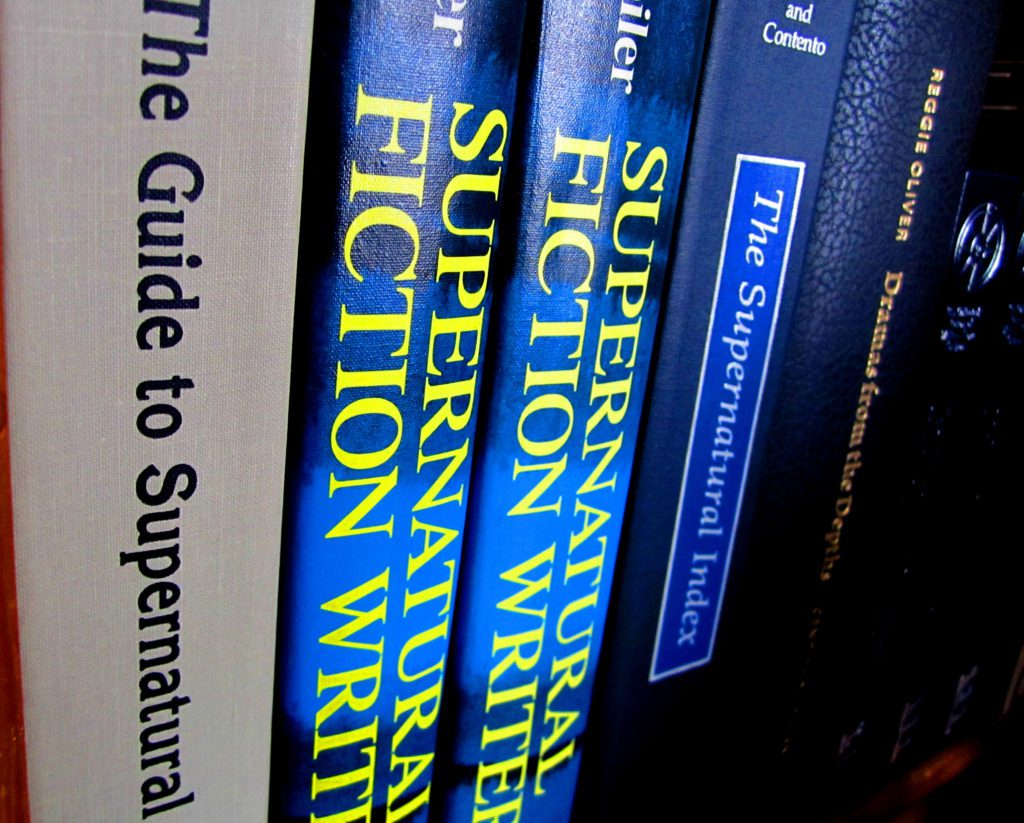
 I’ve long been a fan of checklists, indicies, bibliographies, literary guides, and genre studies. From Lovecraft’s Supernatural Horror in Literature to E.F. Bleiler’s Guide to Supernatural Fiction, and many more besides. One can spend hours immersed in these books, discovering new avenues for exploration and making mental notes on obscure titles to look out for. My shelves groan with these sorts of volumes, and despite severe bowing in some places, I don’t regret it one bit.
 Well, I decided to do something about that. For the past few months I’ve been in the early stages of assembling an “Encyclopaedia of Irish Writers of Fantastic Literature”. Loosely inspired by E.F. Bleiler’s Supernatural Fiction Writers and Jack Sullivan’s Penguin Encyclopedia to Horror and Supernatural, my first step was to compile a list of authors who I felt in some way contributed to Irish fantastic fiction. This list includes obvious writers such as Bram Stoker and Elizabeth Bowen, but also writers who are less well known, or whose contributions might not have had such a detectable effect on their peers.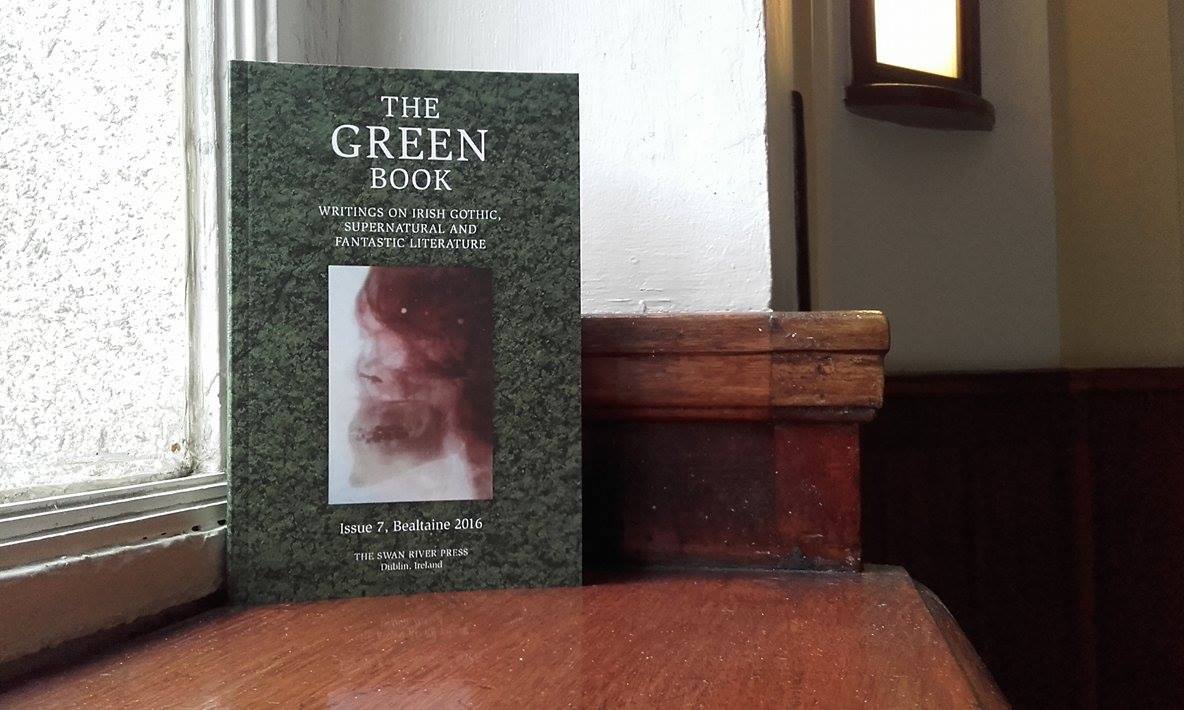


 A.E. continues his story of self-genesis in his chapter on “Imagination” in The Candle of Vision (1918), describing the effects of this epiphany:


 What to make of this?
 The following article by Fred Henderson was first published in the Eastern Daily Press (Norwich) on 19 July 1935, just two days after A.E.’s death. We reprint it here on the cusp of A.E.’s 150th birth anniversary.

 Here we are on the first day of 2017, and I realise that Swan River Press hasn’t had a single publication since August 2016. But the end of summer was certainly busy enough: we not only published one collection and two anthologies, but also helped run a festival. I’d feel a little more guilty about it had I not spent most of my holiday working on no less than three forthcoming publications (erm, one of them being the now overdue issue of
 Our second contribution to the national spirit of Ireland was a never-before reprinted collection from 1924 by Dorothy Macardle. The stories in
  The next book we did was another dream project: Fritz Leiber’s
  Next up is a book I feel most privileged to have published: Lynda E. Rucker’s second collection,
  Also published in August were a pair of books I’d been working on for well over a year. I’m happy to introduce the first two volumes of Swan River Press’s anthology series, Uncertainties (
 And this post wouldn’t be complete without mentioning the
  So there you have it. Those were the Swan River Press highlights of 2016. Let me know if I missed something. The schedule for 2017 is already shaping up to be an intimidating and ambitious enough project. While I wouldn’t want to say too much, I will say that the first book of the year will be Mervyn Wall’s 1974 short story collection A Flutter of Wings – this reprint will additionally include Wall’s play Alarm Among the Clerks (1937) and the opening chapter of an abandoned novel. Our new edition will feature an introduction by Val Mulkerns and illustrations by Clare Brennan (who is Mervyn Wall’s granddaughter).