


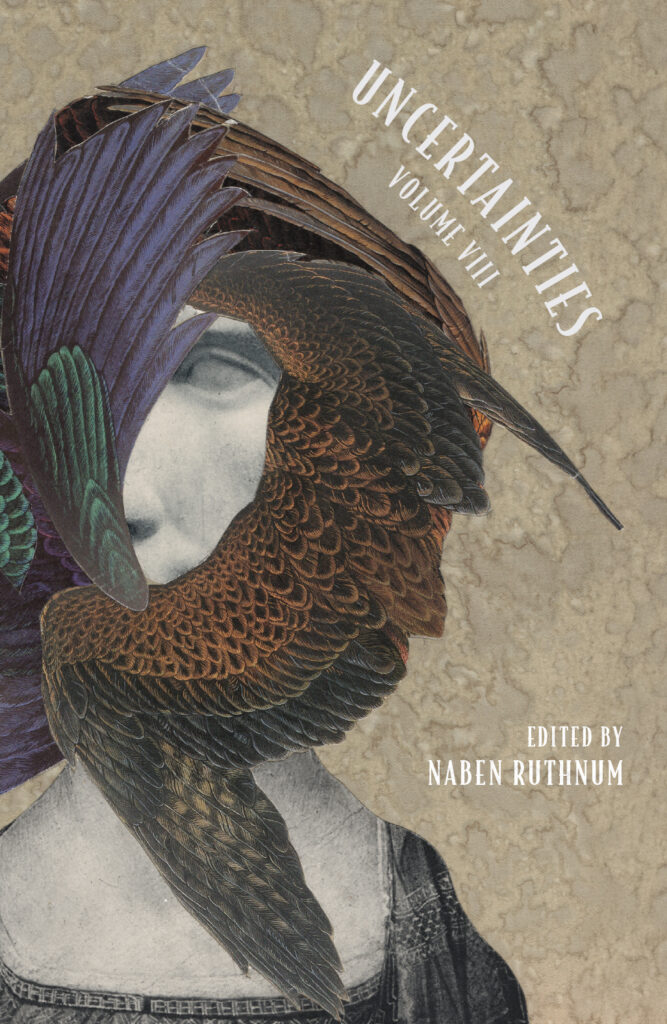
 Conducted by Brian J. Showers
For most of our books we conduct short interviews just prior to the title’s release. In the case of an anthology, the interview is with the editor. For Uncertainties 8, I wanted to do something slightly different. Hoping for just a bit more insight into the genre we love, I posed a single question:
What draws you to write tales in the weird/uncanny mode?
Here are the responses . . .
R. Ostermeier (“A Curio”)
To scare the self is to once more creep up on your own shadow unawares, which is a delight no matter how you cut it
Miriam Richer (“Next of Kin”)
The weird and uncanny fiction that pours out of me is the only way I know how to render my lived experience. For as long as I can remember, I’ve perceived the world and its inhabitants through the gauzy, ambiguating veil of my secret inner life. From my clinician’s perspective, my writing is a byproduct of late-diagnosed autism and trauma-induced dissociation. In my own view, it’s an inherently imperfect transcription of subjective isolation and wonder. Writing weird stuff on the page helps me to stay pretty normal and unobtrusive in the “real world”.
Rebecca Kuder (“All the Little Machines”)
The prism of perception has always fascinated me, and within the mind, weirdness does not seem weird, seems normal and inescapable. Maybe some central questions in my writing are: can I trust what I see and perceive? How do I know? And what if? I have historically been an overly vigilant person, inside myself. To dedicate room for bentness and speculation (in narrative, in life) somehow mitigates what I cannot control. The experience of living is so unruly—it feels important, cathartic, and in some odd way comforting, to step aside from the mundane, and allow the weird to dominate.
Andrew F. Sullivan (“Vanquisher”)
There’s an arrogance to believing you have all the answers, or assuming the universe is truly knowable. The uncanny and the weird do their best to keep my ego from getting too inflated. Every year I learn how little I know, how far I am from so much light out there in the sky. Age reminds me of the unknowable. Writing reminds me of how hard it is to articulate that space in between what we perceive and what we understand. It’s a chasm. It’s a hole. It’s the place where all my fiction goes eventually. There is no bottom.
Mike Thorn (“Soirée”)
I wouldn’t necessarily say I “set out” to write weird fiction so much as I’d say it’s just the kind of fiction that “comes out of me”. There are many possible explanations, including struggles with anxiety, unconscious psychological metabolism, and an increasingly weird and uncanny world. Probably these are all contributing factors, but more than anything, I blame my formative childhood reading diet of fantasy and horror fiction. Ultimately, I think writers are what they read.
Michael Kelly (“Caretakers”)
The uncanny permeates and vivifies my daily existence. Life is a waking dream, each day bringing forth the miracle of the alien and the unknown. When I was five-years-old we moved into an old house that had a large oval mirror with smoky glass. It was affixed to a wall opposite a creaky wooden staircase. I would perch midway up the stairs and peer at the mirror, trying to glimpse some other me that I was convinced hid behind the occluded glass. Leaning forward one day, my wee head slipped between the slats of the handrail and I could not pull myself free. I was trapped. As my mouth yawned open to scream, I saw movement in the mirror opposite me. A pale face came swimming to the dark surface. My face—but distorted in an unpleasant way. That other me mouthed I see you, then vanished, as if it were never there. Eventually, the fire brigade cut me free. The mirror also disappeared—my parents insisting there’d never been one. I’ve been chasing ghosts ever since; chasing after the unknowable.
Erica McKeen (“Goodnight, Grandma Maggie”)
I write with a desire for the world to be stranger than it is, or to uncover the strangeness in it. And by strangeness I mean a slipperiness, an awareness that our lives are less delineated and more interconnected than we have been led to believe. What the uncanny does well is to reveal how everything is not itself—the doll is the child, the hand is the spider, the marble is the eyeball—how everything is actually everything else. Which means that we, too, can be anything, anyone. But which also means we are nothing.
Quentin S. Crisp (“The Poet and the Jaguar and the Poet”)
Substitute “spooky” for “weird” and that is basically the choice we’re facing now. If we ask what humans are, there are two possible answers: we’re either ghosts or we’re ghosts. That is, we’re either spooky ghosts or uncanny ghosts. If we’re spooky ghosts, that means there are more things in heaven and earth than are dreamt of in twenty-first century philosophy departments, where humanists strive and strain to be handmaidens to the physical sciences; if we’re uncanny ghosts, that means all our experience is squeezed into the realm of the unreal, and therefore the ghostly, even though it’s precisely and only experience that we’re using to verify “the facts”. So, some sort of investigation of what kind of ghosts we are and want to be seems warranted. Or, the short answer is, I’ve always loved strange, dark tales since I was a child.
Michael Wehunt (“Monumental Horror Image”)
As much as I love horror and mystery and other genres that play in the shadows, nothing chills my skin like the truly weird, the truly uncanny. Weird fiction is the shadows. When I first read writers like Aickman, Machen, Tuttle, Oliver, I felt as though they had already been imprinted on my DNA. Surely I had read them many times before . . . A thing that is almost normal but somehow, subtly not is more horrifying than the goriest monster, and that visceral sensation of the uncanny is a feeling I’ve been chasing all my life. I want to write those chills onto other arms.
Buy a copy of Uncertainties 8.
No Comments yet!