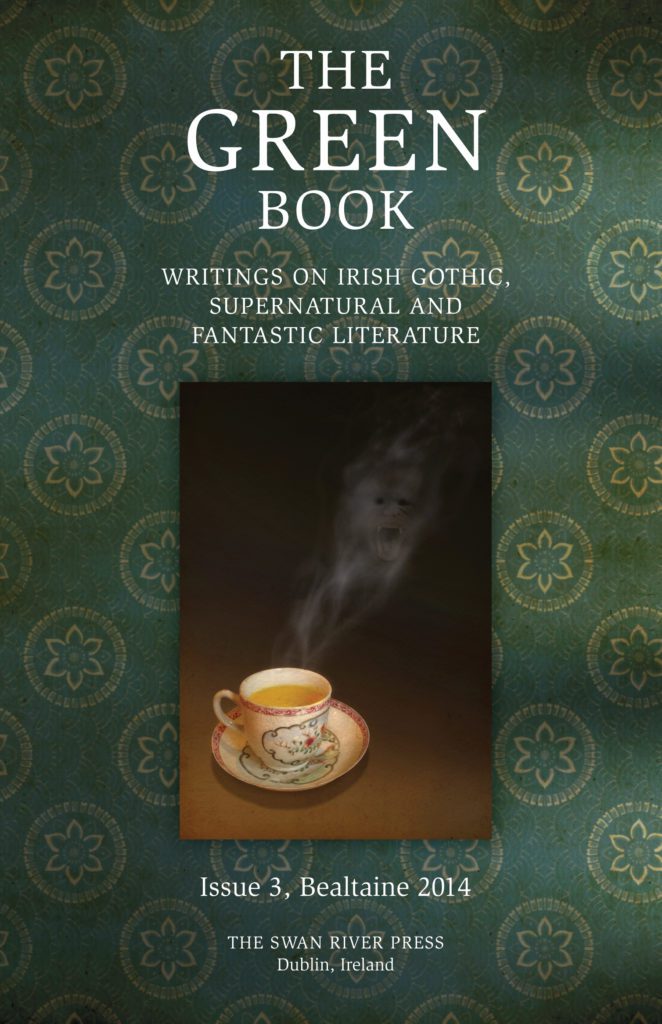
The Green Book 3

As many of you already know, 2014 is an important year for Gothic literature. This coming August marks the 200th birth anniversary of Dublin’s “Invisible Prince”, Joseph Sheridan Le Fanu. While today hardly recognised in his native country of Ireland, his influence has spread around the globe, not only for his sensational Gothic page-turners, but also for his indelible contributions to the genres of the classic ghost story and modern crime novel. Would there even be Dracula without “Carmilla”?

In addition to Le Fanu’s bicentenary, this year also marks the 150th anniversary of Uncle Silas. Perhaps Le Fanu’s best known novel, Uncle Silas was serialised (under its original title “Maud Ruthyn”) in the Dublin University Magazine from July-December 1864. The three-decker novel was then promptly issued in late December by Richard Bentley. Now is the perfect time to revisit the sinister rooms and gloomy passages of Bartram-Haugh. I know what I’ll be re-reading this autumn . . .


Paperback edition limited to 350 copies.

Cover art by Jason Zerrillo
Editor’s Note by Brian J. Showers

ISSN: 2009-6089 (pbk)

The Green Book 4

The summer weather in Ireland has been beautiful, sunny and warm, atypical for sure. Normally our summers are more like our Novembers with “great gusts rattling at the windows, and wailing and thundering among our tall trees and ivied chimneys”—well, maybe not the tall trees or ivied chimneys part. As I re-read Le Fanu’s Uncle Silas this summer, which was first serialised exactly 150 years ago, from July to December 1864, I wondered not only what the weather might have been like that summer—Le Fanu’s chilly prose is not exactly beach-blanket reading, though it is a page-turning thriller—but what would it have been like for readers to encounter this classic piece of literature for the first time as it unfolded in pages of the Dublin University Magazine.

Was the seventeen-year-old Bram Stoker among those Dubliners that summer following the plight of young Maud Ruthyn? Did he delight in the villainous subterfuges of Madame de la Rougierre? Did he wonder about the mysterious sins of Uncle Silas? We know that Stoker definitely read Le Fanu’s masterpiece at some point—he recommended it to his son Noel, who thoroughly enjoyed the novel, noting that his father had excellent taste in literature. (I hope you will forgive me for musing on questions other than: “So, did Stoker actually read ‘Carmilla’ or what?”)


Paperback edition limited to 350 copies.

Cover art by Dolorosa de la Cruz
Editor’s Note by Brian J. Showers

ISSN: 2009-6089 (pbk)
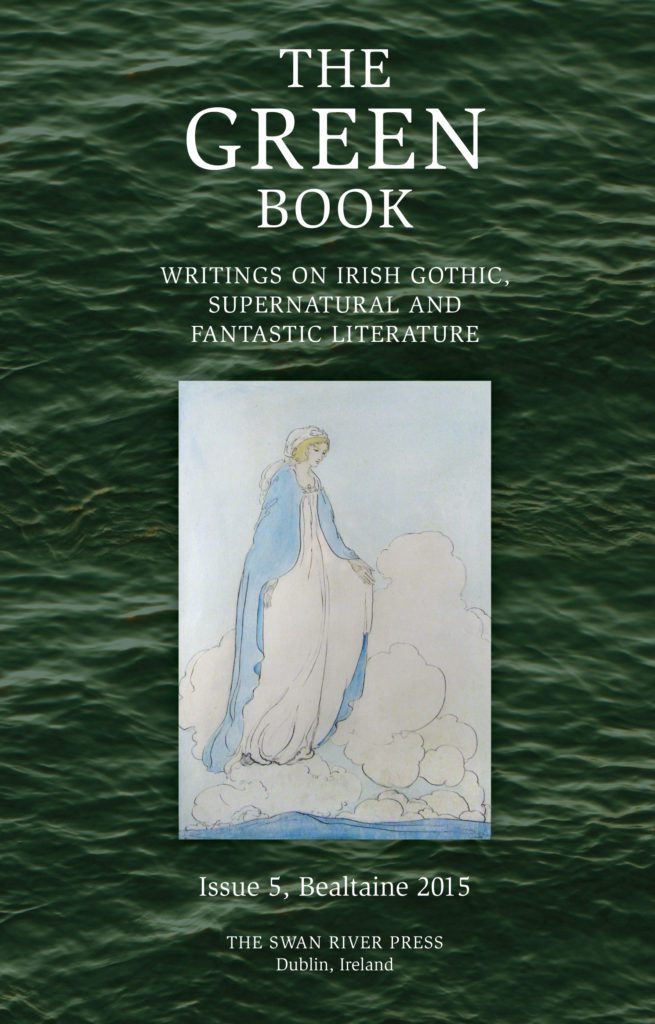
The Green Book 5

“In Ireland we have a national apathy about literature . . . It began to descend on us after we became self-governing; before that we were imaginative dreamers.” – A.E. to Van Wyck Brooks (10 October 1932)

So wrote the poet, painter, and mystic George William Russell (1867-1935)—better known by his spiritual name A.E.—less than a year before he left Ireland after a lifetime working to enrich a nation he loved and dedicated himself to. Yet his vision of Ireland as an enlightened society was seemingly at odds with the mass desire for the cultural censorship and social conservatism that coincided with the birth of the Irish Free State.

Today, with the continuation of a crippling austerity policy—which includes the treatment of the arts as commodity, the considered monetisation of our public museums, financial cuts to arts funding, and the budgetary destitution of the National Library, among other similar injuries masquerading as common sense measures—one wonders just exactly how the arts are valued in a nation that still proudly sells itself as “the land of saints and scholars”.


This issue is sold out.
Please check with our Booksellers for remaining copies.

Cover art by Pamela Colman Smith
Editor’s Note by Brian J. Showers

ISSN: 2009-6089 (pbk)
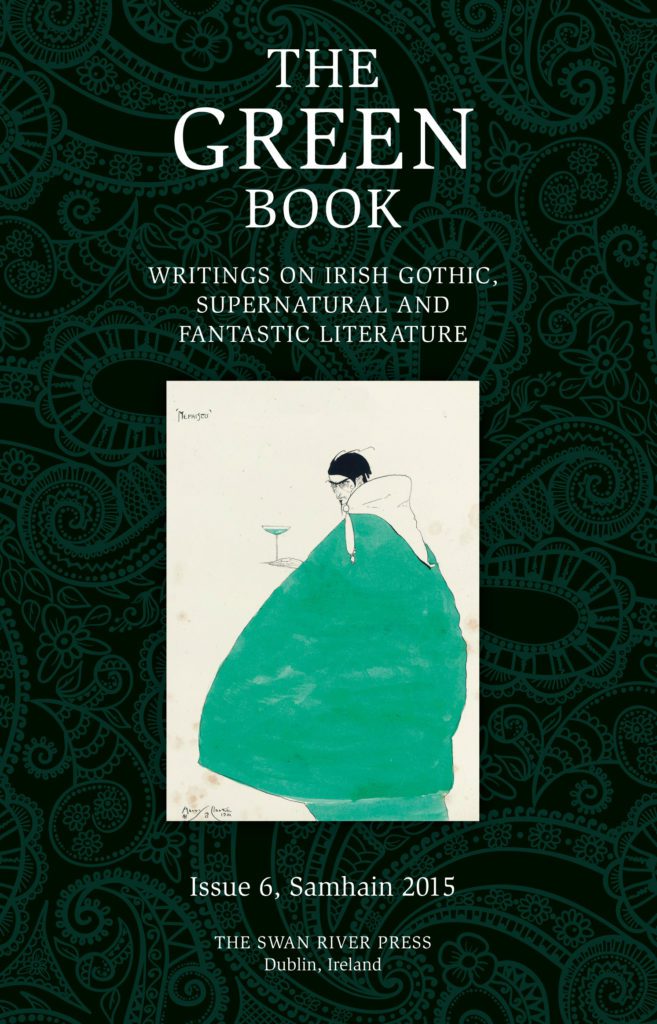
The Green Book 6

So far The Green Book has been avoiding Mr. Bram Stoker. Not out of dislike or animosity, but for a journal that hopes to illuminate the lesser seen corners of Irish fantastic literature, I felt it was okay to let Stoker—our most prominent spokesman—wait patiently in the wings for the first few issues and allow others the spotlight for just a moment. But now that we’re six numbers in, it’s time to give Mr. Stoker his due and allow him to take centre stage. And so we pull back the red velvet curtains on this issue in grand style.

It’s not every day one discovers a forgotten story by Bram Stoker. But there it was, on page three of an equally forgotten Dublin daily newspaper from the 1870s. It appeared quite unexpectedly in the far right-hand column. There’s nothing quite like that rush of excitement one feels when making such a discovery in the otherwise subdued and dimly-lit microfilm room of the National Library. The thrill of reading that recognisable prose, filled with masculinity, adventurous seafaring, nefarious murder, teetotalling, a steadfast and clever fiancée, and a ghost. Did I not mention it’s a ghost story too? It is, and also the second (known) story Stoker had ever published. No, it’s not every day that one discovers a forgotten story by Bram Stoker. But they’re out there, just waiting to be uncovered. And we’re happy to be able to share “Saved by a Ghost”, which has lain dormant for nearly 150 years, with you now.


This issue is sold out.
Please check with our Booksellers for remaining copies.

Cover art by Harry Clarke
Editor’s Note by Brian J. Showers

ISSN: 2009-6089 (pbk)
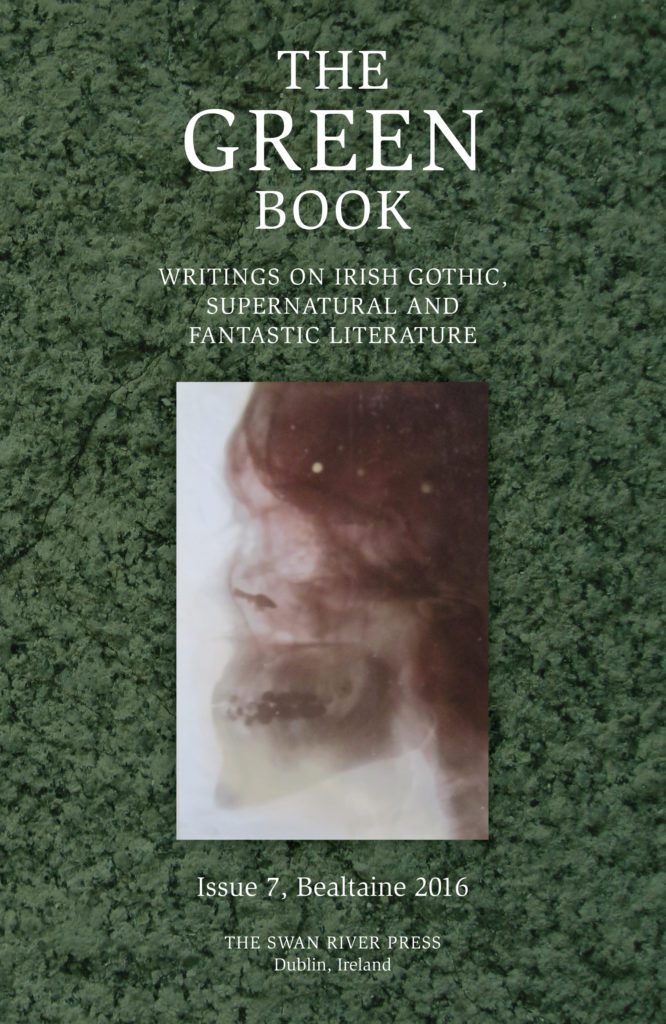
The Green Book 7

“Race hatred is the cheapest and basest of all national passions, and it is the nature of hatred, as it is the nature of love, to change us into the likeness of that which we contemplate.” – A.E., The National Being (1916)

This issue is a little different than the previous ones. It started as an idea half in jest, but became something unexpectedly more viable.

Those living in Ireland will know that this country is in the midst of a year-long commemoration of a watershed event: the 1916 Easter Rising. If you don’t know about this event, take a moment to familiarise yourself with it. Suffice to say the rebellion was a major turning point in the centuries-long struggle for Irish independence. However, the violence that erupted in Dublin (and further afield) during that week in the spring of 1916 became the template for twentieth-century Ireland’s myriad political and social divisions over which much blood has been spilt, creating wounds that have not yet healed. A terrible beauty indeed.

The question in 2016 is not only how we commemorate such a controversial event, but in what ways do we represent the various and sometimes overlooked voices (Unionist, Republican, the role of women, the Anglo-Irish, et cetera) of such a complex moment?


Paperback edition limited to 250 copies.

Cover image of Lord Dunsany
Editor’s Note by Brian J. Showers

ISSN: 2009-6089 (pbk)
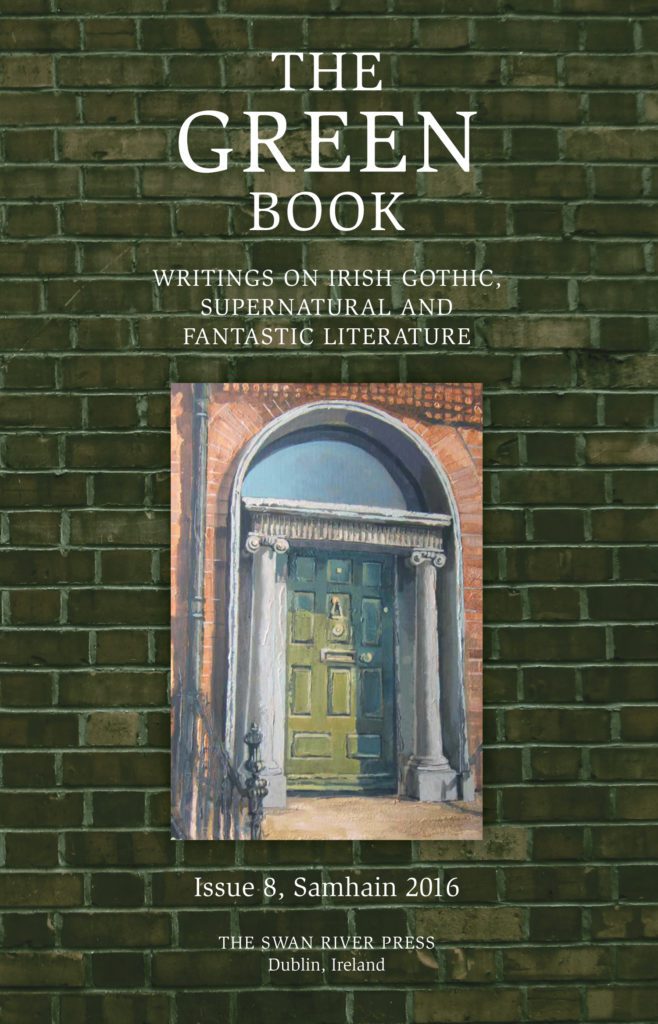
The Green Book 8

Looking at this issue’s eclectic contents, I am struck by the richness of Ireland’s varied contributions to genre literature. Though a small island nation, we don’t exist in a hermetically sealed literary bubble. It’s an obvious thing to say, really, but Irish literature has such a strong sense of itself that I sometimes have to remind myself of its kinship with the rest of the literary world.

During one of my expeditions to the National Library, I happened upon a contemporary review of E. R. Eddison’s novel The Worm Ouroboros (1922) written by James Stephens, author of the classic fantasy novel The Crock of Gold. I was thrilled at the idea—though maybe I should not have been surprised—that Stephens was reading other genre writers of the era. We also know he was an admirer of Arthur Machen, but what else had he read? So for this issue I decided to include Stephens’s review of Ouroboros as a reminder of the interconnections between genre fictions (and their writers).


Paperback edition limited to 250 copies.

Cover art by Brian Gallagher
Editor’s Note by Brian J. Showers

ISSN: 2009-6089 (pbk)

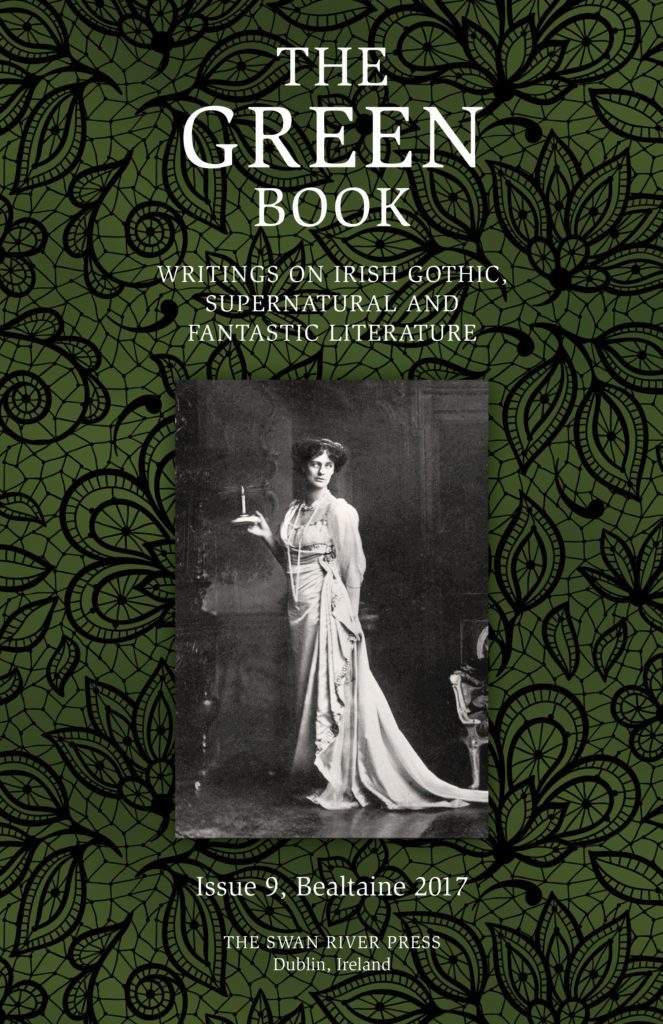
The Green Book 9

“Ghosts draw us together: one might leave it at that.” – Elizabeth Bowen

Twenty-five years after Lady Cynthia Asquith edited her classic anthology The Ghost Book (1926), she followed it up with The Second Ghost Book, a decidedly more modern grouping of uncanny tales written by some of the most eminent authors of the era: Walter de la Mare, V. S. Pritchett, and Rose Macaulay among others. For this second anthology Asquith also approached her close friend and one-time London neighbour Elizabeth Bowen, not just for a story—the now much-anthologised “Hand in Glove”—but Asquith also requested that she write the introduction as well. Bowen obliged.

By the time The Second Ghost Book was published in 1952, Bowen was already an established novelist, rightly lauded for titles such as The Last September (1929) and The Heat of the Day (1948); both books being weighty explorations of relationships set against the background of war and conflict. Nonetheless, Bowen’s decision to make a contribution to and pen the introduction for a popular ghost story anthology is unsurprising. Her earliest collections are littered with treatments of the uncanny, perhaps culminating with the superb collection, The Demon Lover and Other Stories (1945). And so this issue opens with Bowen’s still insightful introduction to The Second Ghost Book—a treatise on a literary form that she no doubt took as seriously as any other.


Paperback edition limited to 250 copies.

Cover photograph of Constance Markievicz
Editor’s Note by Brian J. Showers

ISSN: 2009-6089 (pbk)

The Green Book 10

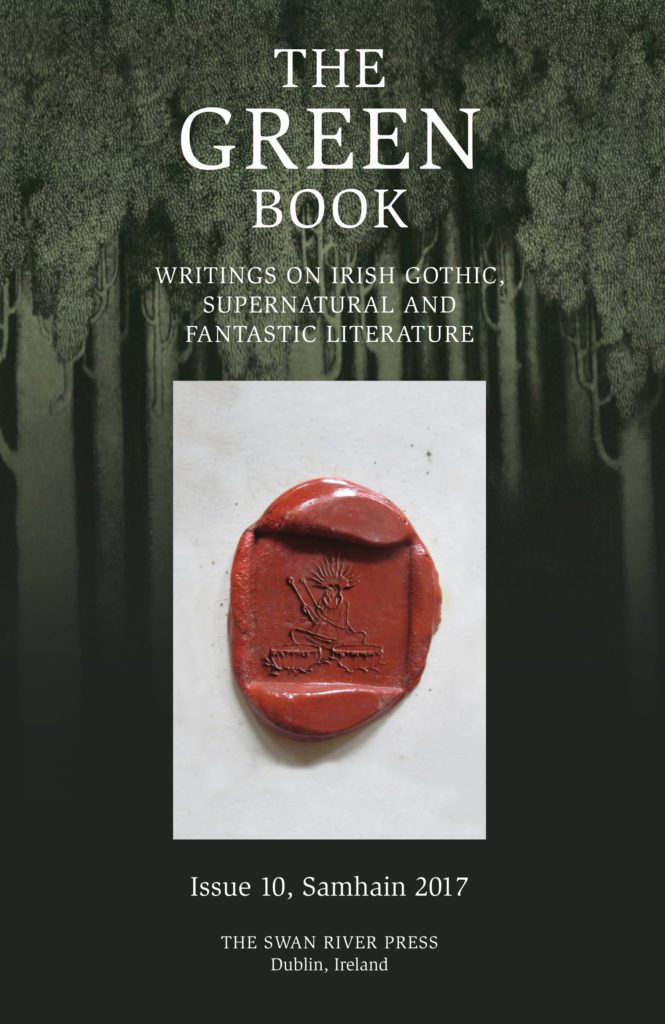
“A man is a very small thing, and the night is very large and full of wonders.” – Lord Dunsany, The Laughter of the Gods (1917)

Without question, Lord Dunsany (1878-1957) was one of the leading fantasists of the twentieth-century, fitting in somewhere between William Morris and J. R. R. Tolkien. As a writer he emerged fully formed, with an incomparable prose style and literary sensibilities that can only be described as sui generis. Dunsany’s writing is widely acknowledged as an influence on H. P. Lovecraft and Neil Gaiman, while his stories, novels, and plays are admired by luminaries such as Aleister Crowley, Arthur C. Clarke, Jorge Luis Borges, and Ursula Le Guin. And though Dunsany’s writing is held in high regard among readers of fantastic literature, his work is curiously not as widely read as it should be. Stranger still, despite Ireland’s obsession with claiming, reclaiming, and rediscovering its literary heritage, Lord Dunsany remains virtually absent from the Irish literary canon, dismissed by certain disengaged academics as “second-rate”, almost unavailable in bookshops, and often reduced to a walk-on part in the biographies of better known writers and artists.


Paperback edition limited to 250 copies.

Cover art by Jason Zerrillo
Editor’s Note by Brian J. Showers

ISSN: 2009-6089 (pbk)
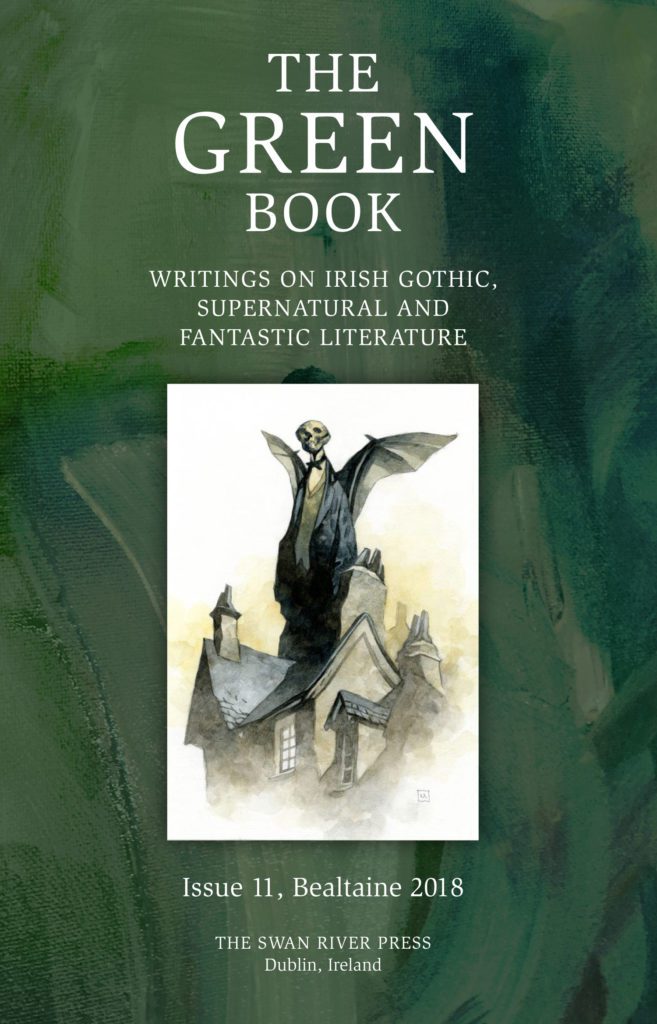
The Green Book 11

Our previous issue saw a fabulous array of reminiscences of Lord Dunsany—and also some contemporary assessments of his works—written by his Irish colleagues, including Yeats, Bowen, Gogarty, Tynan, A.E., and others. Issue 10 was fascinating to assemble and the process gave me a better understanding of and more insight into Dunsany’s literary standing in Ireland during his lifetime. If you’ve not yet had a look at our Dunsany issue, and you are in any way interested in this important author, I urge you to track down a copy.

The focus on Dunsany’s contemporaries in Issue 10 was an approach that evolved during research and production. However, during that time I also received a handful of modern appraisals of Dunsany and his work that I simply couldn’t fit into that issue. That’s why I’d like to start this instalment with just a bit more Dunsany.

First up we have Dunsany bibliographer Darrell Schweitzer’s career-spanning survey of the fantasist’s considerable body of work—where a new reader could start, what aficionados might have overlooked, and which titles can, perhaps, be left until later. Next, Martin Andersson, co-editor of the posthumous Dunsany collection The Ghost in the Corner (also reviewed in this issue), explores a lesser-known episode in Dunsany’s life: his Nobel Prize nomination. Finally, novelist Mike Carey offers an appreciation of Fifty-One Tales (1915), a collection not as widely celebrated as Dunsany’s other titles, but maybe one that should be given another read.


Paperback edition limited to 250 copies.

Cover art by Mike Mignola
Editor’s Note by Brian J. Showers

ISSN: 2009-6089 (pbk)
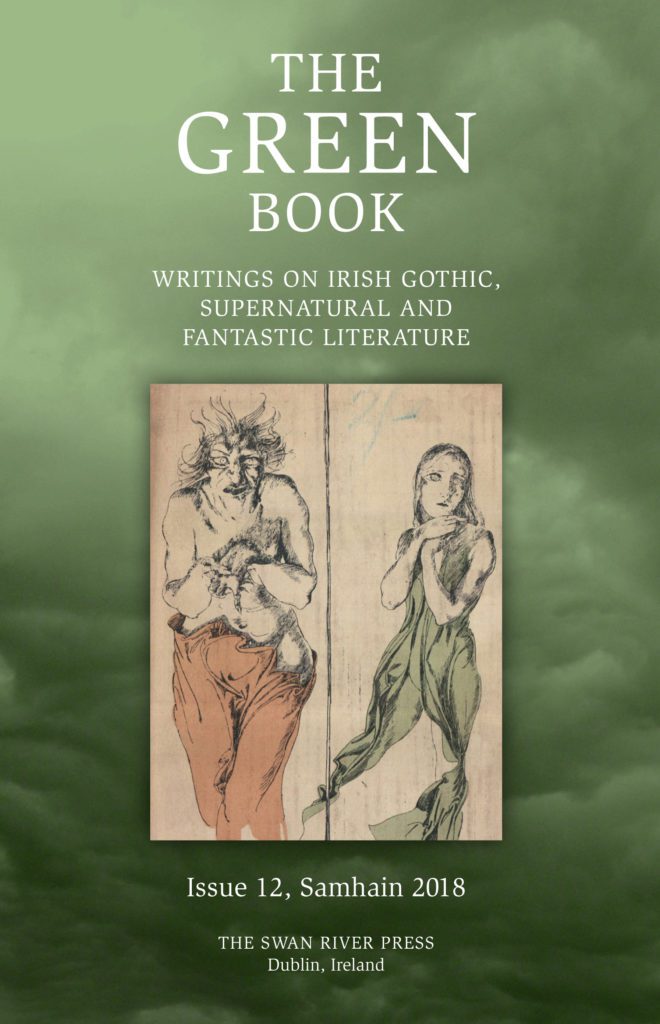
The Green Book 12

“Ireland’s contributions to supernatural literature has been a major one and, like its contribution to literary endeavour generally, out of proportion to the country’s small size.” – Peter Berresford Ellis, Supernatural Literature of the World

One of the occasional criticisms of The Green Book is that it’s far too niche. That the focus on Irish literature of the gothic, supernatural, and fantastic is too limiting a remit. I could never really understand this assertion, especially not now that the journal has survived twelve issues—and I’m already working on the next.

In fact, I’ve found quite the opposite to be true. The more I look at the island of Ireland’s wide-ranging and far-reaching contributions to fantastical literature, the more I learn and the more I feel excited about further exploration as both a reader and publisher; a sentiment I hope the audience of this publication shares.


Paperback edition limited to 250 copies.

Cover art from Elliott O’Donnell’s The Banshee
Editor’s Note by Brian J. Showers

ISSN: 2009-6089 (pbk)