The Green Book 26

We find ourselves with a second issue this year focusing on Joseph Sheridan Le Fanu. I had a handful of items that I couldn’t fit into the previous issue, so I hope you’ll allow me the indulgence of a few more pages. There’s some interesting stuff between these covers.

The first piece is the subject of some debate among Le Fanu scholars. The story “My Aunt Margaret’s Adventure” was first published in the Dublin University Magazine (March 1864) between the final instalments of Wylder’s Hand (February) and “Wicked Captain Walshawe, of Wauling” (April). Along with “Wicked Captain Walshawe”, “My Aunt Margaret’s Adventure” was identified by M. R. James as having been written by Le Fanu—although authorship was not explicitly stated in its original publication of the story and no known records have surfaced to confirm this conjecture.


Paperback edition limited to 250 copies.

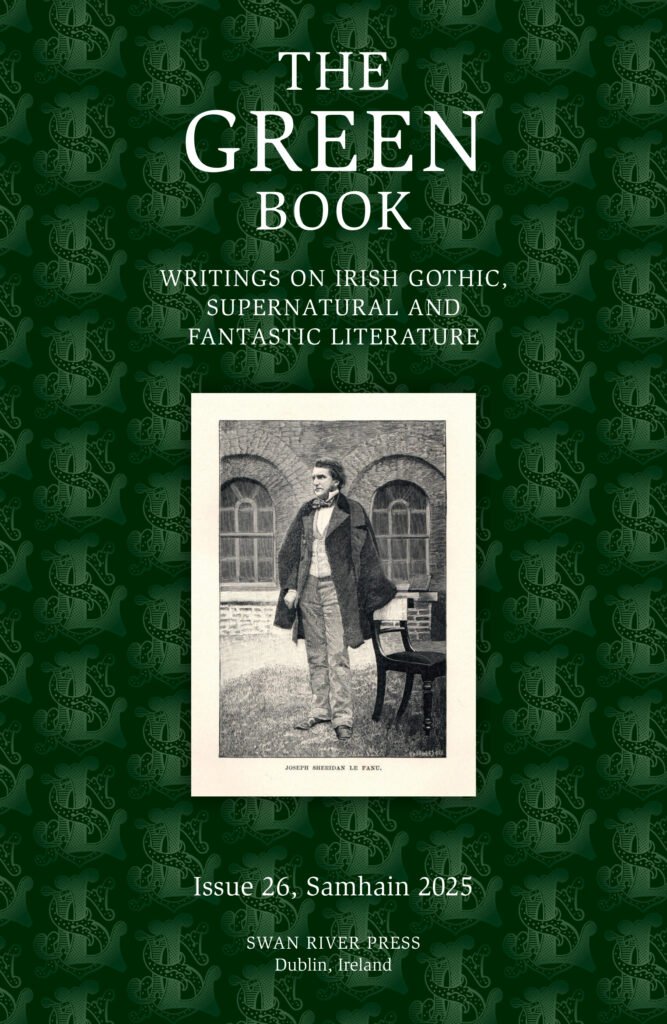
Cover art: “Joseph Sheridan Le Fanu” by H. Fitzner Davey
Editor’s Note by Brian J. Showers

ISSN: 2009-6089 (pbk)
The Green Book 25

If you’ve already browsed the contents of this issue, you’ll have noticed that we devoted the entire number to Joseph Sheridan Le Fanu (1814-1873). The last time we gave so much space to Le Fanu was for the bicentenary of his birth in 2014 (see Issue 3 and Issue 4). There is no special occasion to herald this issue, save that we’ve since accumulated a handful of interesting items that I feel deserve broader attention.

Reprinted here for the first time since its initial publication in 1910 is a recently rediscovered monograph of Le Fanu written by his publisher Edmund Downey (1856-1937). While this memoir leans heavily on earlier portraits of the author, notably A. P. Graves’s lengthy introduction to the Poems of J. S. Le Fanu (1896) and anecdotes related by Le Fanu’s son Brinsley (1854-1929), there are some new sketches and scenes that further illuminate the Gothic novelist’s sense of humour and warmth of character. While Dublin’s “Invisible Prince” may sometimes seem an inscrutable presence, even to his close friends, he was clearly remembered with fondness by those who knew him.


Paperback edition limited to 250 copies.

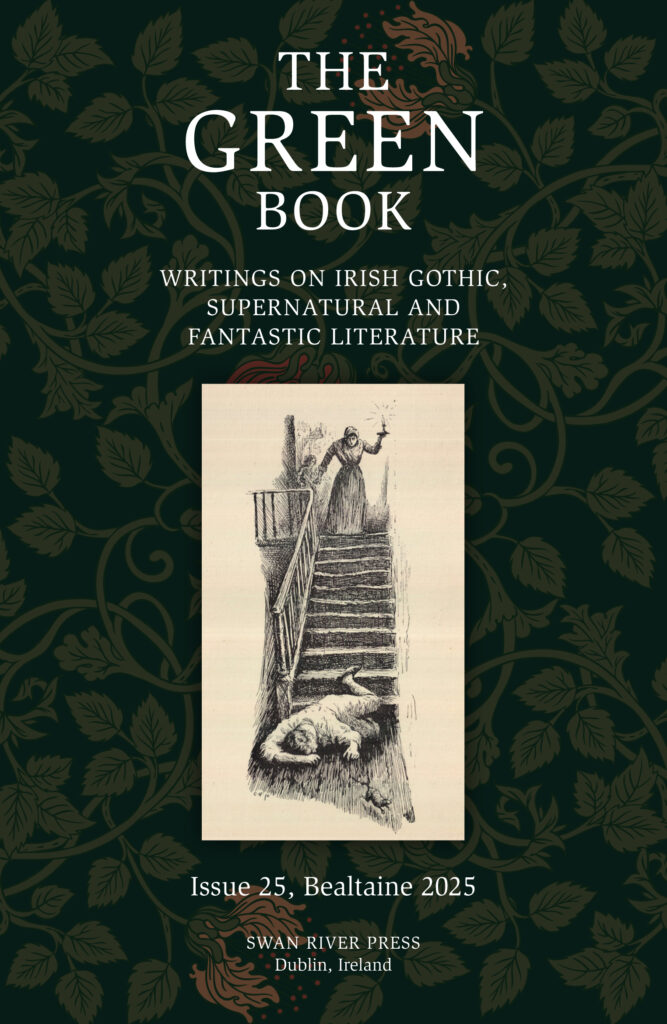
Cover art: “The Dream” by Brinsley Le Fanu (1894)
Editor’s Note by Brian J. Showers

ISSN: 2009-6089 (pbk)
The Green Book 24

In Issue 23 of The Green Book we featured a sketch of Charles Maturin (1782-1824) penned by James Clarence Mangan, originally published in March 1849. Although we now celebrate Maturin as the author of Melmoth the Wanderer (1820), Mangan identified The Milesian Chief (1812) as his own favourite novel: “the grandest of all Maturin’s productions”. In that essay, Mangan also muses on Maturin’s underappreciated legacy in his native Dublin—“not forgotten because he had never been thought about”. He goes on tell us that the writer William Godwin wished to make a pilgrimage to Maturin’s grave, but Mangan observes, “where the remains of my distinguished countryman repose, I confess I know not”.

The answer to that question in 1849 would have been simple: the churchyard of St. Peter’s on Aungier Street, where Maturin once served as curate. The answer to that same question in 2024, as we approach the bicentenary of Maturin’s death on 30 October, is substantially more complex . . .


Paperback edition limited to 250 copies.

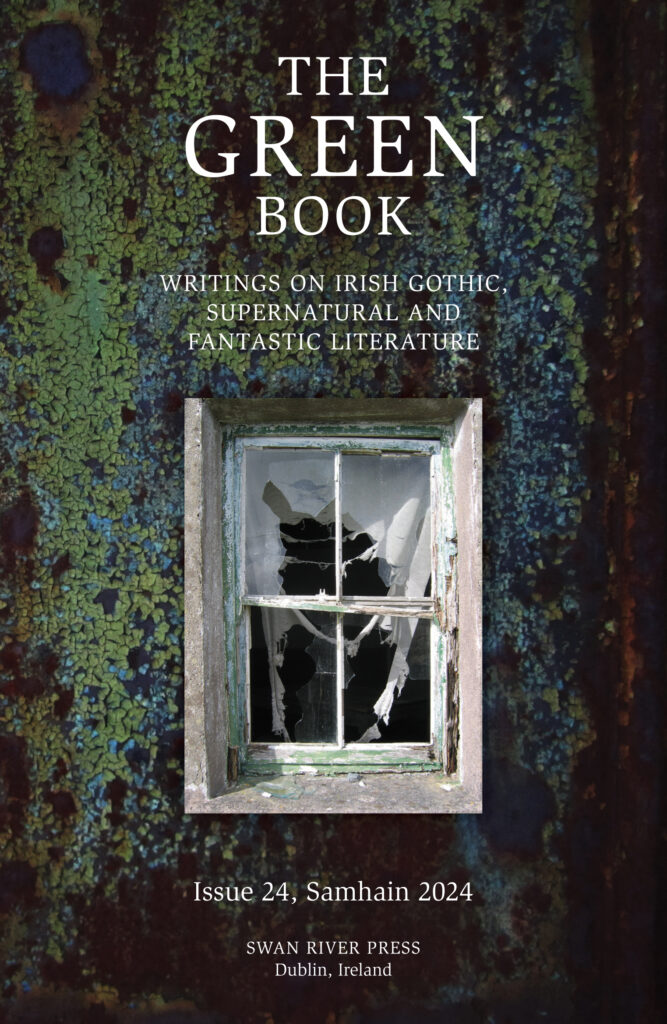
Cover art: “West Kerry Window” (2008)
Editor’s Note by Brian J. Showers

ISSN: 2009-6089 (pbk)
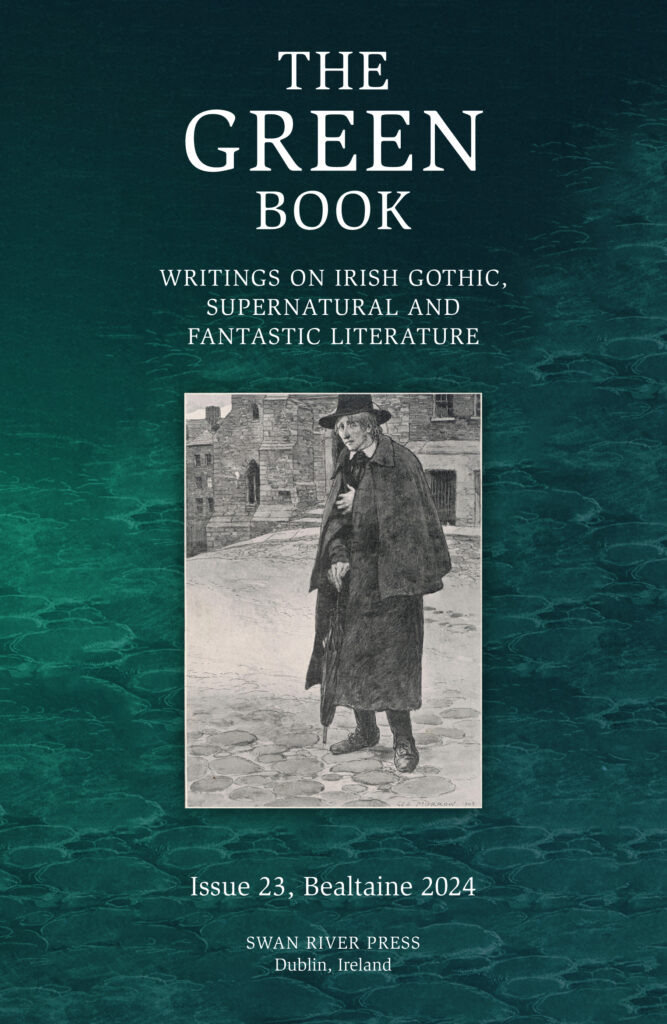
The Green Book 23

As a whole, I like to think that The Green Book serves as a sort of portrait of Irish Gothic literature in its myriad guises, incomplete though it may be, but ever adding detail to the canvas. Looking over this issue, I feel that most of what has been assembled here are portraits of the proprietors of the darker fantastic—some of the pieces are direct reminiscences, others illustrate their subjects in more oblique ways. I like when this happens—when the themes of an issue, or even just an approach, emerge of their own accord.

The opening triptych of portraits in this issue comes courtesy of the thunder-scarred poet James Clarence Mangan (1803-1849), whose beckoning and forlorn visage also adorns this issue’s cover. Those of you who pay attention to such things, take note that 30 October will be the 200th anniversary of Charles Maturin’s death (1782-1824). Mangan’s reminiscence of the author of Melmoth the Wanderer (1820) makes for a colourful portrayal; it strikes me now as I read it that this piece is the touchstone for how we now perceive Maturin, with all his eccentricities and swiftly underappreciated Gothic legacy. Maturin’s final resting place seems to be something of a mystery. I won’t speculate here, but if any reader wishes to conduct an investigation—and write up their findings for The Green Book—please do.


Paperback edition limited to 250 copies.

Cover art: “James Clarance Mangan” by George Morrow (1903)
Editor’s Note by Brian J. Showers

ISSN: 2009-6089 (pbk)
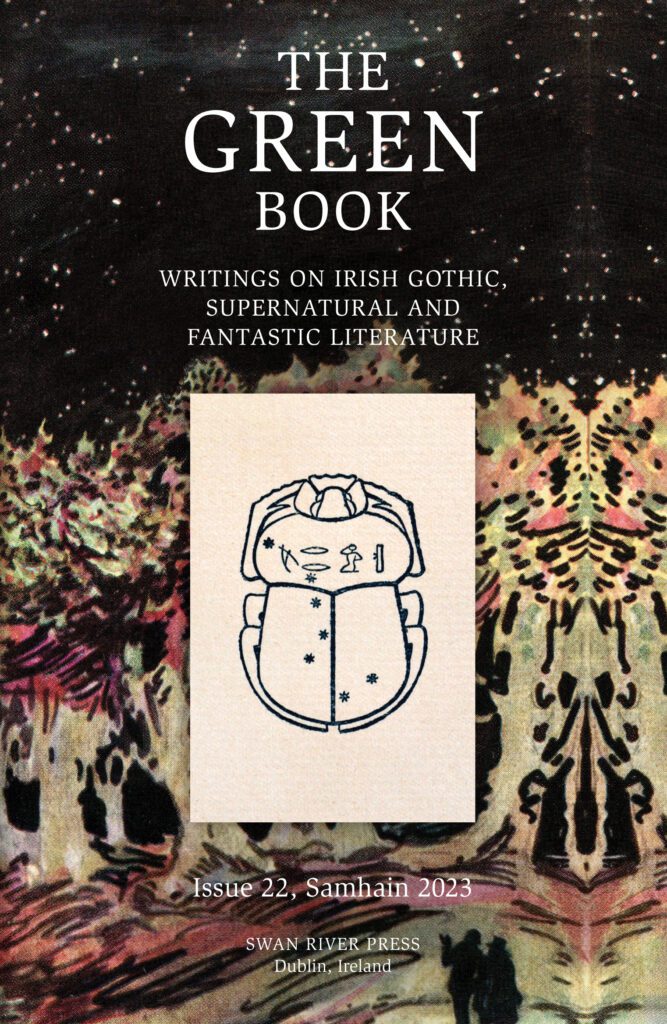
The Green Book 22

I thought this moment might never come. Perhaps on some levels I was even avoiding it due to an oversaturation of the blood-stained, opera-cloaked market. But at long last, we seem to have a Bram Stoker issue of The Green Book in our hands! Some of the keen-eyed might have realised this from the cover, which features as the background Pamela Colman Smith’s illustration for The Lair of the White Worm (1911), while the inset image is a detail from the printed boards of The Jewel of Seven Stars (1903). (It dawns on me as I write this that, while there is plenty of White Worm action herein, there’s nothing about Jewel—however, a scarab does make an appearance . . . )

The first piece in this issue is an appreciation of “The Judge’s House” (1891), and an accompanying illustration, by Mike Mignola, a writer and artist whose memorable creation Hellboy boasts direct lineage from the works of Stoker. This short essay first appeared as the introduction to the Swan River booklet The Definitive Judge’s House (2011), now long out of print. I thought it might be nice to give it another outing.


Paperback edition limited to 250 copies.

Cover art from The Jewel of Seven Stars (1903) and The Lair of the White Worm (1911)
Editor’s Note by Brian J. Showers

ISSN: 2009-6089 (pbk)
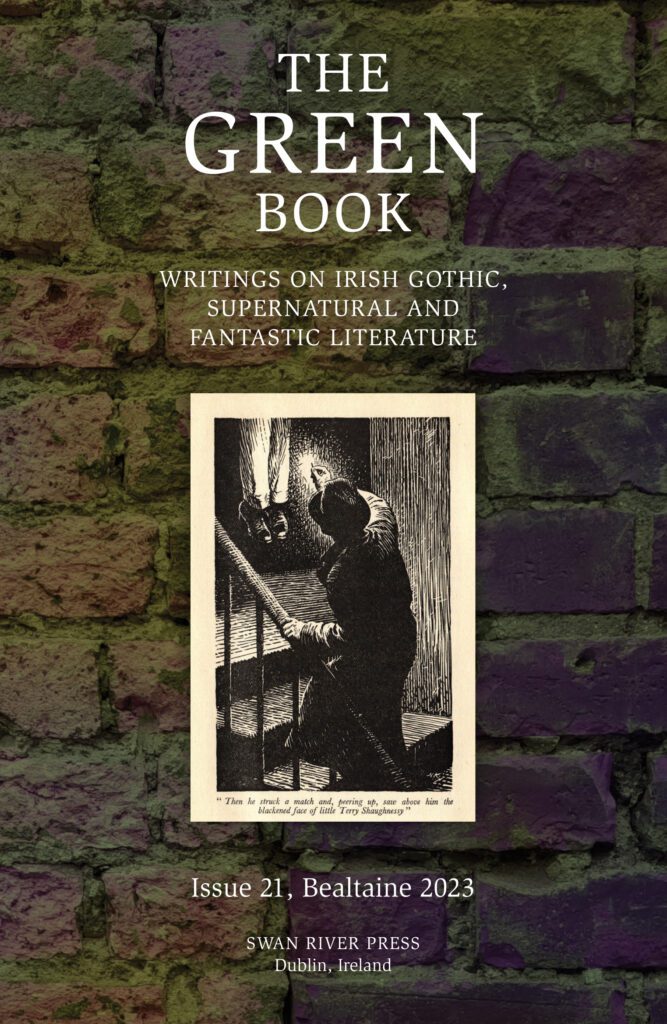
The Green Book 21

The centrepiece of this issue is undoubtedly Althea Gyles’s “A Woman Without a Soul”, which, to my knowledge, has never before seen print. This story is mentioned often in the scant scholarship on Althea Gyles (1867-1949) that exists, with most critics curiously referring to the piece as an unpublished “novel” or sometimes “novella”. At just over seven thousand words, it is assuredly a short story—and an intriguing one at that. In his critical profile of Gyles in The Green Book 20, Simon Cooke calls the story a Faustian tale of necromancy and obsession; other scholars have likened “A Woman Without a Soul” to The Picture of Dorian Gray (1890) by Oscar Wilde, whom Gyles befriended in Paris after an introduction from publisher Leonard Smithers. Kristin Mahoney, in her excellent Literature and the Politics of Post-Victorian Decadence, goes so far as to write that the story “reads much like a revision of The Picture of Dorian Gray, a feminized retelling of one of Wilde’s most significant works”. Suffice to say, I’m pleased to be able to present this hitherto unpublished story—after patient and careful transcription by Jim Rockhill—to The Green Book’s readership.


Paperback edition limited to 250 copies.

Cover art by Norman Keene
Editor’s Note by Brian J. Showers

ISSN: 2009-6089 (pbk)

The Green Book 20

With this issue, we offer another ten profiles of Irish writers of gothic, supernatural, and fantastic fiction. The two most notable writers this issue—and therefore lengthiest entries—are, of course, Charlotte Riddell (1832-1906) and Bram Stoker (1847-1912). Along with names like Charles Maturin, Joseph Sheridan Le Fanu, and Lord Dunsany, Riddell and Stoker might be considered pillars of Irish fiction. It might even be said that Dracula (1897), for better or for worse, is a key text of world literature and beyond. After all, who would not recognise the Lugosi-inflected visage of Stoker’s infamous Count?

John Edgar Browning has shown in A Critical Feast (2012) that Dracula was a hit from the start, when it first landed on booksellers’ shelves in late May of 1897. But Stoker’s magnum opus really took on a life of its own when it transitioned to other media. Dracula’s early rise in popular culture is most thoroughly traced in David J. Skal’s Hollywood Gothic: The Tangled Web of Dracula from Novel to Stage to Screen (1990).


Paperback edition limited to 250 copies.

Cover art by Frank O’Meara
Editor’s Note by Brian J. Showers

ISSN: 2009-6089 (pbk)
The Green Book Bundle

Want to start reading issues of The Green Book, but don’t know where to start?

We’re offering a special discount: 5 issues for €65 EUR.

Just order by using the PayPal button at the left, then contact us to let us know which five issues you want. Or wait for us to email you and ask after you’ve placed the order (this might not happen immediately).

This offer is inclusive of domestic and international shipping.

Out of print issues are not included in this offer. Obviously, right?

You may use this offer multiple times (10 issues for €130 EUR, etc). But please no substitutions or permutations.

Single issues can still be bought at the regular prices.

If you’re after out of print issues, please check with our booksellers, who might still have some in stock.

As always, let us know if you have any questions.

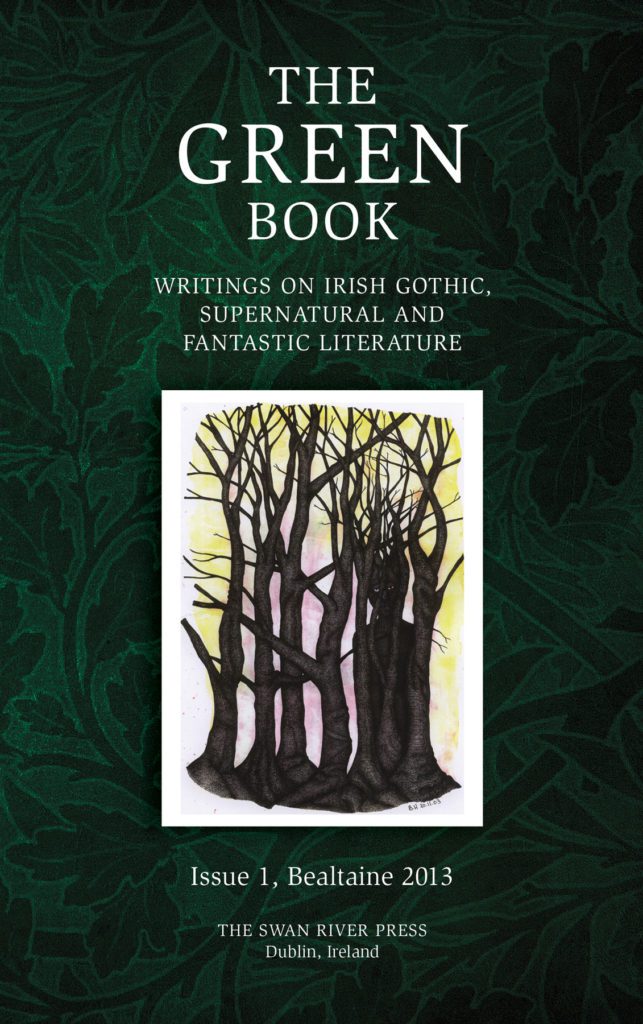
The Green Book 1

“To my young fellow-countrymen, at home and in exile, in the cottage and the mansion, amidst the green fields and in the crowded cities, soon to be the men of Ireland, I dedicate this little book . . .” – Alexander M. Sullivan, The Story of Ireland (1883)

This journal’s inception arose from a series of questions that I’ve long pondered and often asked others: Is there a tradition—a traceable pedigree or lineage of dialogue—in Irish fantastic literature? And if so, in what way might it be defined? How has it developed over the centuries? What are the connections, if any, between the writings of Charles Maturin and Elizabeth Bowen? Or Charlotte Riddell and Mervyn Wall? And what can be said of Irish literary sensibilities carried abroad in the writings of expatriate authors—and let’s face it, there’s a lot of them—as they encountered new ideas and cultures? Fitz-James O’Brien emigrated to New York where he joined the Bohemian set, Bram Stoker spent half of his life in England working for Sir Henry Irving, while Lafcadio Hearn ended up in Tokyo (by way of everywhere else). Is there an underlying gestalt—something between these lives and between their lines—that unifies these authors?


This issue is sold out.
Please check with our Booksellers for remaining copies.

Cover art by Bill Howe
Editor’s Note by Brian J. Showers

ISSN: 2009-6089 (pbk)
The Green Book 2

As I write this, the newly constructed bridge spanning the River Liffey here in Dublin remains yet unnamed. The short-list is comprised of five Dubliners and includes trade unionist Rosie Hackett, who participated in the 1913 Lockout; and camogie player Kay Mills. But one name among them will stand out to devotees of horror and gothic literature the world over: Bram Stoker.

Since Dracula was chosen for One City, One Book in 2009, public awareness of Stoker’s connections with Ireland (he was born in Dublin, so he was!), and Irish acceptance of his importance to world literature, has approached fever pitch. In addition to being short-listed for the new bridge, Dublin now hosts an annual Bram Stoker Festival, the first of which was held in 2012 to mark the centenary of Stoker’s death; the illuminating “Lost Dublin Journal”, edited by Elizabeth Miller and Dacre Stoker, saw publication; and Dublin UNESCO City of Literature proudly lists Stoker alongside Yeats, Shaw, Joyce, and Beckett. So too did the Stoker family rally to establish the Bram Stoker Estate, and embarked upon their mission to spread awareness of Bram Stoker’s life and achievements—and with a man like Stoker, even leaving Dracula aside, there’s much to explore.


This issue is sold out.
Please check with our Booksellers for remaining copies.

Cover art by Alan Corbett
Editor’s Note by Brian J. Showers

ISSN: 2009-6089 (pbk)