


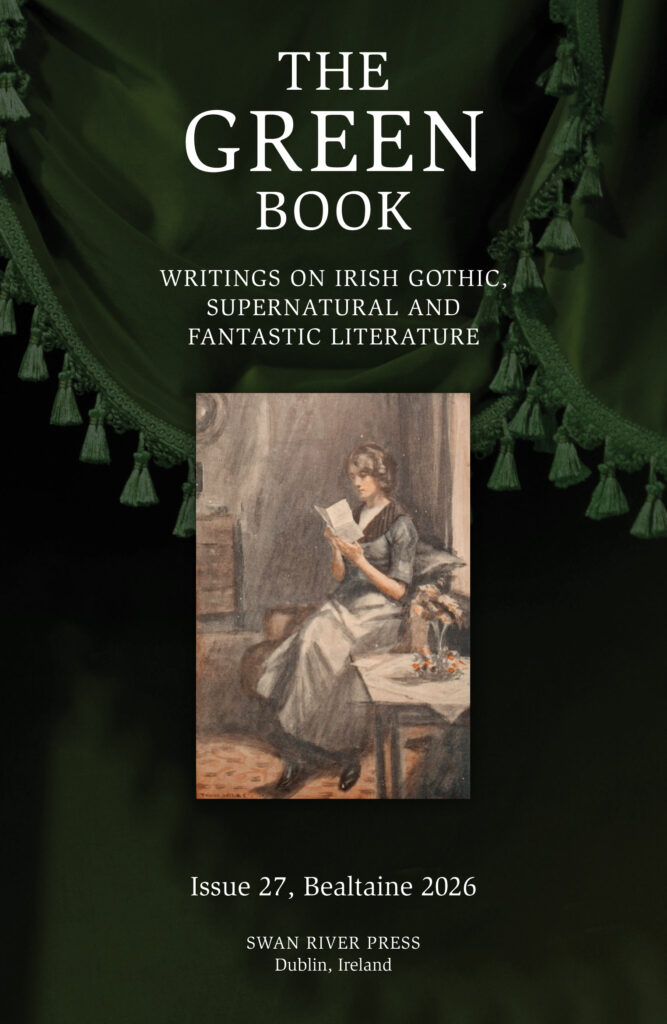
 Editor’s Note #27
With this issue, I am pleased to present another clutch of short fictions by Irish writers that do not seem to fit well into any other Swan River Press project. Thankfully, we have The Green Book, which I hope continues to be a fascinating contextual repository for stray writings of interest to readers of Irish gothic, supernatural, and fantastic literature.
The centrepiece of this issue is three stories by Anna Maria Hall (1800-1881), whose supernatural tales do not number enough in quantity to warrant a standalone volume of her own in our Strange Stories by Irish Women series. And yet, her stray contributions to genre literature remain of note.
Although far from a household name now, Hall was quite well known and celebrated in her time. A review of Stories of the Irish Peasantry that appeared in the Dublin University Magazine (October 1839) writes favourably of not only Hall’s book, but also highlights an appreciation for her importance in Irish literature:
Among the many who have exerted themselves in the walks of Irish literature, by giving to the public, local and characteristic details of its peasantry, there are three who have more eminently distinguished themselves, and these three are Irish ladies—namely, Miss Edgeworth, Lady Morgan, and Mrs. S. C. Hall.
If you’re curious to read more, Hall’s most significant ghost story is “The Dark Lady” (1848), which can be found in the Swan River Press anthology Bending to Earth: Strange Stories by Irish Women (2018).
Although glimpses of the supernatural emerge throughout Hall’s writing, all three of the stories included in this issue serve as examples of her talent for depicting “local and characteristic details”. The shortest is “The Witch Hare”, which appeared in Fairy and Folk Tales of the Irish Peasantry (1888) edited by W. B. Yeats (incidentally, dedicated “To My Mystical Friend G. R.” [George Russell—A.E.]). In “The Drowned Fisherman” (1836), Hall transports the reader to a village “on the brink of the Waterford river”, again weaving hints of the fantastic into Irish rural life, while “The Redderbrae” (November 1838) is an enjoyable tale of menace set in the less-than-welcoming neighbourhood of an Irish bog.
Other stories in this issue include an uncollected yuletide mystery by Rosa Mulholland, “The Old Stain on the Floor” (December 1884), and a moon-drenched foray into the supernatural by Lennox Robinson with “The Face” (1919). “Manon and Her Spirit-Lover” was originally published in the Dublin University Magazine under the shorter title “Manon” (May 1863) and attributed to “Herr Vanderhausen”—perhaps an invocation of the then-fashionable German Gothic—this is the only overt ghost story written by Thomas Caulfield Irwin (1823-1892), a contemporary of J. S. Le Fanu and Henry Ferris. With its delicate and sensitive characterisation, it is a pity that Irwin did not further explore writing in this vein.
Rounding out the issue is a piece by Mildred Darby: “The Cambleford Hand of Death” was published in March 1902 under the name “Andrew Merry”. And the tone here is strikingly different than what’s in the rest of the issue, being more of a drawing-room jape than a serious ghostly tale—merry indeed! I hope you’ll find it’s an agreeably entertaining way to wrap up the proceedings.
As usual, biographic profiles and literary overviews for some of these writers can be found in previous instalments of The Green Book: Rosa Mulholland in issue 9, Thomas Caulfield Irwin in issue 16, Anna Maria Hall in issue 18. With luck, we’ll see a profile on Mildred Darby in a forthcoming issue.
Addendum: I would like to dedicate this issue to the memory of Donald Sidney-Fryer, Hobgoblin Apollo, High Scholar of Averoigne, Golden State Phantastick, the Last of the Courtly Poets, who left us on 2 May 2026. Great Atlantis still stands supreme! Donaldo, avé!
Brian J. Showers
Æon House, Dublin
27 April 2026
No Comments yet!