
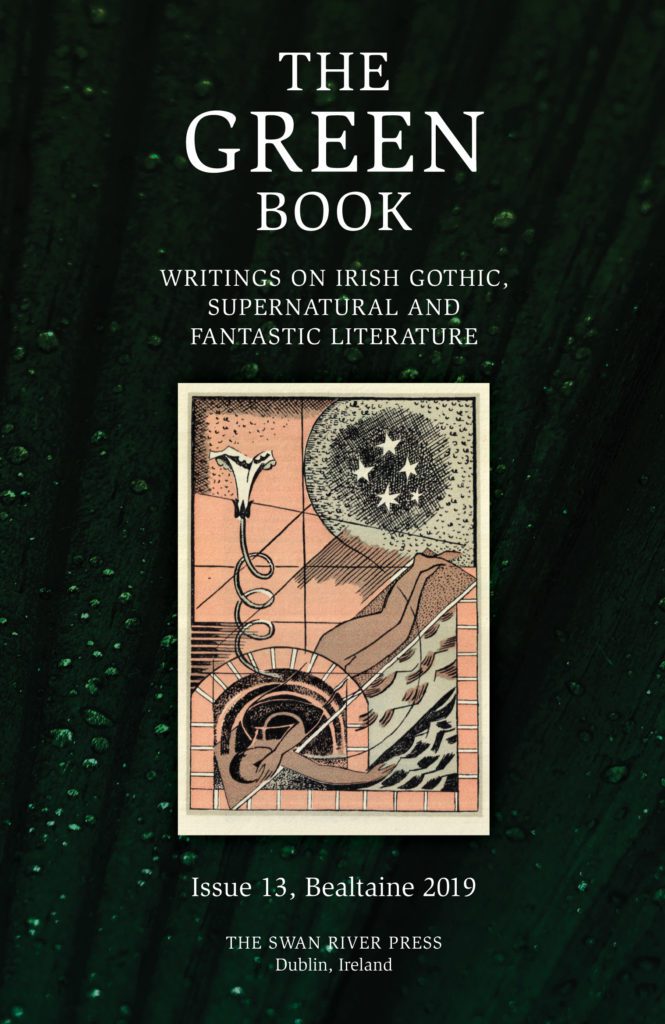
The Green Book 13

One perennial question about genre fiction centres around the notion of “tradition”: the influence authors and their works have on the next generation, and so on down the line. In posing this question, we ask whether or not an unbroken literary pedigree can be established. For example, an excessive amount of energy has been expended exploring links, both legitimate and spurious, between Le Fanu’s “Carmilla” (1871/2) and Stoker’s Dracula (1897)—and believe me, this seems to be an all-consuming pastime for some. But to me, Irish genre fiction has always seemed more a web of thematic shadows, authorial echoes, even social links, rather than a series of linear connections.

Those who read the editor’s note in Issue 12 will recall our endeavour to serialise biographical/critical sketches of Irish writers, which commenced in Issue 11. These entries are the results of an on-going project tentatively called the Guide to Irish Writers of Gothic, Supernatural and Fantastic Fiction, edited by myself and Jim Rockhill. What form this project will ultimately take is still uncertain, but until then we will continue to share the results here. This issue continues with fourteen further such entries, a new crop of names featuring authors with whom readers of The Green Book might already be acquainted, such as Cheiro and A.E., while the likes of Beatrice Grimshaw and Mary Fortune may be less familiar—but whom I hope you will find no less fascinating.


Paperback edition limited to 250 copies.

Cover art by Paul Nash
Editor’s Note by Brian J. Showers

ISSN: 2009-6089 (pbk)
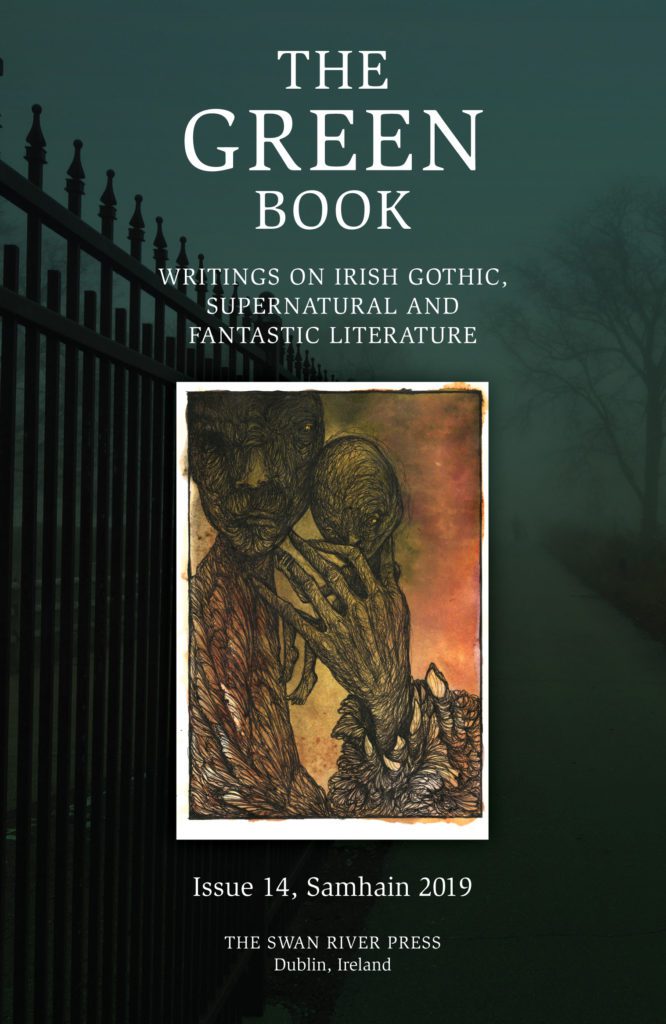
The Green Book 14

We encounter and enjoy authors mostly through their writing, forgetting sometimes that there are personalities behind their words, some astonishingly well-known in their time, often now relegated to small press rediscoveries. With sufficient spans of years, these authors and their personalities pass out of memory, becoming less familiar to us as people and more so as names on title pages. But it is important to remember that these authors lived and worked, had careers and relationships; some of them died while relatively unknown, others were widely celebrated for their creations. With this in mind, I’ve decided to focus the current issue on reminiscences, interviews, and memoirs in hopes of summoning the shades of these writers and to show that in some ways their lives were not always so different from our own.

To that end, you will find a number of texts I have been collecting these past few years, now nestled here comfortably beside one another. Each one, I hope, will give you some insight into the lives of these authors, who they were, and a past that is not necessarily so far distant.


Paperback edition limited to 250 copies.

Cover art by Stephen J. Clark
Editor’s Note by Brian J. Showers

ISSN: 2009-6089 (pbk)
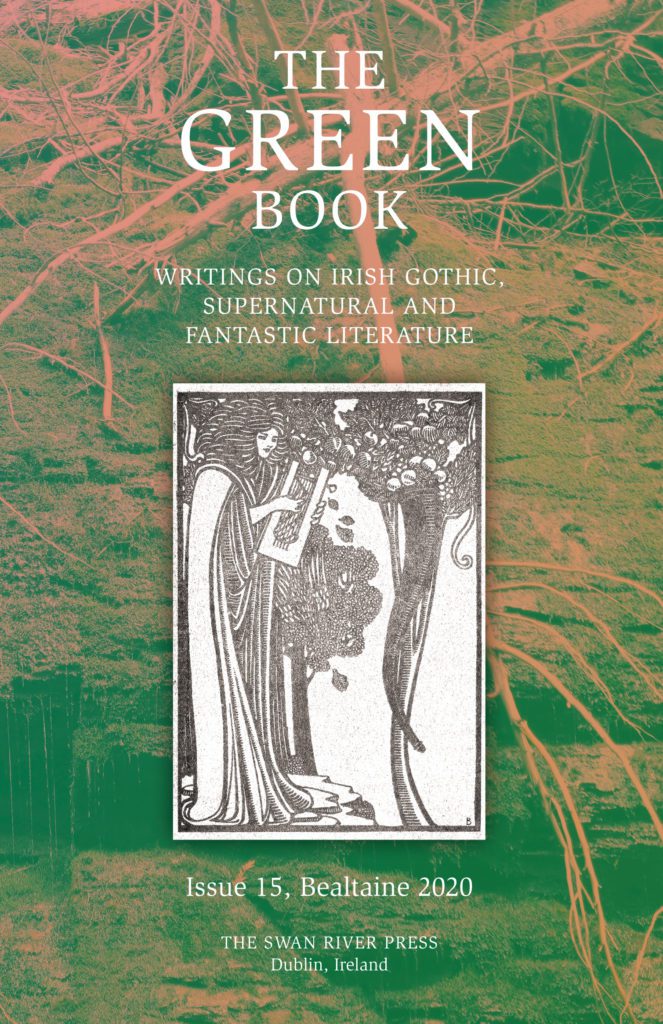
The Green Book 15

In our previous issue, we focused on the lives of writers, featuring as we did reminiscences, interviews, and memoirs. For this issue I’d like to do something different. While we have featured occasional pieces of fiction in previous issues, including “Saved by a Ghost” by Bram Stoker in Issue 6 and “The Boys’ Room” by Dorothy Macardle in Issue 9, I’ve decided this time around to turn over the entire issue to fiction.

Consider this issue a special anthology issue, and an eclectic one at that. There is little to tie these pieces together, save for the fact each author grew from the soil of the same island at the edge of Europe, which is to say they are all Irish by birth. Perhaps, instead, to state the obvious, one might find that each story reflects more so its author than any affinity with one another—and yet they are here between these covers. I hope most, if not all, of these stories will be new to you.

Rosa Mulholand’s “A Priest’s Story” is certainly informed by her own Catholic beliefs, the supernatural elements driven by faith more than fear. Similarly, “The Story of a Star” is a fable that could only have flowed from the pen of the mystical poet and painter A.E.


Paperback edition limited to 250 copies.

Cover art from A.E.’s The Earth Breath (1897)
Editor’s Note by Brian J. Showers

ISSN: 2009-6089 (pbk)

The Green Book 16

Here we are, after a brief hiatus, with the continued serialisation of the Guide to Irish Writers of Gothic, Supernatural and Fantastic Literature, which I am co-editing with my long-time collaborator Jim Rockhill. (How many years has it been now, Jim?)

This is a project we started work on sometime in 2017—although it’s something we had talked about for longer than that. Our goal is to create a resource for both readers and scholars, not unlike E. F. Bleiler’s Supernatural Fiction Writers (1985), showing the rich extent of Ireland’s contributions to supernatural literature and its related genres. The first entries appeared in Issue 11, back in 2018, and continued through Issue 12 and Issue 13. In the “Editor’s Notes” for those issues you’ll also find more details on the background of this project, plus how we as editors have set about defining the criteria to guide us through such an enormous task.

It’s been three years now, and, near as I can reckon, we’re somewhere over the halfway mark. When we initially embarked on this journey, neither Jim nor myself quite realised the scope of the undertaking. Perhaps it’s good that we hadn’t as we might have been instilled with a deep sense of daunting fear and put off entirely. But that’s not what happened, and so here we are with another issue filled cover to cover with more fascinating entries on an array of Irish authors whose lives and works span the better part of three centuries.


Paperback edition limited to 250 copies.

Cover art by Althea Gyles
Editor’s Note by Brian J. Showers

ISSN: 2009-6089 (pbk)
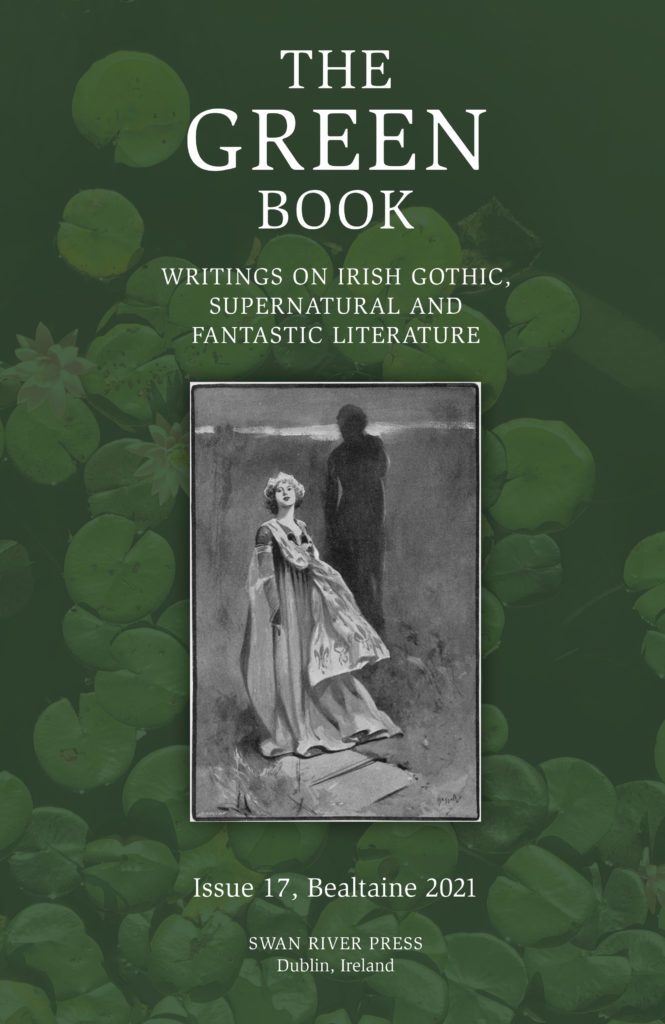
The Green Book 17

As it turned out, Issue 15, which was comprised entirely of fiction, proved to be quite popular. So I had a look in my files to see if I could put together another such issue of refugee writings that did not fit elsewhere in our publishing schedule.

Let the curtains rise on Oscar Wilde’s “The Harlot’s House”, first published in The Dramatic Review (11 April 1885), which publisher Leonard Smither’s notes is “not included in the edition of his collected Poems”—I assume a reference to the volume issued by Elkin Mathews and John Lane in 1892. While “The Harlot’s House” has since become available, we would like to present it here as Leonard Smithers had in a portfolio edition in 1904: with five “weirdly powerful and beautiful” drawings by Althea Gyles, known for her lavish cover designs for Yeats’s poetry collections, including The Secret Rose (1897), two covers for The Wind Among the Reeds (1899/1990), and Poems (1900). We will explore more fully this remarkable artist in a future issue of The Green Book.


Paperback edition limited to 250 copies.

Cover art by John Hassall
Editor’s Note by Brian J. Showers

ISSN: 2009-6089 (pbk)

The Green Book 18

This issue is another selection of profiles from our tentatively named Guide to Irish Writers of Gothic, Supernatural and Fantastic Literature. The keen-eyed will spot one name that might seem out of place: Harry Clarke (1889-1931). Clarke, of course, was not a writer, but an artist who worked in watercolour, pen and ink, and stained glass. As an illustrator, Clarke put his indelible mark on literature of the macabre and fantastic. His best-known illustrations are those accompanying Edgar Allan Poe’s Tales of Mystery and Imagination (1919/23), though his illustrations for Andersen, Perrault, and Swinburne also bear hallmarks of the strange. So too do goblins and grotesques leer from the corners of his stained glass work. Writing in The Irish Statesman on Clarke’s illustrations for Goethe’s Faust, the poet A.E. was clearly taken with the artist’s power:

“Nothing in these drawings represents anything in the visible world: all come from that dread mid-world or purgatory of the soul where forms change on the instant by evil or beautiful imagination, where the human image becomes bloated and monstrous by reason of lust or hate, the buttocks become like those of a fat swine, and thoughts crawl like loathsome puffy worms out of their cells in the skull. Shapeless things gleam with the eye of a snake . . . “


Paperback edition limited to 250 copies.

Cover art by Harry Clarke
Editor’s Note by Brian J. Showers

ISSN: 2009-6089 (pbk)
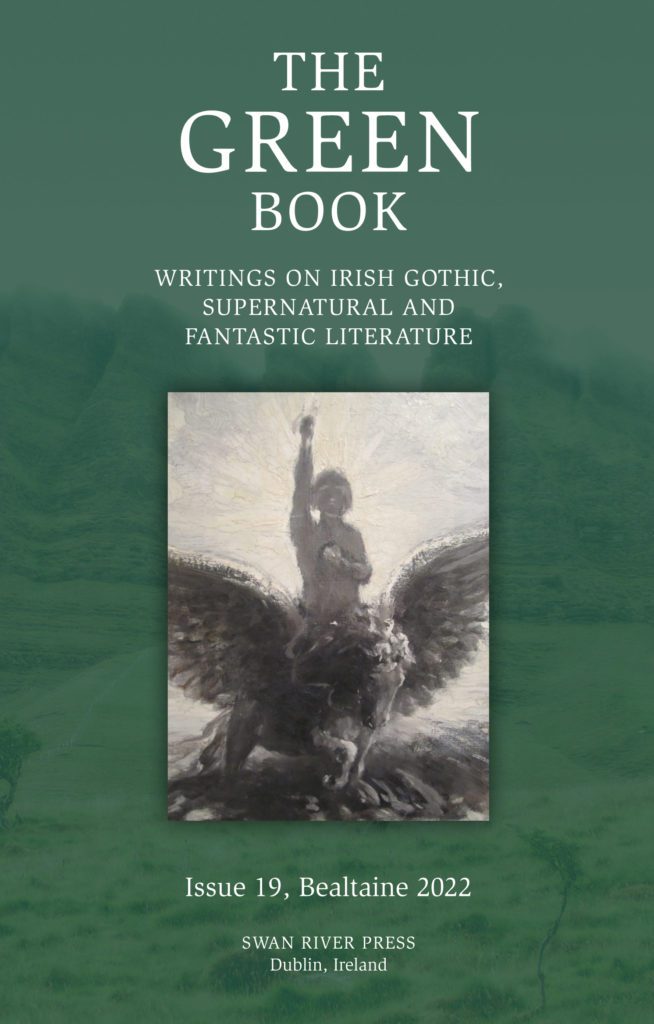
The Green Book 19

“Probably there has never been in any country,” wrote John Eglinton in his Memoir of A.E. (1937), “a period of literary activity which has not been preceded or accompanied by some stimulation of the religious interest. Anyone in search of this in Ireland at this time may find it if he looks for it, though he certainly will not find it in either the Catholic or the various Protestant religious bodies: he will find it, unless he disdains to look in that direction, in the ferment caused in the minds of a group of young men by the early activities of the Theosophical Movement in Dublin.”

Ireland of the late nineteenth century was awash in reawakened interest in Irish legends and folklore, craft and custom, language and art; the men and women whose works would come to define the ensuing Celtic Literary Revival often concerned themselves with a belief in the authoritative wisdom of ancient traditions and mythology, and with these fervent beliefs, they propelled Ireland toward nationhood. That a new spiritual movement could hold such sway over young minds in late nineteenth-century Ireland comes as no surprise.


Paperback edition limited to 250 copies.

Cover art by George William Russell (A.E.)
Editor’s Note by Brian J. Showers

ISSN: 2009-6089 (pbk)