


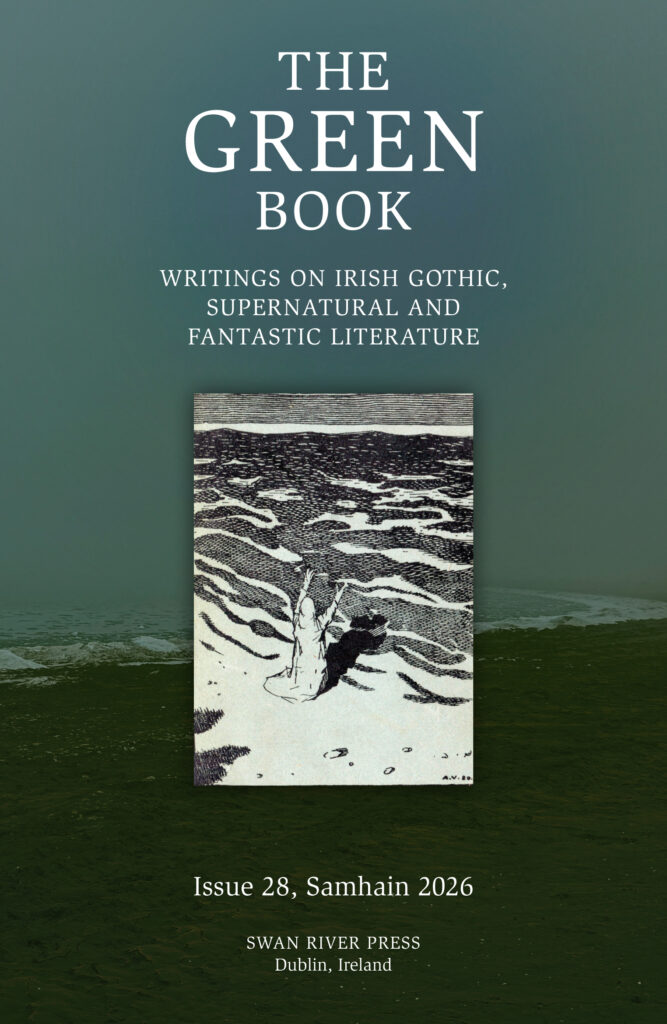
 Editor’s Note #28
With Issue 11, we began running a series of in-depth profiles to showcase genre literature produced by Irish writers. Most of our readers will be familiar with names such as Stoker, Macardle, Dunsany, Riddell, Le Fanu—writers who already receive popular attention to various degrees—but we wanted to explore further. What else was out there hiding on dusty bookshelves of old family homes, tucked away in the storerooms of second-hand bookshops, or secreted in dust-moted libraries and out of the way archives?
I suppose there were two main questions we were addressing during this near decade-long exercise of literary exploration. First: What writers and works are out there that might be more generally overlooked or less appreciated? We wanted to unearth hidden gems and outré writers, those who might have once been popular, and those for whom success remained elusive. Might some of these works still resonate with modern readers? Second: How do all these writers and their works, including the more popularly recognisable names, fit into the context of genre literature and the broader constellation of Irish creativity? How do these writers and their books influence each other? What social connections did they share, if any?
Naturally, this project gave rise to some complex questions. Who do we define as Irish for these profiles? And how do we decide what should be considered within the genre of the dark fantastic? Out of necessity, we had to set some ground rules, lest we find ourselves with a sprawling (and meaningless) list. I set out our criteria in Issue 12, but here was our general approach:
To be considered for a profile, authors should be either born in Ireland, raised/schooled in Ireland, lived a substantial or formative portion of their life in Ireland, or have a strong connection with Ireland through their writing.
The author in question must have contributed either substantially or uniquely to literature of the gothic, supernatural, or fantastic. Furthermore, mythology, folklore, and science fiction, despite the occasional overlap, fall outside our focus, and so are generally not included.
Those who have been following the series already will know that we push at the boundaries of our own definitions. But unsurprisingly, the people and books that are positioned in the more nebulously grey areas are often the most fascinating.
So where does this put us? Well, since 2018, with the editorial help of Jim Rockhill and 25 contributors, we’ve now published 82 profiles. You’ll recognise a bunch of names, others you won’t, and some you’ll see through fresh eyes—I hasten to add that this list, while thorough, is not exhaustive. Everyone will have their suggestions as to who should have been included, but I’m pleased with what we have accomplished. You will also notice a sharp drop off at the mid-twentieth century; we deliberately shied away from featuring too many writers with ongoing careers. However, in some cases, we simply couldn’t find anyone to write an entry—apologies to John Connolly, whose absence in these pages is both glaring and inexcusable given his literary contributions. This will be remedied. (Joseph O’Neill is also curiously absent!)
What next? Well, the plan has always been to gather these profiles as an illustrated reference book, akin to those edited by E. F. Bleiler, Mike Ashley, Jack Sullivan, S. T. Joshi, and others—the books that have provided so many with hours of perusal. I hope that some day that our Guide to Irish Writers of Gothic, Supernatural and Fantastic Literature will sit on your shelf beside other such august volumes. Until then, I hope you will continue to find the serialisation of these profiles in The Green Book a valuable resource for scholarship and discovery. To help, I’ve created a number of indices that you’ll find at the back of this issue. You can download the indices here: The Green Book-Author Profile Indexes.
As for what you’ll find in these pages: Le Fanu contemporary Henry Ferris, a long-overdue entry on Oscar Wilde; stalwart contributor Reggie Chamberlain-King writes on Mildred Darby, the dramatists Micheál MacLiammóir and Hilton Edwards, and more; while Richard Bleiler and R. B. Russell look at Frances Browne and Francis Bacon, respectively.
As always, thank you to everyone who contributed to or followed this series. It’s already an achievement of which we can all be proud. Until next issue . . .
Brian J. Showers
Æon House, Dublin
3 October 2026
No Comments yet!